Crayonbird
Menu

Maths · Ages 6–7 · 50 minutes

Subtracting within 20

Children subtract within 20 by counting back on a number line and check their answers with the related addition fact.

Success criteria

  • I can start at the bigger number and count back
  • I can say what I land on
  • I can check with adding

Key vocabulary

  • subtract
  • take away
  • minus
  • count back
  • difference
  • fact family

You will need

  • number lines 0–20
  • a 20-bead string or two strips of ten cubes
  • mini whiteboards
  • Year 2· England
  • Grade 1· United States
  • Primary 2· Nigeria
  • Class 2· India

Practice sheets

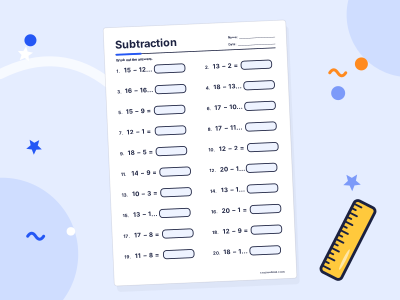
Generated fresh each time you press a button, and marked instantly on screen.

The lesson at a glance

50 minutes in all. Timings are a guide: follow your class.

  1. Step 1: Starter

    Count backwards together from 20 to 0, then from 14, then from 11 to 3.
    8 minutes
  2. Step 2: Teach

    Draw a number line 0–20.
    12 minutes
  3. Step 3: Guided practice

    On whiteboards with number lines, do five together.
    10 minutes
  4. Step 4: Independent practice

    Use the practice buttons above.
    15 minutes
  5. Step 5: Plenary

    Write 14 − 5 = 10 on the board.
    5 minutes
  6. Step 6: Assessment for learning

    Look for children who: start on the first number and count back without counting the start; choose counting up when numbers are close; use the related addition fact without being asked.
  7. Step 7: Differentiation

    Children who need concrete support can use a bead string: push away the number being taken away and count what's left.
  8. Step 8: Common misconceptions

    Counting the start number as the first hop (15 − 6 = 10).
  9. Step 9: Home link

    When sharing out snacks, ask "We had 12 grapes and ate 5.

1.Starter

8 minutes

Count backwards together from 20 to 0, then from 14, then from 11 to 3. Children crouch lower with each number and jump up at the end.

Quick question: "I had 12 stickers and gave away 2. How many now?" Then: "I had 12 and gave away 9. Is that easy to count back?" Leave it open.

2.Teach

12 minutes

Draw a number line 0–20. Put a rabbit picture on 15.

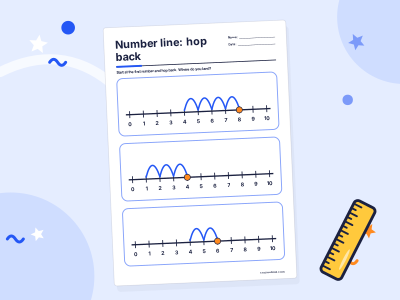
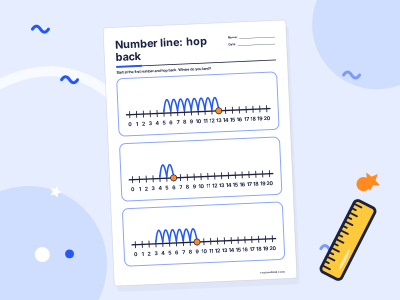
"Subtracting means the rabbit hops backwards. 15 − 6. The rabbit sits on 15 and hops back six times." Count each hop aloud: 14, 13, 12, 11, 10, 9. "Where did it land? 9. So 15 − 6 = 9."

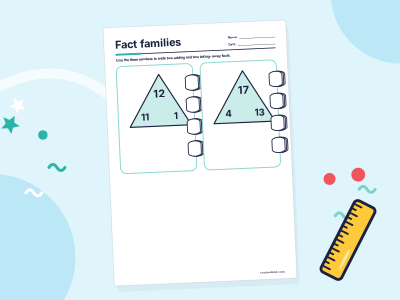
Then link it to adding: "If 15 − 6 = 9, then 9 + 6 should get me back to 15. Let's hop forwards and check." It does.

Step by step

  1. Start on the first numberIn subtraction, the first number is where you begin.
  2. Hop backOne hop for each, saying the number you land on.
  3. Check by addingAdd what you took away to your answer. You should get back to the start.

Now go back to 12 − 9. "Nine hops back is a lot. These numbers are close together, so let's count the gap instead. From 9 up to 12 is... 10, 11, 12. Three hops. So 12 − 9 = 3." Show both on the board. "When the numbers are close, counting up the gap is quicker. That's called finding the difference."


The rest of the plan

Guided and independent practice, the plenary, assessment for learning, differentiation, common misconceptions and the home link are free with a Crayonbird account.

  1. Guided practice10 minutes
  2. Independent practice15 minutes
  3. Plenary5 minutes
  4. Assessment for learning
  5. Differentiation
  6. Common misconceptions
  7. Home link

Learning Wiki

Subtraction

Subtraction is taking one amount away from another, or finding the difference between two numbers. The sign is −, so 9 − 4 = 5.

Number bonds

Number bonds are pairs of numbers that add up to a given total, like 3 and 7 making 10. Knowing them by heart makes adding and subtracting much faster.

Odd and even numbers

Even numbers can be split into two equal groups or pairs with none left over (2, 4, 6…). Odd numbers always leave one left over (1, 3, 5…).

  • Maths · Ages 6–7 · 50 min

    The 2, 5 and 10 times tables

    Children count in steps of 2, 5 and 10, connect skip counting to multiplication facts, and spot the patterns that help them check an answer.

  • Maths · Ages 6–7 · 50 min

    Adding within 20 on a number line

    Children add two numbers within 20 by counting on along a number line, starting from the larger number.