Crayonbird
Menu

Science · Ages 6–8 · 50 minutes

The healthy eating plate

Children sort foods into the main food groups and explain that a balanced meal includes a variety of foods, with plenty of fruit and vegetables.

Success criteria

  • I can sort foods into groups
  • I can say what each group helps my body do
  • I can plan a balanced plate

Key vocabulary

  • balanced
  • food group
  • fruit
  • vegetables
  • protein
  • carbohydrate
  • dairy
  • variety

You will need

  • paper plates
  • food pictures cut from leaflets or drawn
  • empty clean food packaging
  • glue
  • a large plate drawn on the board

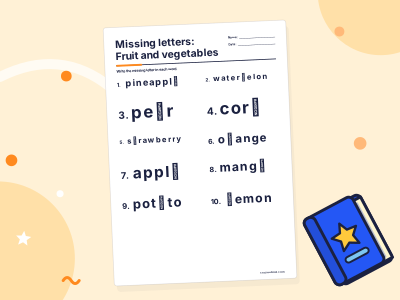
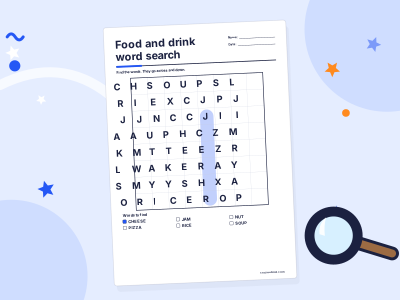
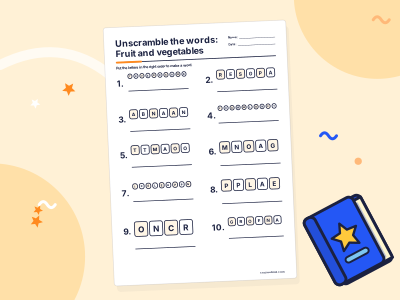
Practice sheets

Generated fresh each time you press a button, and marked instantly on screen.

The lesson at a glance

50 minutes in all. Timings are a guide: follow your class.

  1. Step 1: Starter

    Show five foods (pictures or real packaging): an apple, a slice of bread, an egg, a carton of milk and a carrot.
    7 minutes
  2. Step 2: Teach

    Draw a big circle plate on the board and divide it into sections.
    10–15 min
  3. Step 3: Guided practice

    Give each table a pile of food pictures.
  4. Step 4: Independent practice

    Each child designs a balanced lunch on a paper plate, with at least one food from each group and plenty of fruit and vegetables.
  5. Step 5: Plenary

    Show two plates on the board: one that is all bread and pasta, one with a mix.
  6. Step 6: Assessment for learning

    Can children name the main food groups and one food in each?
  7. Step 7: Differentiation

    Support: give pictures to cut and stick instead of writing, and limit the groups to three (fruit and vegetables, energy foods, growing foods).
  8. Step 8: Common misconceptions

    "Some foods are bad." No single food is bad; balance and amount matter.
  9. Step 9: Home link

    Draw tonight's dinner on a plate shape together and see how many food groups it includes.

Children hear a lot about "good" and "bad" food. This lesson replaces that with a more useful idea: different foods do different jobs, and a balanced plate has some of each, with fruit and vegetables taking up a big share. There is no calorie counting, no talk about body size and no food is banned.

1.Starter

7 minutes

Show five foods (pictures or real packaging): an apple, a slice of bread, an egg, a carton of milk and a carrot. Ask: "Which one gives you the most energy for running around? Which one helps your bones? Talk to your partner." There is no single right answer yet; you are finding out what they already know. Seven minutes.

2.Teach

10–15 min

Draw a big circle plate on the board and divide it into sections. Introduce each group with one job:

  • "Fruit and vegetables help keep our bodies working well and help us fight off illness. They get one of the biggest parts of the plate."
  • "Starchy foods, like rice, bread, potatoes, yam and pasta, give us energy. They get another big part."
  • "Protein foods, like beans, eggs, fish, meat and lentils, help our bodies grow and repair."
  • "Dairy and alternatives, like milk, yoghurt and cheese, help build strong bones and teeth."

Then add: "Foods like cakes, crisps and sweets are fine sometimes. We just have them in small amounts, not every meal." Countries draw their plates a little differently (England uses the Eatwell Guide, the US uses MyPlate), but they share the same big ideas.

  • apple
  • carrot
  • bread
  • egg
  • milk
  • rice
Foods from each of the main groups.

The rest of the plan

Guided and independent practice, the plenary, assessment for learning, differentiation, common misconceptions and the home link are free with a Crayonbird account.

  1. Guided practice
  2. Independent practice
  3. Plenary
  4. Assessment for learning
  5. Differentiation
  6. Common misconceptions
  7. Home link

Learning Wiki

Parts of a plant

The main parts of a flowering plant are the roots, stem, leaves and flowers. Each part has a job, from soaking up water to making food and producing seeds.

Habitats

A habitat is the natural home of a living thing, where it finds the food, water, shelter and space it needs to survive.

Living things

Living things are organisms that grow, feed, get rid of waste, sense the world and reproduce. Plants, animals, fungi and bacteria are all alive.

  • Science · Ages 7–8 · 50 min

    Magnets: attract, repel and magnetic materials

    Children test which materials are magnetic, discover that magnets attract or repel depending on which poles face each other, and record results in a table.

  • Science · Ages 7–9 · 55 min

    Animal life cycles

    Children sequence the life cycles of a butterfly, a frog and a bird, and explain how a young animal changes as it grows into an adult.

  • Science · Ages 7–9 · 55 min

    Light sources and shadows

    Children recognise that we need light to see, sort light sources from reflectors, and explain that a shadow forms when an opaque object blocks light and changes size as the object moves.