Crayonbird
Menu

Science · Ages 7–8 · 50 minutes

Magnets: attract, repel and magnetic materials

Children test which materials are magnetic, discover that magnets attract or repel depending on which poles face each other, and record results in a table.

Success criteria

  • I can predict and test whether an object is magnetic
  • I can explain that not all metals are magnetic
  • I can describe what happens when poles face each other

Key vocabulary

  • magnet
  • magnetic
  • attract
  • repel
  • pole
  • north
  • south
  • force
  • metal
  • iron
  • steel

You will need

  • large bar magnets (one per pair)
  • a tray of test objects (paper clips, steel spoon, aluminium foil, plastic ruler, wooden pencil, rubber, keys, coins, a drinks can, card)
  • recording sheets
  • string
  • Year 3· England

Practice sheets

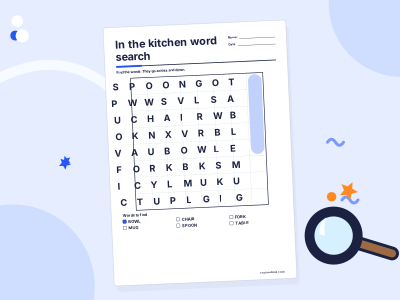
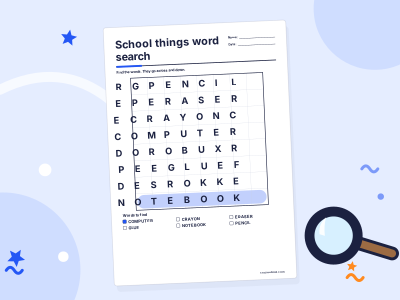
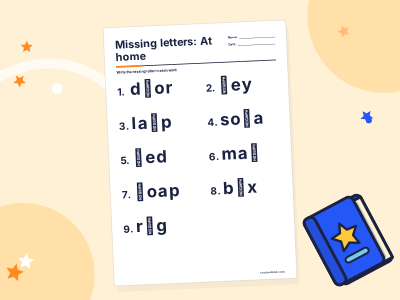
Generated fresh each time you press a button, and marked instantly on screen.

The lesson at a glance

50 minutes in all. Timings are a guide: follow your class.

  1. Step 1: Starter

    Hold up a magnet and a paper clip.
    6 minutes
  2. Step 2: Teach

    Explain: "A magnet makes an invisible pushing or pulling force.
    10–15 min
  3. Step 3: Guided practice

    Pairs test every object on the tray and fill in the table.
    15 minutes
  4. Step 4: Independent practice

    Children complete a word puzzle from the practice buttons, then sort every found word into two columns: "I predict magnetic" and "I predict not magnetic".
  5. Step 5: Plenary

    Ask: "Is this statement true or false: all metals are magnetic?" Children use evidence from their table.
  6. Step 6: Assessment for learning

    Do children predict before testing?
  7. Step 7: Differentiation

    Support: use a smaller set of objects, with picture labels on the recording sheet.
  8. Step 8: Common misconceptions

    "Magnets attract all metals." Only some, mainly iron, steel, nickel and cobalt.
  9. Step 9: Home link

    With an adult, use a fridge magnet to find three things at home that are magnetic (never near phones, screens or cards).

Children love magnets, and most arrive believing that magnets stick to "all metal". This lesson tests that idea, so the surprise does the teaching, then moves on to the two poles and why some magnets push each other away.

1.Starter

6 minutes

Hold up a magnet and a paper clip. Ask: "Why do you think the magnet picks up the paper clip?" Then ask each pair to write one object on a whiteboard that they think a magnet will pick up and one that it won't. Six minutes.

2.Teach

10–15 min

Explain: "A magnet makes an invisible pushing or pulling force. When it pulls something towards it, we say it attracts. Things that are attracted are magnetic."

Show the tray of test objects and model how to predict and test fairly: "I think the spoon will be attracted because it is metal. Now I'll test it. I hold the magnet close without pushing. Did it pull?" Record it in the table on the board: object, prediction, result.

Then introduce poles: "Every magnet has two ends called poles: north and south. Watch what happens when I bring two magnets together." Turn one round. "When opposite poles face each other, they attract. When the same poles face each other, they push apart. We say they repel."

  • key
  • spoon
  • scissors
  • ruler
  • pencil
  • eraser
Some of these objects are magnetic and some are not. Predict before you test.

The rest of the plan

Guided and independent practice, the plenary, assessment for learning, differentiation, common misconceptions and the home link are free with a Crayonbird account.

  1. Guided practice15 minutes
  2. Independent practice
  3. Plenary
  4. Assessment for learning
  5. Differentiation
  6. Common misconceptions
  7. Home link

Learning Wiki

Habitats

A habitat is the natural home of a living thing, where it finds the food, water, shelter and space it needs to survive.

Living things

Living things are organisms that grow, feed, get rid of waste, sense the world and reproduce. Plants, animals, fungi and bacteria are all alive.

Teeth

Teeth bite, tear and grind food so it can be swallowed and digested. Children have 20 baby teeth, which are replaced by up to 32 adult teeth.

  • Science · Ages 8–10 · 55 min

    Building and reading food chains

    Children build food chains that start with a plant, use arrows to show the direction the energy goes, and identify producers, prey and predators.

  • Science · Ages 5–7 · 50 min

    Everyday materials and their properties

    Children name everyday materials, describe their properties and test which materials are waterproof to choose the best one for a job.

  • Science · Ages 7–9 · 55 min

    Animal life cycles

    Children sequence the life cycles of a butterfly, a frog and a bird, and explain how a young animal changes as it grows into an adult.