Science
Why do we have day and night?
Quick answer
We have day and night because Earth spins once around every 24 hours. The side facing the Sun has daylight, and the side facing away is in darkness.


In one sentence
Day and night happen because Earth spins around, so each place on Earth faces the Sun for part of the time and away from it for the rest.
Explained
The Sun is a star, a ball of burning gas that gives off light. Earth is a ball that does not make light of its own. The Sun can only light half of Earth at a time, the half facing it. That half has day, and the half facing away from it has night.
 sun
 moon
 globe
Earth does not stay still. It spins like a top around an imaginary line called its axis, which runs from the North Pole to the South Pole. One full spin takes about 24 hours, which is one day. As Earth turns, you are carried from the sunny side into the dark side and back again.
In the morning, your part of Earth is turning towards the Sun, and the Sun seems to rise in the east. At midday, the Sun is highest in the sky. In the evening, your part turns away, and the Sun seems to set in the west. The Sun is not really moving across the sky; we are the ones turning.
That is why shadows change through the day. They are long in the morning, short around noon and long again in the evening. See shadows. It is also why clocks differ around the world: when it is 8 in the morning in Nigeria, it is already 4 in the afternoon in Japan and still the middle of the night in Mexico.
Some places on Earth have very long days or nights. Near the poles, the Sun may not set for weeks in summer or not rise for weeks in winter. This is because Earth's axis is tilted, which also causes the seasons. The Moon is also visible in both day and night; learn about it in the Moon.
Examples
| Time | What the Sun does |
|---|---|
| Morning | rises in the east |
| Midday | highest in the sky |
| Evening | sets in the west |
| Night | other side of Earth is lit |
Common mistakes
- "The Sun moves around Earth." Earth spins; the Sun seems to move.
- "Night is when the Sun goes away." The Sun is still there; our side is turned away.
- "The Moon causes night." Night is caused by Earth's spin.
Quick quiz
Day and night
Check what you know with 4 quick questions.
Question 1 of 4
What causes day and night?
Practise it
Try it
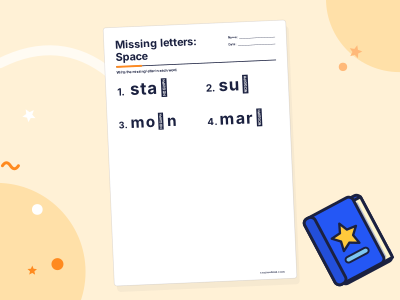
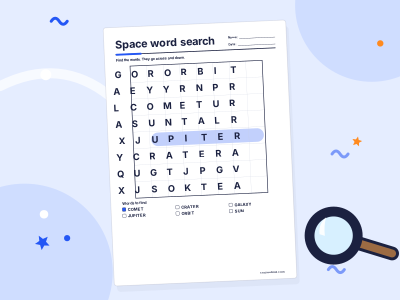
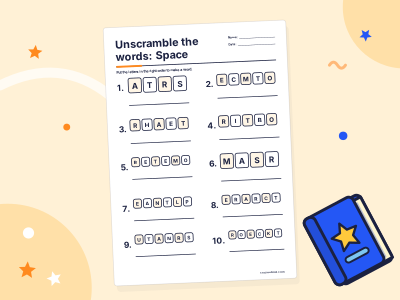
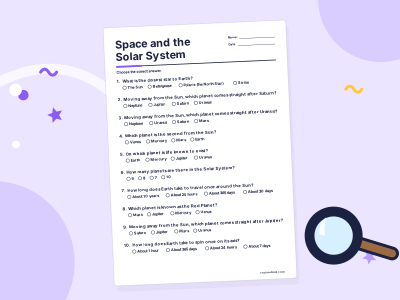
Space practice
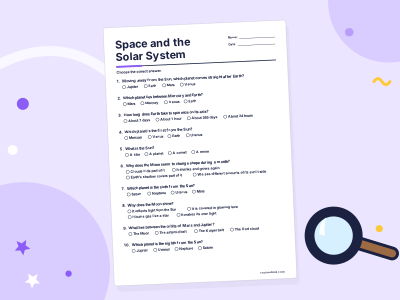
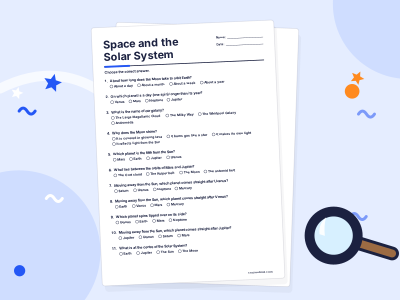
Practise it step by step in a full course: Grade 2 Science
For grown-ups
Related topics

Seasons
Seasons happen because Earth is tilted. As Earth orbits the Sun over a year, each half of the planet takes turns leaning towards the Sun, getting more direct sunlight and longer days.
The Moon
The Moon is Earth's natural satellite, a rocky ball about a quarter of Earth's width that orbits us roughly once a month. It shines by reflecting sunlight.
The solar system
The solar system is the Sun and everything that orbits it, including eight planets, their moons, dwarf planets such as Pluto, asteroids and comets.
Phases of the Moon
The Moon does not really change shape. As it orbits Earth, we see more or less of its sunlit half, which gives the phases from new moon to full moon and back in about 29.5 days.
Solar and lunar eclipses
An eclipse happens when the Sun, Earth and Moon line up. In a solar eclipse the Moon blocks the Sun; in a lunar eclipse Earth's shadow falls on the Moon.

Space exploration
Space exploration began in 1957 with the first satellite, Sputnik 1. Since then people have orbited Earth, walked on the Moon and sent robots to planets, moons and beyond.