Science
Why do we have seasons?
Quick answer
Seasons happen because Earth is tilted. As Earth orbits the Sun over a year, each half of the planet takes turns leaning towards the Sun, getting more direct sunlight and longer days.
In one sentence
We have seasons because Earth is tilted, so as it travels round the Sun each half of the planet takes turns leaning towards the Sun.
Explained
Earth spins on an imaginary line called its axis, which runs through the North and South Poles. That axis isn't straight up and down. It is tilted by about 23.5 degrees, and it stays pointing the same way as Earth makes its year-long orbit around the Sun with the rest of the solar system.
So for part of the year, the Northern Hemisphere (the top half, with Europe, North America, China and Nigeria) leans towards the Sun. For the other part, the Southern Hemisphere (with Australia, South Africa and much of South America) leans towards it.
When your half leans towards the Sun:
- sunlight hits the ground more directly, so it heats it more
- the Sun climbs higher in the sky, so shadows are shorter
- days are longer and nights are shorter
That's summer. When your half leans away, the light is spread out, days are short, and it's winter. Spring and autumn are the in-between times.
Imagine shining a torch straight down on a table: you get a small, bright circle. Tilt the torch and the same light spreads into a bigger, dimmer patch. Winter sunlight is like the tilted torch.
Near the equator, the Sun is high all year, so it stays warm and day length hardly changes. Many tropical places, such as much of Nigeria, India and Indonesia, have a wet season and a dry season instead of the four temperate seasons. Near the poles, summer can bring days when the Sun never sets.

Examples
| Month | Northern Hemisphere (e.g. UK, Canada) | Southern Hemisphere (e.g. Australia) |
|---|---|---|
| January | winter | summer |
| April | spring | autumn |
| July | summer | winter |
| October | autumn | spring |
 snowman
 flower
 sun
sun leaf
leaf
Common mistakes
- "Summer is when Earth is closest to the Sun." Earth is actually closest in early January. The tilt, not the distance, causes the seasons.
- "Everywhere has the same seasons at the same time." The hemispheres are opposite: Christmas is a summer holiday in Australia.
- "Every country has four seasons." Many tropical countries have wet and dry seasons instead.
Quick quiz
Seasons
Check what you know with 4 quick questions.
Question 1 of 4
What causes the seasons?
Practise it
Try it
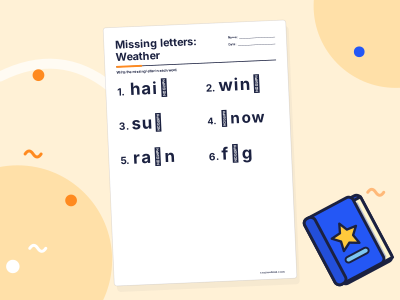
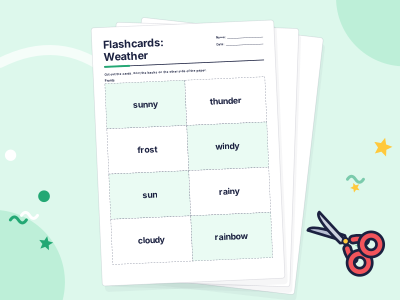
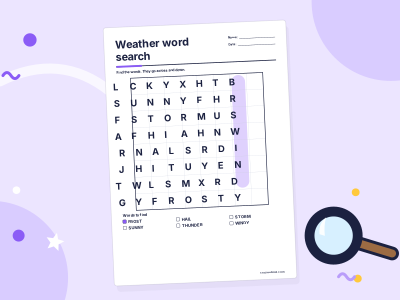
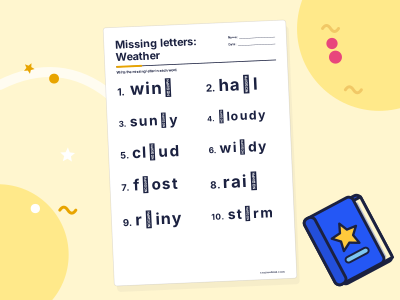
Shine a torch on a globe or ball while tilting it, and see which half gets more direct light. Then try weather and seasons activities.
Seasons activities to print
For grown-ups
Related topics
Weather
Weather is what the air is like at a particular place and time, such as hot or cold, wet or dry, windy or calm, sunny or cloudy. It changes from day to day.
The solar system
The solar system is the Sun and everything that orbits it, including eight planets, their moons, dwarf planets such as Pluto, asteroids and comets.
Shadows
A shadow is a dark area made when an opaque object blocks light. Because light travels in straight lines, it cannot bend round the object, leaving a dark shape behind it.
Climate
Climate is the usual pattern of weather in a place over many years, usually 30 or more. Weather is what is happening in the sky today.
Evaporation
Evaporation is when a liquid slowly turns into a gas from its surface, like a puddle drying in the sun. It happens faster when it is warm, windy or the liquid is spread out.
The water cycle
The water cycle is the endless movement of water between the land, the sea and the sky. Water evaporates, condenses into clouds, falls as rain or snow and collects in rivers and oceans.