Science
What is weather?
Quick answer
Weather is what the air is like at a particular place and time, such as hot or cold, wet or dry, windy or calm, sunny or cloudy. It changes from day to day.
In one sentence
Weather is what the air outside is doing right now, like being sunny, rainy, windy, snowy or cloudy.
Explained
Look out of the window: is it sunny, rainy, windy or foggy? That's the weather. It describes the air around us at one place and one time, and it can change quickly, sometimes several times a day.
Scientists who study weather are called meteorologists. They measure:
- temperature — how hot or cold the air is, with a thermometer
- rainfall — how much rain falls, with a rain gauge
- wind — its speed and direction, with an anemometer and a wind vane
- cloud cover — how much of the sky is covered
- air pressure — the weight of air pressing down, with a barometer
The engine behind weather is the Sun. It heats the land and sea unevenly. Warm air rises and cooler air rushes in to replace it, making wind. The Sun also drives the water cycle: water evaporates, rises, cools and condenses into clouds, which may then drop rain or snow.
Weather is not the same as climate. Weather is like your mood today; climate is like your personality, the usual pattern over many years. A place with a hot, dry climate can still have a rainy day.
Weather also changes with the seasons. In the UK winter brings colder weather; in places such as Nigeria or India the rainy season brings heavy downpours.

Examples
| Weather | What causes it |
|---|---|
| Rain | water droplets in clouds join and get too heavy to float |
| Snow | ice crystals in very cold clouds fall without melting |
| Fog | a cloud forming at ground level |
| Thunderstorm | strong rising warm air builds tall clouds with lightning |
| Rainbow | sunlight shining through raindrops |
 sun
sun cloud
cloud rain
rain snow
snow wind
wind lightning
Common mistakes
- "Weather and climate mean the same thing." Weather is short-term; climate is the long-term pattern.
- "Lightning never strikes the same place twice." It often does. Tall buildings can be struck many times a year.
- "Clouds are made of steam or smoke." They are tiny droplets of water or ice crystals.
Quick quiz
Weather
Check what you know with 4 quick questions.
Question 1 of 4
What is the difference between weather and climate?
Practise it
Try it
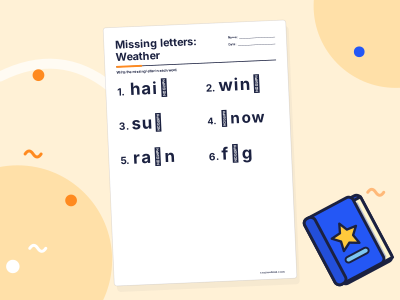
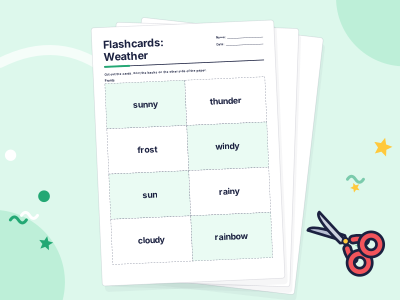
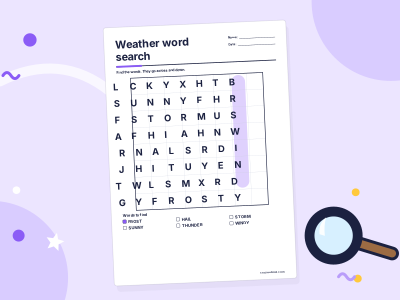
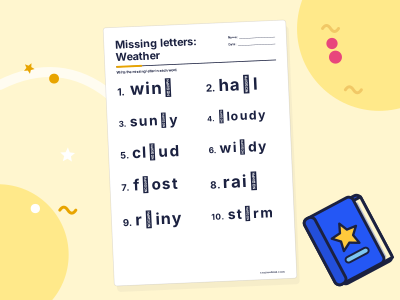
Keep a weather diary for a week: draw the sky, note the temperature and make a simple rain gauge from a cut-down bottle. Then try weather activities.
Weather activities to print
For grown-ups
Related topics
The water cycle
The water cycle is the endless movement of water between the land, the sea and the sky. Water evaporates, condenses into clouds, falls as rain or snow and collects in rivers and oceans.
Seasons
Seasons happen because Earth is tilted. As Earth orbits the Sun over a year, each half of the planet takes turns leaning towards the Sun, getting more direct sunlight and longer days.
Climate
Climate is the usual pattern of weather in a place over many years, usually 30 or more. Weather is what is happening in the sky today.
Evaporation
Evaporation is when a liquid slowly turns into a gas from its surface, like a puddle drying in the sun. It happens faster when it is warm, windy or the liquid is spread out.
Electric circuits
An electric circuit is a complete loop that electricity flows around. A simple circuit has a battery, wires and a component like a bulb. If the loop is broken, the electricity stops.
Digestive system
The digestive system is the long tube and organs that break food down into tiny pieces your body can absorb for energy and growth, then get rid of what is left as waste.