Geography
What is climate, and how is it different from weather?
Quick answer
Climate is the usual pattern of weather in a place over many years, usually 30 or more. Weather is what is happening in the sky today.
In one sentence
Climate is the average weather a place has over a long time, while weather is what is happening outside right now.
Explained
Think of it this way: weather is your mood today; climate is your personality. A rainy day in a desert is weather. The fact that the desert gets very little rain most years is its climate. To describe a climate, scientists average temperature, rainfall and wind over 30 years or more. You can read more about day-to-day conditions in weather.
Several things shape a place's climate:
- Distance from the Equator. Near the Equator, sunlight hits the ground almost straight on, so it is hot all year. Towards the poles, sunlight is spread out and weaker. See latitude.
- Height. Mountains are colder than lowlands at the same latitude.
- Distance from the sea. The sea warms up and cools down slowly, so coastal places have milder winters and summers than places far inland.
- Winds and ocean currents. These carry warm or cold air and water around the world.
Geographers group the world into climate zones: tropical, dry, temperate, continental and polar. Each zone suits different plants and animals, which is why climate shapes habitats.
Earth's climate has always changed slowly over very long periods. Since the late 1800s, though, the planet has warmed by more than 1 °C, mostly because burning coal, oil and gas adds greenhouse gases that trap heat. Scientists, governments and young people around the world are working on cleaner energy and other solutions.

Examples
| Climate zone | What it is like | Example place |
|---|---|---|
| Tropical | hot all year, often very rainy | Lagos, Nigeria |
| Dry | very little rain | Cairo, Egypt |
| Temperate | mild, with rain in most seasons | London, UK |
| Continental | warm summers, very cold winters | Moscow, Russia |
| Polar | freezing most of the year | Antarctica |
Common mistakes
- "It is cold today, so the climate is not warming." One day is weather. Climate is about long-term averages.
- Using climate and weather as the same word. Weather changes hour by hour; climate is measured over decades.
- Thinking hot countries are always closer to the Sun. It is the angle of sunlight that matters, not the distance.
Quick quiz
Climate
Check what you know with 4 quick questions.
Question 1 of 4
Which sentence is about climate rather than weather?
Practise it
Try it
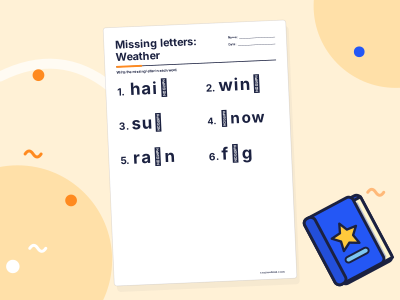
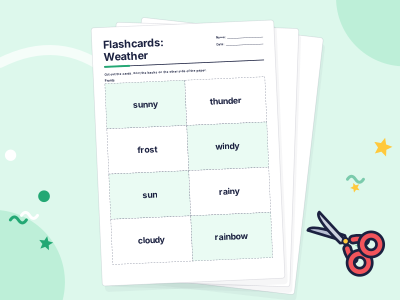
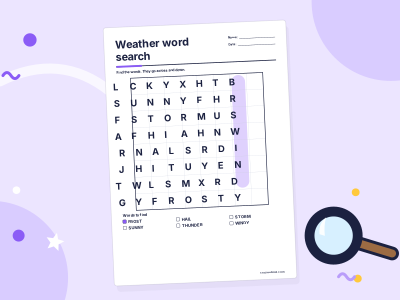
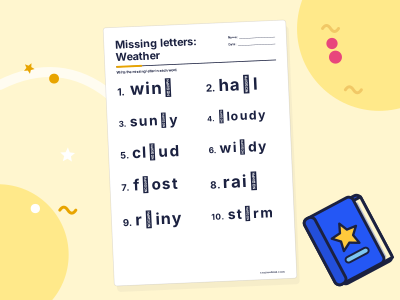
Weather and climate practice
For grown-ups
Related topics
Weather
Weather is what the air is like at a particular place and time, such as hot or cold, wet or dry, windy or calm, sunny or cloudy. It changes from day to day.
Seasons
Seasons happen because Earth is tilted. As Earth orbits the Sun over a year, each half of the planet takes turns leaning towards the Sun, getting more direct sunlight and longer days.
Latitude and longitude
Latitude and longitude are imaginary lines on Earth. Latitude measures how far north or south of the Equator you are; longitude how far east or west.
Habitats
A habitat is the natural home of a living thing, where it finds the food, water, shelter and space it needs to survive.
Capital cities
A capital city is the city where a country's government is based. It is not always the biggest city: Nigeria's capital is Abuja, not Lagos.
Compass directions
The four main compass directions are north, east, south and west. Between them are northeast, southeast, southwest and northwest.