Science
What is the solar system?
Quick answer
The solar system is the Sun and everything that orbits it, including eight planets, their moons, dwarf planets such as Pluto, asteroids and comets.
In one sentence
The solar system is our Sun and all the planets, moons and smaller space objects that travel around it.
Explained
At the centre of the solar system is the Sun, a star. It is a gigantic ball of extremely hot gas that gives out light and heat. It holds about 99.8% of all the mass in the solar system, so its gravity keeps everything else circling around it. Each path is called an orbit.
There are eight planets. In order from the Sun:
- Mercury — the smallest planet and the closest to the Sun
- Venus — the hottest planet, covered in thick clouds
- Earth — our home, the only planet known to have life
- Mars — the red planet, cold and dusty
- Jupiter — the biggest planet, a gas giant with a giant storm
- Saturn — famous for its bright rings
- Uranus — an ice giant that spins tipped on its side
- Neptune — the windiest and furthest planet
A handy way to remember the order: My Very Easy Method Just Speeds Up Naming.
The first four are small and rocky. The last four are huge and made mostly of gas and ice. Between Mars and Jupiter is the asteroid belt, millions of rocky lumps. Beyond Neptune are icy worlds including Pluto, now called a dwarf planet.
Many planets have their own moons. Earth has one, the Moon. Jupiter and Saturn each have many dozens of known moons, and astronomers keep finding more.
The solar system is enormous. Sunlight, travelling at about 300,000 km per second, takes around 8 minutes to reach Earth.

Examples
| Planet | Type | One fact |
|---|---|---|
| Mercury | rocky | a year lasts only 88 Earth days |
| Venus | rocky | spins backwards compared with most planets |
| Earth | rocky | about 71% of its surface is water |
| Jupiter | gas giant | its Great Red Spot is a storm bigger than Earth |
| Saturn | gas giant | its rings are made of ice and rock |
| Neptune | ice giant | winds faster than any on Earth |
 sun
sun planet
 moon
moon rocket
Common mistakes
- "The Sun is not a star." It is. It only looks bigger and brighter than other stars because it is so much closer.
- "Pluto is the ninth planet." In 2006 astronomers reclassified it as a dwarf planet.
- "Planets are evenly spaced." The outer planets are much further apart than the inner ones.
Quick quiz
The solar system
Check what you know with 4 quick questions.
Question 1 of 4
How many planets are in our solar system?
Practise it
Try it
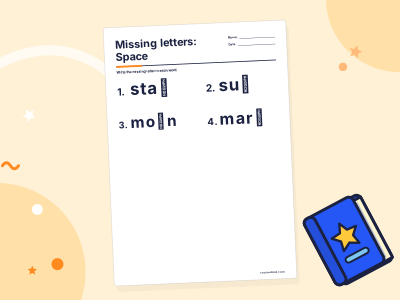
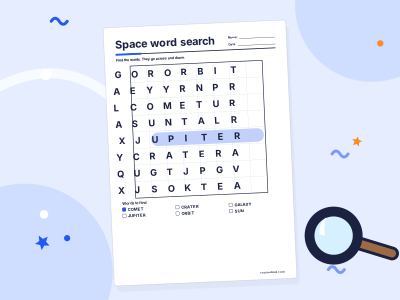
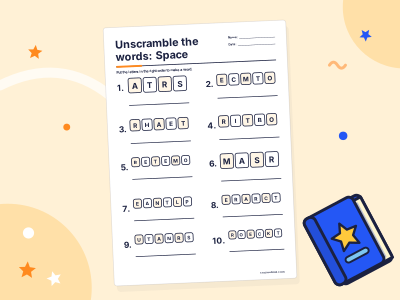
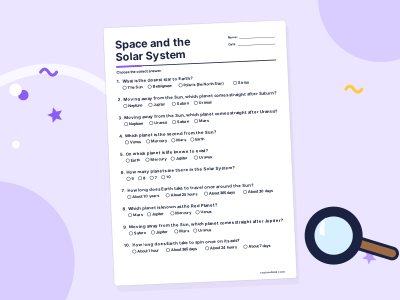
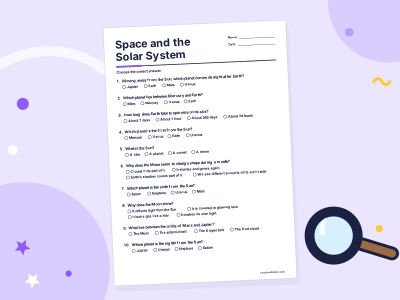
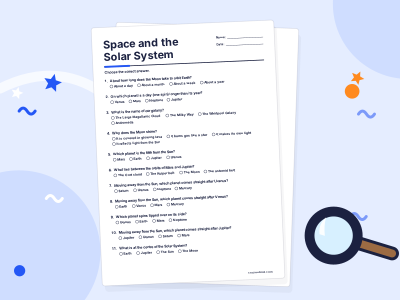
Make a model with fruit and balls for the planets, then try some space activities.
Space and planet activities
For grown-ups
Related topics
The Moon
The Moon is Earth's natural satellite, a rocky ball about a quarter of Earth's width that orbits us roughly once a month. It shines by reflecting sunlight.
Gravity
Gravity is the force that pulls objects towards each other. Earth's gravity pulls everything towards its centre, which is why things fall down and why the Moon orbits Earth.
Seasons
Seasons happen because Earth is tilted. As Earth orbits the Sun over a year, each half of the planet takes turns leaning towards the Sun, getting more direct sunlight and longer days.
Light
Light is a form of energy that travels in straight lines, very fast. We see things when light from them enters our eyes, either because they make light or because they reflect it.
Shadows
A shadow is a dark area made when an opaque object blocks light. Because light travels in straight lines, it cannot bend round the object, leaving a dark shape behind it.
Electric circuits
An electric circuit is a complete loop that electricity flows around. A simple circuit has a battery, wires and a component like a bulb. If the loop is broken, the electricity stops.