Science
What is the Moon?
Quick answer
The Moon is Earth's natural satellite, a rocky ball about a quarter of Earth's width that orbits us roughly once a month. It shines by reflecting sunlight.
In one sentence
The Moon is a rocky ball that travels around Earth, and we see it because it reflects light from the Sun.
Explained
The Moon is Earth's only natural satellite, meaning it orbits our planet. Earth's gravity keeps it circling us. It is about a quarter as wide as Earth and, on average, about 384,000 kilometres away. That's roughly 30 Earths lined up in a row.
The Moon makes no light of its own. It shines because sunlight bounces off its grey, dusty surface, a bit like a ball lit by a torch in a dark room.
Phases. Half of the Moon is always lit by the Sun, just as half of Earth is always in daytime. As the Moon travels around Earth, we see different amounts of that lit half. That's why it seems to change shape: from a new moon (we can't see the lit side), to a thin crescent, to a half moon, to a full moon, and back again. One full cycle takes about 29.5 days, which is where the idea of a "month" comes from.
The Moon has no air, no liquid water on its surface and no weather. Its surface is covered with craters made by space rocks crashing into it long ago. Footprints left by astronauts can last for a very long time because there's no wind or rain to wear them away.
Between 1969 and 1972, twelve astronauts walked on the Moon during NASA's Apollo missions. Neil Armstrong was the first, on 20 July 1969.
The Moon's gravity tugs on Earth's oceans, causing most of the rise and fall of the tides.

Examples
| Phase | What we see |
|---|---|
| New moon | almost nothing |
| Crescent | a thin curved sliver |
| First quarter | the right half lit (from the Northern Hemisphere) |
| Full moon | a complete bright circle |
| Last quarter | the left half lit (from the Northern Hemisphere) |
Common mistakes
- "The phases are caused by Earth's shadow." Earth's shadow only falls on the Moon during a lunar eclipse. Phases come from our changing view of the sunlit half.
- "There is a permanently dark side of the Moon." The far side gets just as much sunlight; we just never see it from Earth, because the Moon always keeps the same face towards us.
- "The Moon only comes out at night." You can often see it in the daytime sky too.
Quick quiz
The Moon
Check what you know with 4 quick questions.
Question 1 of 4
Why does the Moon shine?
Practise it
Try it
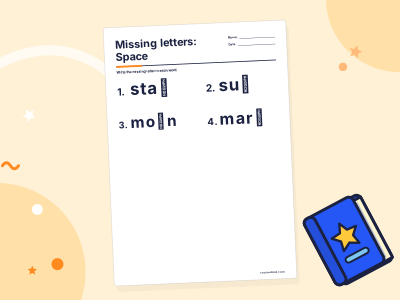
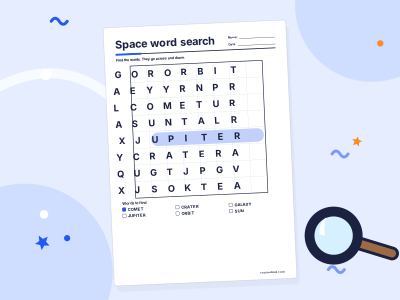
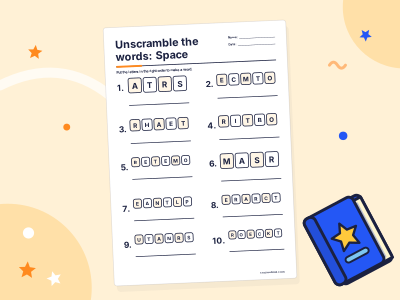
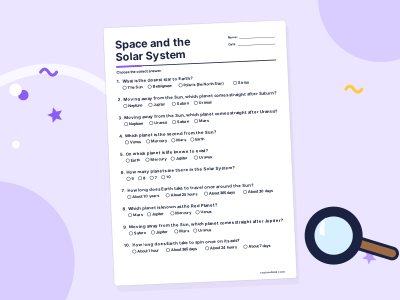
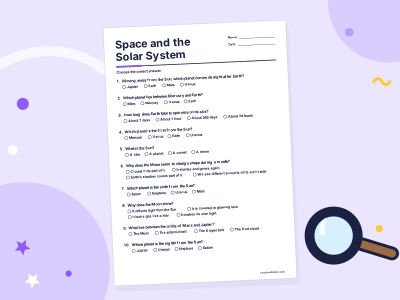
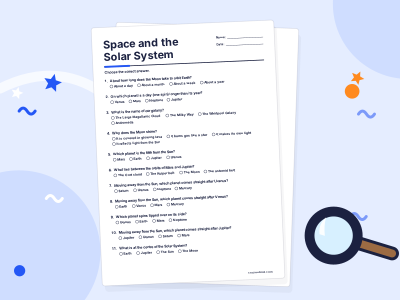
Keep a Moon diary for a month, drawing its shape each clear night. Then try some space activities.
Moon and space activities
For grown-ups
Related topics
The solar system
The solar system is the Sun and everything that orbits it, including eight planets, their moons, dwarf planets such as Pluto, asteroids and comets.
Gravity
Gravity is the force that pulls objects towards each other. Earth's gravity pulls everything towards its centre, which is why things fall down and why the Moon orbits Earth.
Light
Light is a form of energy that travels in straight lines, very fast. We see things when light from them enters our eyes, either because they make light or because they reflect it.
Shadows
A shadow is a dark area made when an opaque object blocks light. Because light travels in straight lines, it cannot bend round the object, leaving a dark shape behind it.
Electric circuits
An electric circuit is a complete loop that electricity flows around. A simple circuit has a battery, wires and a component like a bulb. If the loop is broken, the electricity stops.
Digestive system
The digestive system is the long tube and organs that break food down into tiny pieces your body can absorb for energy and growth, then get rid of what is left as waste.