Angles
An angle measures the amount of turn between two lines that meet at a point. Angles are measured in degrees (°); a right angle is 90° and a full turn is 360°.
Maths · Ages 10–11 · 55 minutes
Pupils find the perimeter and area of rectangles and right-angled triangles, use the correct units, and explain the difference between the two measures.
Generated fresh each time you press a button, and marked instantly on screen.
Show two rectangles drawn on squared paper: 6 × 2 and 4 × 3. "Which one is bigger?" Let pupils argue. Some will count the squares inside (12 and 12), some will count round the edge (16 and 14). "You're both right, but you're measuring different things. Today we sort out which is which."
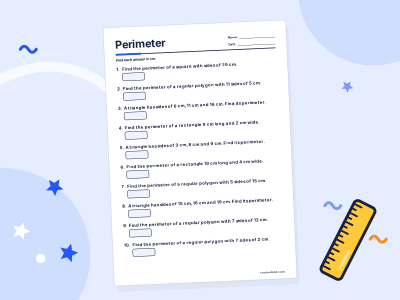
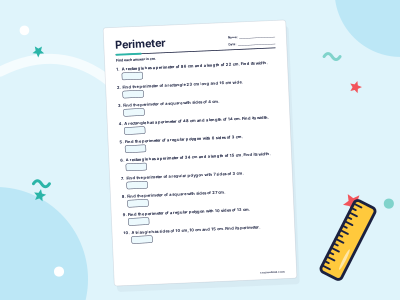
Perimeter. "Perimeter is the distance all the way round the edge, like a fence round a field." Trace round a 6 cm by 2 cm rectangle: 6 + 2 + 6 + 2 = 16 cm. "It's a length, so the unit is cm."
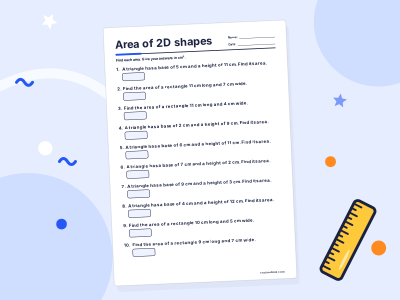
Area. "Area is the space inside a flat shape, like the grass inside the fence. We measure it in squares." Count the squares: 12. "Each square is 1 square centimetre, so the area is 12 cm²."
"Counting takes a long time for big shapes. Look: 2 rows of 6. Area of a rectangle = length × width."
Step by step
Draw a 6 cm by 4 cm rectangle, then a diagonal. "Two identical triangles. Each one is half the rectangle: 24 ÷ 2 = 12 cm²." Cut a paper rectangle along its diagonal and lay the halves on top of each other to prove it.