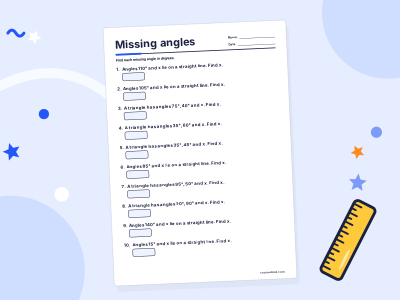
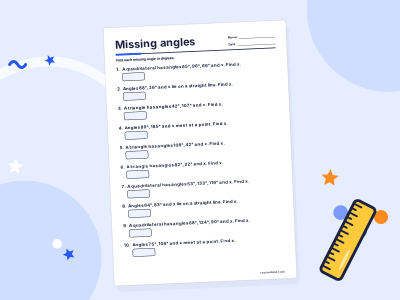
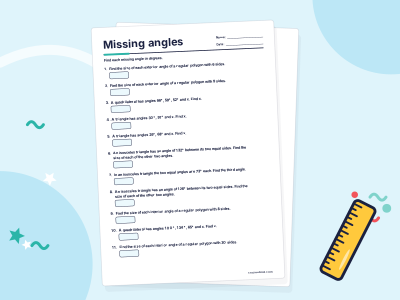
Angles
An angle measures the amount of turn between two lines that meet at a point. Angles are measured in degrees (°); a right angle is 90° and a full turn is 360°.
Maths · Ages 10–11 · 50 minutes
Pupils show that the angles in a triangle add up to 180°, use this and angles on a straight line to find missing angles, and give a reason for each step.
Generated fresh each time you press a button, and marked instantly on screen.
Quick recall: "How many degrees in a right angle? On a straight line? In a full turn?" (90°, 180°, 360°.)
Then mental subtraction from 180 on whiteboards: 180 − 70, 180 − 125, 180 − 95 − 40. These calculations are what the whole lesson relies on, so make them quick.
Every pupil has a different paper triangle. "Mark each corner with a dot. Now tear off the three corners." (Tearing works better than cutting, because the torn edge shows which part is the corner.)
"Put the three corners together so the points meet and the edges touch." Pupils find they make a straight line. "Everyone had a different triangle, and everyone got a straight line. What do we know about angles on a straight line?" (180°.) "So the three angles in any triangle add up to 180°."
Model a missing-angle question. A triangle has angles 65° and 40°. "65 + 40 = 105. 180 − 105 = 75. The missing angle is 75°, because angles in a triangle add up to 180°."
Step by step
Then special triangles. "An equilateral triangle has three equal angles: 180 ÷ 3 = 60° each. An isosceles triangle has two equal angles. If the odd angle is 40°, the other two share 140°, so each is 70°."