Crayonbird
Menu

Maths · Ages 10–11 · 55 minutes

Percentages of amounts

Pupils find percentages of amounts by building from 50%, 10% and 1%, and explain why per cent means parts per hundred.

Success criteria

  • I can find 50% 10% and 1% of an amount
  • I can build other percentages from these
  • I can check my answer is sensible

Key vocabulary

  • per cent
  • percentage
  • hundredth
  • of
  • equivalent
  • discount
  • build up

You will need

  • 100-square grids
  • mini whiteboards
  • a shop "sale" poster with prices
  • calculators for checking only
  • Year 6· England
  • Grade 5· United States
  • Primary 6· Nigeria
  • Class 6· India

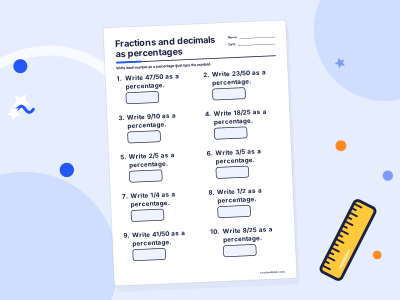
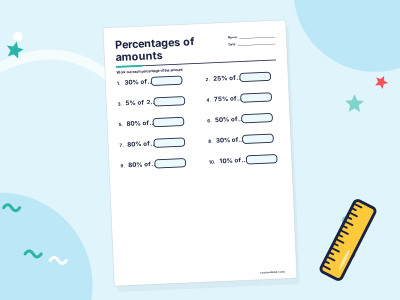
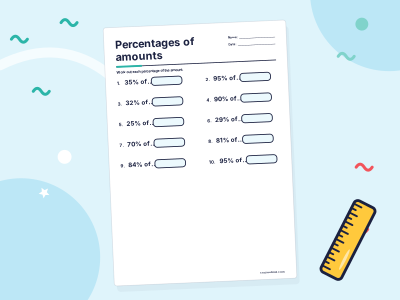
Practice sheets

Generated fresh each time you press a button, and marked instantly on screen.

The lesson at a glance

55 minutes in all. Timings are a guide: follow your class.

  1. Step 1: Starter

    Show a 100-square with 30 squares shaded.
    8 minutes
  2. Step 2: Teach

    "Per cent means per hundred, out of every hundred.
    14 minutes
  3. Step 3: Guided practice

    On whiteboards, show the building blocks you used: 10% of 450 30% of 450 25% of 64 75% of 64 12% of 300 99% of 200 (pupils who spot "100% minus 1%" deserve credit) Then ask: "Is 40% of 50 the same as
    10 minutes
  4. Step 4: Independent practice

    Use the practice buttons above.
    18 minutes
  5. Step 5: Plenary

    Return to 40% of 50 and 50% of 40.
    5 minutes
  6. Step 6: Assessment for learning

    Look for pupils who: find 10% by dividing by 10, not by subtracting 10; choose efficient building blocks; check that an answer is sensible (a percentage under 100% must give less than the whole).
  7. Step 7: Differentiation

    Pupils who need support should stick to 50%, 25%, 10% and multiples of 10% with a 100-square for reference.
  8. Step 8: Common misconceptions

    Finding 10% by subtracting 10.
  9. Step 9: Home link

    In a shop or online, find a sale price and work out the discount together using 10% and 50%.

1.Starter

8 minutes

Show a 100-square with 30 squares shaded. "What fraction is shaded? As a decimal? As a percentage?" (30/100, 0.3, 30%.) Repeat with 75 and 5 squares.

Then a quick fire on whiteboards: "Half of 80. A tenth of 80. A hundredth of 800." These three are the whole lesson in disguise.

2.Teach

14 minutes

"Per cent means per hundred, out of every hundred. 100% is the whole amount."

Write 360 in a bar at the top of the board. "Let's find some percentages of 360."

  • "50% is half: 180."
  • "10% is one tenth, so divide by 10: 36."
  • "1% is one hundredth, so divide by 100: 3.6."

"Now I can build almost anything. 20% is 10% doubled: 72. 5% is half of 10%: 18. 15% is 10% + 5%: 54. 25% is half of 50%: 90."

Step by step

  1. Find the building blocks50% (halve), 10% (÷ 10), 1% (÷ 100).
  2. Build the percentage you need35% = 10% + 10% + 10% + 5%, or 50% − 15%.
  3. Check it makes sense35% is a bit more than a third, so the answer should be a bit more than a third of the amount.

Model one more in context: "A coat costs $80. It's 15% off. How much is the discount? 10% is $8, 5% is $4, so 15% is $12. The coat now costs $68."


The rest of the plan

Guided and independent practice, the plenary, assessment for learning, differentiation, common misconceptions and the home link are free with a Crayonbird account.

  1. Guided practice10 minutes
  2. Independent practice18 minutes
  3. Plenary5 minutes
  4. Assessment for learning
  5. Differentiation
  6. Common misconceptions
  7. Home link

Learning Wiki

Percentages

A percentage is a number out of 100, written with the sign %. So 25% means 25 out of every 100, which is the same as one quarter.

Ratio

A ratio compares two or more amounts, written with a colon. A ratio of 2:3 means for every 2 of one thing there are 3 of the other.

Angles

An angle measures the amount of turn between two lines that meet at a point. Angles are measured in degrees (°); a right angle is 90° and a full turn is 360°.

  • Maths · Ages 10–11 · 50 min

    Angles in a triangle

    Pupils show that the angles in a triangle add up to 180°, use this and angles on a straight line to find missing angles, and give a reason for each step.

  • Maths · Ages 10–11 · 55 min

    Area and perimeter

    Pupils find the perimeter and area of rectangles and right-angled triangles, use the correct units, and explain the difference between the two measures.

  • Maths · Ages 10–11 · 60 min

    Long multiplication

    Pupils multiply a two- or three-digit number by a two-digit number using the formal written method, explain each partial product, and check with an estimate.