Crayonbird
Menu

Maths · Ages 10–11 · 60 minutes

Long multiplication

Pupils multiply a two- or three-digit number by a two-digit number using the formal written method, explain each partial product, and check with an estimate.

Success criteria

  • I can estimate the answer first
  • I can multiply by the ones and then by the tens
  • I can add the partial products and check against my estimate

Key vocabulary

  • multiply
  • product
  • partial product
  • place holder
  • estimate
  • exchange
  • formal written method

You will need

  • squared paper
  • a times-table grid for reference
  • mini whiteboards
  • a grid-method example on the board
  • Year 6· England
  • Grade 5· United States
  • Primary 6· Nigeria
  • Class 6· India

Practice sheets

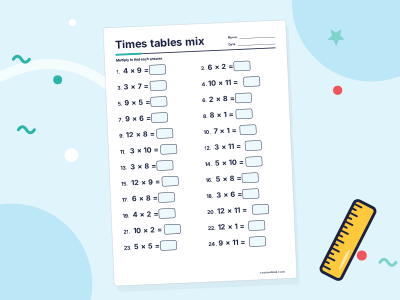
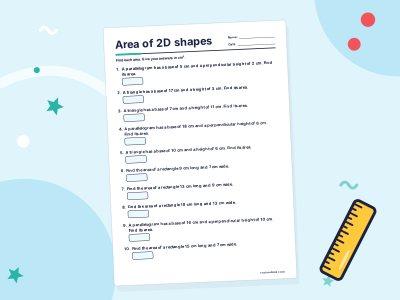
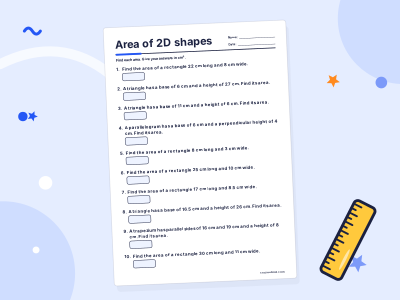
Generated fresh each time you press a button, and marked instantly on screen.

The lesson at a glance

60 minutes in all. Timings are a guide: follow your class.

  1. Step 1: Starter

    Rapid recall on whiteboards: 7 × 8, 6 × 9, 4 × 12, then 7 × 80, 60 × 9, 40 × 12.
    8 minutes
  2. Step 2: Teach

    Start with the grid method for 38 × 24, because it shows what's really happening.
    15 minutes
  3. Step 3: Guided practice

    Do these with pupils working alongside, one step at a time on squared paper: 46 × 13 57 × 32 124 × 15 (three-digit by two-digit) After each, ask a pupil to say what the second row means: "57 × 30 is 1
    12 minutes
  4. Step 4: Independent practice

    Use the practice buttons above.
    20 minutes
  5. Step 5: Plenary

    "Which is quicker: 25 × 48 by long multiplication, or by thinking 100 × 12?" (25 × 4 = 100, so 25 × 48 = 100 × 12 = 1200.) The written method is a reliable tool, not the only tool.
    5 minutes
  6. Step 6: Assessment for learning

    Look for pupils who: estimate before calculating and use the estimate to check; write the place-holder zero and can explain it; keep columns aligned and exchanged digits tidy.
  7. Step 7: Differentiation

    Pupils who need support should use the grid method throughout, which keeps every part visible, and keep a times-table grid on the table.
  8. Step 8: Common misconceptions

    Forgetting the place-holder zero.
  9. Step 9: Home link

    Ask your child to work out a real total, such as 24 bottles at 35p or 15 days at 45 minutes, and estimate first.

1.Starter

8 minutes

Rapid recall on whiteboards: 7 × 8, 6 × 9, 4 × 12, then 7 × 80, 60 × 9, 40 × 12. "What happens when one number is ten times bigger?" Pupils should say the product is ten times bigger, so a zero appears at the end.

Then: "Roughly, what's 38 × 24?" Accept 40 × 20 = 800 or 40 × 25 = 1000. Keep that estimate on the board.

2.Teach

15 minutes

Start with the grid method for 38 × 24, because it shows what's really happening.

30 8
20 600 160
4 120 32

"Four parts: 600 + 160 + 120 + 32 = 912." Then show the formal method on squared paper, one digit per square.

"Row one is 38 × 4. 8 × 4 = 32: write the 2, exchange the 3 tens. 3 × 4 = 12, plus the 3 is 15. So 152."

"Row two is 38 × 20, not 38 × 2. Because I'm multiplying by tens, I put a zero in the ones column first. That's the place holder. Then 8 × 2 = 16, write 6, exchange 1. 3 × 2 = 6, plus 1 is 7. So 760."

"Add the rows: 152 + 760 = 912. Same as the grid. And close to my estimate of 800 to 1000."

Step by step

  1. EstimateRound both numbers and multiply.
  2. Multiply by the ones digitWrite the first partial product.
  3. Write a zero, then multiply by the tens digitThe zero shows you are multiplying by a multiple of ten.
  4. Add the partial productsThen compare with your estimate.

The rest of the plan

Guided and independent practice, the plenary, assessment for learning, differentiation, common misconceptions and the home link are free with a Crayonbird account.

  1. Guided practice12 minutes
  2. Independent practice20 minutes
  3. Plenary5 minutes
  4. Assessment for learning
  5. Differentiation
  6. Common misconceptions
  7. Home link

Learning Wiki

Multiplication

Multiplication is adding equal groups quickly. 4 × 3 means 4 groups of 3 (or 3 groups of 4), which makes 12. The answer is called the product.

Angles

An angle measures the amount of turn between two lines that meet at a point. Angles are measured in degrees (°); a right angle is 90° and a full turn is 360°.

Decimals

Decimals are numbers with a decimal point. Digits after the point show tenths, hundredths and so on, so 2.5 means two and five tenths.

  • Maths · Ages 10–11 · 50 min

    Angles in a triangle

    Pupils show that the angles in a triangle add up to 180°, use this and angles on a straight line to find missing angles, and give a reason for each step.

  • Maths · Ages 10–11 · 55 min

    Area and perimeter

    Pupils find the perimeter and area of rectangles and right-angled triangles, use the correct units, and explain the difference between the two measures.

  • Maths · Ages 10–11 · 55 min

    Percentages of amounts

    Pupils find percentages of amounts by building from 50%, 10% and 1%, and explain why per cent means parts per hundred.