Summer Learning Without the Battle: A Light Plan for the Holidays
What the research on the summer slide really says, plus a 20-minute routine, reading ideas, real-world maths and travel journals for children aged 4–11.
On this page
Every summer the same worry goes round: children will forget everything over the break, and September will start with a slide backwards. The reality is calmer than the headlines, and the fix is lighter than a holiday spent at the kitchen table. This plan uses about twenty minutes a day, leans heavily on reading and real life, and leaves plenty of room for doing nothing much at all.
What the research on the summer slide actually says
The idea of "summer learning loss" has been studied for about a century, and you will often see it stated as a settled fact. It isn't quite.
Older studies, many from the 1970s to the 1990s, suggested that children lose ground over the summer and that the gap between richer and poorer children widens during the break. More recent work has complicated that picture. One researcher, Paul von Hippel, tried to reproduce a well-known finding using modern tests and couldn't, and argued that some older results came from the way the tests were scored rather than from real forgetting.
Newer data from large modern tests do show scores flattening or dipping over the summer on average, with bigger drops in maths than in reading. But the estimates vary widely depending on the test and the method, and individual children differ enormously: in one large dataset, roughly half of pupils lost ground over the summer while the other half gained. A Brookings summary of the research sets out this debate clearly.
So what does a parent do with that? Three sensible conclusions:
- Some forgetting is normal. Children (and adults) forget things they haven't used for a while. A bit of rustiness in September is not a disaster, and teachers expect it.
- Maths seems to fade faster than reading. That's worth knowing, because a few minutes of number practice a week is easy to add.
- Light practice is cheap insurance, not an emergency. You don't need a summer school at home. You need a small, regular habit.
 sun
sun book
book pencil
 map
map shell
shell ice cream
A light routine: twenty minutes, most mornings
The trick is to make learning a small, predictable part of the day rather than a negotiation. Mornings usually work best, before friends, trips and tiredness take over. Twenty minutes is enough for most children aged 5–11; four- and five-year-olds may only want ten.
| Day | Main activity (10–15 min) | Quick extra (5 min) |
|---|---|---|
| Monday | Read a book of their choice | One maths puzzle or game |
| Tuesday | Write in the holiday journal | Read a page aloud to you |
| Wednesday | Real-world maths (shopping, cooking, measuring) | Reading |
| Thursday | Reading | One worksheet they choose |
| Friday | Free choice: drawing, a puzzle, a library trip | Journal: "best thing this week" |
| Weekend | Nothing planned | Bedtime story as usual |
The weekend column is deliberate. A routine that allows days off is one children are more likely to accept.
Reading is the main event
If you only do one thing this summer, make it reading. Reading for pleasure is consistently linked with doing better at school, it costs nothing with a library card, and it doesn't feel like work to most children when they choose the book.
Let them choose, and let it be "easy". Comics, joke books, graphic novels, football annuals and re-reading a favourite for the fifth time all count. A child reading something slightly below their level, fluently and happily, is practising exactly what they need.
Keep reading aloud. Children who can read alone still benefit from being read to. You can read books a little above their level, so they hear new words and longer sentences. Our post on reading aloud at bedtime has ideas for keeping it going past the picture-book years.
Audiobooks count. On car trips, at the beach or during quiet afternoons, listening to stories builds vocabulary and comprehension. It's still reading in every way that matters for understanding.
Make a reading challenge, not a reading target. "Read ten books" can feel like a chore. A grid of challenges works better: a book with an animal on the cover, a book recommended by a grandparent, a book read outside, a book with a map in it, a book in another language. Each box is a small adventure.
For short, ready-to-print reads, try our short stories for kids, or picture books like The Tiny Seed for a summer garden theme.
Real-world maths and science
This is where the summer holidays have an advantage over school. Real life is full of numbers, and children take them more seriously when there's an ice cream at the end of the sum.
- At the shop: "We have 5 pounds. Can we buy the watermelon and the juice?" For older children: "Which pack is cheaper per biscuit?"
- In the kitchen: doubling a recipe, halving it, reading the scales, setting a timer for 12 minutes and checking when it'll be done.
- On trips: reading timetables ("the bus leaves at 10:45 — how long do we have?"), estimating distances, counting coins in a foreign currency.
- In the garden or park: measuring how much a sunflower grows each week, timing how long an ice cube takes to melt in the sun and in the shade, counting different types of insects.
None of this needs a worksheet, but it's the same skill a worksheet practises. Our post on everyday maths at home has dozens more ideas by age.
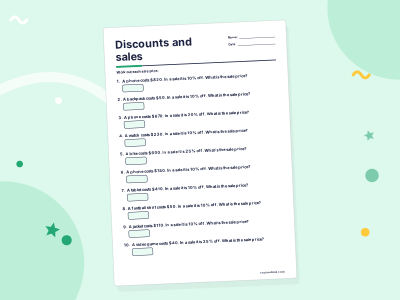
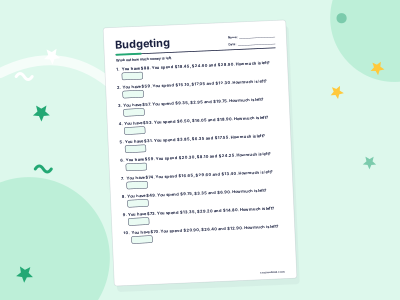
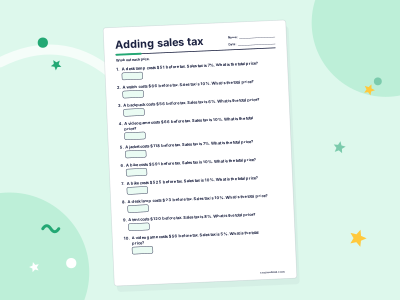
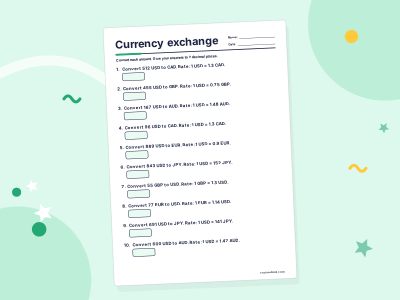
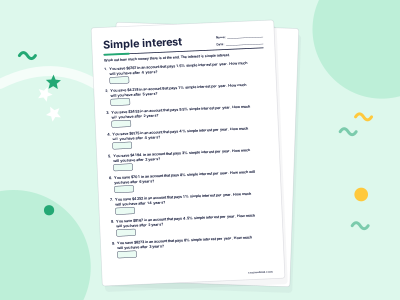
Money maths pages for shopping practice
Travel journals and holiday writing
Writing is the subject children are most likely to resist over the summer, so make it short and personal. A holiday journal does this well. It doesn't matter whether you are going abroad or staying at home: a trip to the park, a visit to a cousin or a rainy day of baking is all journal material.
Keep each entry small. For ages 4–6, one drawing and one labelled word or a sentence they say aloud while you write it. For ages 7–9, two or three sentences. For ages 10–11, a short paragraph, a list or a "review" of a day out with stars.
Give a prompt when the page is blank. Some that work:
- Today I saw…
- The best thing I ate this week was… because…
- Draw a map of where we went today.
- If I could take one thing home from this place, it would be…
- Three sounds I heard today.
- Write a postcard to your teacher (you don't have to send it).
Stick things in. Tickets, leaves, wrappers, a photo of an ice cream. Gluing and labelling counts as writing for younger children.

Keeping it from becoming a battle
Even a light routine can turn into a daily argument. A few approaches help.
Don't call it homework. "Reading time" and "journal time" sound better than "work", and they are not the same thing as school homework anyway.
Use "first, then". "First twenty minutes of reading and the journal, then the park." It's predictable and keeps the fun bit as the reward.
Give two choices, both fine with you. "Do you want to do the maths game or the word search first?" Children who feel some control push back less.
Keep it short, and stop on time. If you said twenty minutes, stop at twenty minutes, even if it's going well. Next time, your child will trust that it really is short.
Skip days without guilt. Holidays, friends visiting, illness or just a bad mood are reasons to drop the routine for a day. A routine that bends is one that lasts until September.
What summer learning looks like at each age
The same plan stretches across a wide age range, but the details change.
Ages 4–5. Learning is almost entirely play and talk. Read together every day, sing counting songs, sort the shopping, notice letters on signs ("That's an s — like your name, Sami!"), draw and colour. Ten minutes of anything that looks like a worksheet is the most you need, and only if your child enjoys it. If they're starting school in September, practising independence (putting on shoes, opening a lunchbox, going to the toilet alone) is more useful than any letter work.
Ages 6–8. Reading fluency is the big one: plenty of easy, enjoyable reading, aloud and alone. Add a little number-fact practice, such as number bonds to 10 and 20 or the 2, 5 and 10 times tables, through games rather than drills. Journals can now include a sentence or two, with drawings.
Ages 9–11. Children can take more ownership. Let them choose their reading challenge, plan part of a day trip (route, times, budget), or start a summer project: a nature diary, a comic, a family recipe book. Five minutes of times tables or mental maths a few days a week keeps those facts quick. Children moving up to secondary school may also like to practise organising themselves with a simple weekly planner.
At every age, the same principle applies: short, regular and chosen by the child whenever possible.
The last week before school
In the final week, shift gently towards school rhythms: earlier bedtimes, a bit more number practice, and some writing by hand. Revisit one or two things your child found tricky last year, such as a times table or spelling pattern, for five minutes a day.
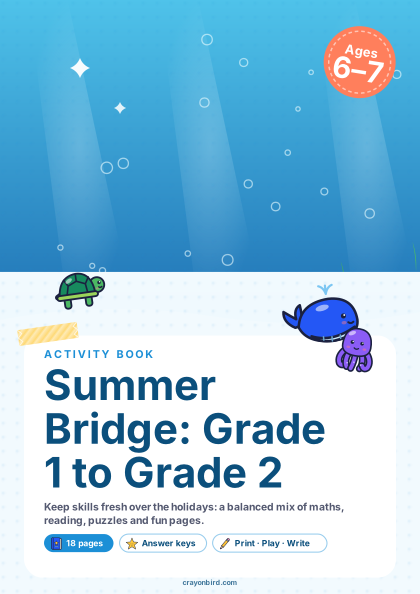
Our summer activities page and the summer packs are designed for exactly this kind of light practice. The Summer Bridge: Grade 1 to Grade 2 pack (roughly Year 2 to Year 3 in England) is a good example of short, mixed pages that refresh what children learnt without going over the same ground for hours.
Activity bookAges 6–7
Summer Bridge: Grade 1 to Grade 2
Keep skills fresh over the holidays: a balanced mix of maths, reading, puzzles and fun pages.
See what’s insideThis week, pick one small habit to start with: a library trip and a twenty-minute morning reading slot is enough. Add the journal next week, and the real-world maths whenever an opportunity turns up at the shop.
Browse summer printables
Common questions
Is the summer slide real?
The evidence is mixed. Many studies find children's test scores flatten or dip over the long break, especially in maths, but the size of the effect varies a lot between studies and between children, and some children gain ground.
How much learning should my child do over the summer holidays?
For most primary-age children, about twenty minutes on most days is plenty, with reading as the main activity. Short and regular beats long and occasional, and days off are fine.
Should I buy workbooks for the summer?
A small workbook or a few printables can help if your child likes them, but they are not essential. Daily reading, everyday maths and a holiday journal cover a lot of ground for free.
Printables used in this article
Crayonbird Editorial Team
Writers, illustrators and educators
We are the small team that writes, draws and tests Crayonbird’s activities. We try every idea with our own printables, keep advice practical and honest about what doesn’t work, and point to official guidance where it matters. Nothing on this blog is sponsored.
Related articles
Seasons and festivals
Christmas Learning Activities for Kids: Maths, Writing, Art and Kindness
Festive maths, letter writing, art and kindness activities for ages 3–11, plus winter swaps and ideas for families who celebrate differently or not at all.
Ages 3–117 min read
Seasons and festivals
Halloween Learning Activities for Kids: Maths, Literacy and Art
Friendly, not-too-scary Halloween maths, literacy, art and science activities for ages 3–11, with a week plan and autumn swaps for families who don't celebrate.
Ages 3–118 min read
Parenting and learning
A Realistic Daily Learning Routine for Preschoolers (15–20 Minutes)
A realistic 15–20 minute daily learning routine for 3–5 year olds at home, with a sample week plan, what to do in each block and how to keep it going.
Ages 3–58 min read