A Realistic Daily Learning Routine for Preschoolers (15–20 Minutes)
A realistic 15–20 minute daily learning routine for 3–5 year olds at home, with a sample week plan, what to do in each block and how to keep it going.
On this page
Plenty of parents start the year with a laminated timetable and a box of new pens, and by week three the box is under the sofa. The problem is rarely motivation. It's that the plan was built for a seven-year-old's attention span and a parent with no other jobs. This routine takes 15 to 20 minutes, assumes you are busy, and is designed to survive real life with a three, four or five year old.
What "learning time" looks like at three, four and five
At this age, almost all real learning happens through play, conversation and everyday experiences: helping cook, sorting the washing, splashing in puddles, being read to. A short adult-led slot each day doesn't replace any of that. Its job is to add a little focused practice of the things children don't usually stumble into on their own, such as hearing the first sound in a word or counting objects carefully one by one.
Some honest expectations:
- Three-year-olds often manage a few minutes on one adult-led activity before they need to move. A session might be two or three tiny blocks with wriggling in between.
- Four-year-olds can usually stay with something for longer if they chose it or it involves their hands, but sitting still and listening is still hard work.
- Five-year-olds can often manage the full 20 minutes, especially if part of it is active.
Attention varies hugely between children and from day to day. A sleepy Tuesday will look nothing like a bright Saturday morning, and that's fine.
The four blocks
The routine has four short blocks, always in the same order. Same order matters more than the content: once your child knows what's coming, there's far less negotiation.
Step by step
- Talk and sing (3 minutes)A song with actions, a nursery rhyme, or "what did you dream about?" Warms up voices and attention.
- Busy hands (5 minutes)Play-dough, cutting, threading, building, tracing. Something physical that strengthens fingers.
- Little focus (5 minutes)One tiny bit of letters or numbers. A sound game, counting objects, a single printable.
- Story (5 minutes)Read one picture book together, talk about one page. Always end here, because it's the part children love most.
That's 18 minutes. Some days you'll do 10, some days 25 because your child didn't want the play-dough block to stop. Neither is a problem.
Why this order works
The talk block is easy and gets your child sitting with you. Busy hands gets the fidgets out before the one block that needs focus. And ending with a story means the routine always finishes on something warm. Children remember how a session ended, and that memory decides how tomorrow starts.

Picking your time and place
Time. Choose a time when your child is fed, rested and not already deep in a game. For many families that's straight after breakfast, or after an afternoon snack. Avoid the hour before dinner; it rarely ends well.
Place. The same spot each day, ideally a table where your child's feet can touch the floor or a box. Keep a learning box nearby so you aren't hunting for scissors while attention evaporates.
Your phone. Put it in another room. Fifteen minutes of your full attention is what makes this routine work, and it is a pleasant thing for both of you.
What goes in the learning box
- Chunky crayons and a few short pencils
- Child-safe scissors and a glue stick
- A tub of play-dough
- 20 small counters (buttons, pasta shapes, bottle tops)
- A set of letter cards for the sounds you're working on
- A folder of printables for the week
- Two or three library books
A sample week
Use a light weekly theme to tie the blocks together. It gives you ideas for songs, books and printables, and children love the feeling of "farm week" or "space week". Here's an autumn example.
| Day | Talk and sing | Busy hands | Little focus | Story |
|---|---|---|---|---|
| Mon | "Leaves are falling" with actions | Tear orange and red paper for a leaf collage | Count leaves on the collage: 1 to 5 | A picture book about autumn |
| Tue | What colour is your favourite leaf? | Play-dough hedgehog with pasta spines | Hear the first sound: l for leaf | Re-read Monday's book |
| Wed | "Five little ducks" song | Thread pasta onto a pipe cleaner | Count the ducks, take one away: how many now? | Where Is Number Five? |
| Thu | Talk about yesterday's walk | Trace wavy lines (leaves blowing) | Sort leaves: big and small | A new book |
| Fri | Child's choice of song | Colour an autumn picture | Find two things that start with /l/ | Child's choice |
Notice that nothing here requires much preparation. The Monday collage becomes Tuesday's counting; Wednesday's song becomes the focus block. Recycling one idea across several days is how busy parents keep this going, and young children enjoy the repetition anyway.
For the little focus block, a short phonics game fits neatly; our guide to teaching letter sounds at home gives you a five-week sequence. For numbers, see teaching numbers 1 to 20, which explains why counting a pile of buttons beats chanting to twenty.
 leaf
leaf tree
tree mushroom
 rain
rain
Adjusting the routine for your child's age
The four blocks stay the same from three to five. What changes is how long each one lasts and how much your child does on their own.
For a young three-year-old, shrink everything. Two minutes of song, three of play-dough, one or two of the focus block, and a short board book. Do the focus block on the floor if sitting at a table is a struggle. Counting three toy cars into a box is plenty; so is saying "/b/ for ball" while rolling one back and forth. Expect to do most of the talking.
For a four-year-old, the session above fits well. Start handing over small jobs: your child fetches the learning box, chooses the song, turns the pages. Ask one open question during the story ("What do you think the fox will do?") and wait a full five seconds for an answer before helping. That wait feels endless to adults and is exactly what children need.
For a five-year-old, especially one starting school soon, stretch the focus block to seven or eight minutes and include a little writing: their name, a label for a drawing, the number of leaves they counted. Let them "read" a familiar book to you, even if they're reciting from memory. Retelling a story in order is a real pre-reading skill.
If you have children of different ages, run one session with layered jobs rather than two separate ones. The five-year-old counts ten leaves and writes the number; the three-year-old counts three and sticks them down.
Keeping it going for months, not days
Most routines don't fail on day one. They fail in week four, when the novelty has gone. A few things help.
Rotate, don't reinvent. Keep a list of ten busy-hands activities and ten focus games. Cycle through them. You don't need anything new each week, just a different theme to wrap around the same activities.
Let your child choose one thing. "Do you want play-dough or cutting today?" Two options, both fine with you. Choice buys a lot of cooperation.
Keep a little record. A sticker on a calendar for each session, or a folder where finished pages go. Four-year-olds like seeing a pile grow. So do adults.
Take breaks on purpose. Drop the routine during holidays, illness or a new baby. Going back after a week off is easy if you return to the simplest version: song and story only, then add blocks back in.
Change the theme with the seasons. A set of autumn activities in October and snowy pages in winter keep things fresh without extra planning.
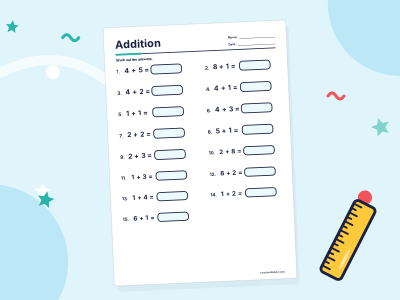
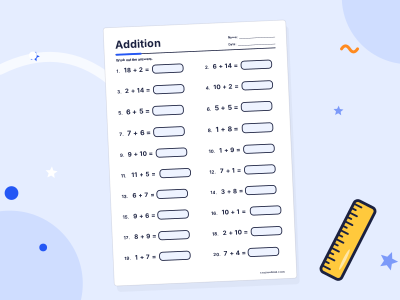
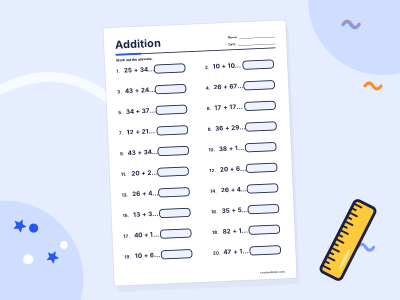
Printables for the little focus block
When it falls apart (it will)
"I don't want to!" Try starting with the story instead. Once your child is on your lap, you can usually slide into a song and then a short activity. If not, the story alone counts for today.
Siblings want to join. Let them. A toddler can scribble or squash play-dough beside an older child. An older sibling can be "the teacher" for the song block, which they usually love.
Your child wants to keep going. Great, but stop before they're tired. "Let's save the rest for tomorrow" leaves them looking forward to it.
You missed three days. Nothing is lost. Children don't keep score; they just pick up from where you left off.
Everything turns into silliness. Often a sign the focus block is too hard or too long. Cut it to two minutes and make it physical: jump to the number, hop to the letter.
The learning that happens outside the 20 minutes
The routine is a small, steady part of the day. The bigger part is ordinary life, and you can nudge it towards learning without turning everything into a lesson.
- Cooking: counting spoonfuls, naming shapes of cutters, talking about hot and cold.
- Laundry: matching socks, sorting by colour or by whose clothes they are.
- Walks: spotting numbers on doors, collecting five sticks, hearing birds.
- Shopping: "Can you find three apples?" "Which bag is heavier?"
- Quiet afternoons: a basket of independent activities, as described in our ideas for quiet time.
And at the end of the day, a bedtime story does more than any worksheet. If you'd like ideas for making that time count, see our piece on reading aloud at bedtime.
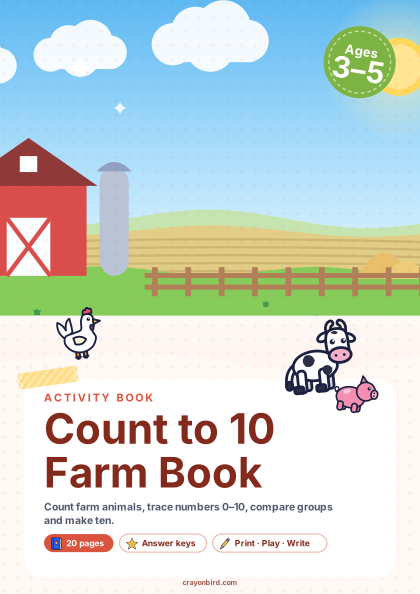
Activity bookAges 3–5
Count farm animals, trace numbers 0–10, compare groups and make ten.
See what’s insideTomorrow, try just two blocks: one song and one story at the same time and place. If that goes well for a week, add the busy-hands block. A routine that grows slowly is far more likely to last than one that starts big.
Common questions
How long should a preschooler do learning activities each day?
For most three to five year olds, 15 to 20 minutes of adult-led activity is plenty, split into short blocks. The rest of their learning happens through play, talk, books and everyday jobs.
What should a 4-year-old be learning at home?
Talking and listening, early number sense (counting small groups, comparing more and fewer), hearing sounds in words, hand strength for drawing, and lots of stories. Formal worksheets are optional extras, not the main event.
What if my child refuses to do the routine?
Shorten it rather than abandon it. Do just the story block for a few days, then add one more block. Refusal is often a sign the session is too long or at the wrong time of day.
Do I need to buy special materials?
No. Paper, crayons, a few household objects for counting, some printables and library books cover almost everything in this routine.
Printables used in this article
Crayonbird Editorial Team
Writers, illustrators and educators
We are the small team that writes, draws and tests Crayonbird’s activities. We try every idea with our own printables, keep advice practical and honest about what doesn’t work, and point to official guidance where it matters. Nothing on this blog is sponsored.
Related articles
Parenting and learning
Homeschool Schedule for Beginners: Sample Days and Weeks by Age
Realistic homeschool schedules for ages 4–14, with sample days, a weekly rhythm, tips for teaching siblings, and a reminder to check the rules where you live.
Ages 4–148 min read
Parenting and learning
Rainy Day Activities for Kids: Indoor Ideas by Age and Energy Level
Indoor rainy day activities for ages 2–11, sorted by energy level: active games, making and building, calm ideas, printable packs and a rainy-day box checklist.
Ages 2–118 min read
Parenting and learning
Screen-Free Activities for Kids: Ideas by Age and Situation
Practical screen-free activities for ages 3–12, sorted by situation: waiting, quiet time, rainy days, trips and "I'm bored", plus an honest note on screens.
Ages 3–128 min read