Teaching Numbers 1 to 20: Building Real Number Sense in 3–6 Year Olds
How to teach numbers 1 to 20 so children understand quantity, not just recite: counting principles, subitising, number bonds, the tricky teens and games.
On this page
A three-year-old who can chant "one, two, three... twenty!" is impressive. Ask the same child to give you five grapes and you may get a handful and a cheerful "five!" Both are completely normal. Reciting numbers and understanding them are different skills, and knowing the difference changes how you teach. This guide covers what real number sense looks like from 1 to 20, the stages children move through, and games that build it in a few minutes a day.
Reciting is not the same as counting
Saying number words in order is closer to singing a song than to doing maths. It's useful, because children need the words, but it's only one of several ideas that have to come together before counting means anything.
Researchers who study young children's maths often describe a set of counting principles. In plain language:
- Stable order. The number words always come in the same order: one, two, three, never one, three, two.
- One-to-one. Each object gets exactly one number word. No skipping, no counting the same teddy twice.
- The last number is the answer. When you count "one, two, three, four" the final word tells you how many there are. This is called cardinality, and it is the big one.
- Anything can be counted. Toys, claps, jumps, sounds, even ideas.
- Order doesn't matter. Count the cars left to right or right to left; there are still five.
Here's a quick test for cardinality. Count four blocks together, then ask, "So how many blocks are there?" A child who has grasped it says "four" straight away. A child who hasn't will often count them all again. That's not a mistake to correct; it's useful information about where they are.
Seeing small numbers without counting
Look at three dots on a dice and you don't count them. You just know. That instant recognition is called subitising, and most people can do it reliably with up to about four objects. It's a powerful foundation, because it lets children see numbers as whole things rather than strings of words.
Ways to build it:
- Dice and dominoes. Flash a dice face for a second and ask "how many?" Start with one to three dots.
- Finger patterns. Show three fingers quickly and hide them. Can your child show you the same? Then try "show me four a different way" (two on each hand, three and one).
- Quick-look cards. Draw dots on cards in different arrangements. Three dots in a line, three in a triangle. Same number, different look.
- Spot it in the world. Four wheels on a car, two eyes, three legs on a stool.
Once small numbers can be seen, larger ones can be built from them. Five looks like "three and two"; six looks like "three and three". This is called conceptual subitising, and it's the bridge to adding.
 ladybird
 bee
bee butterfly
 ant
ant
Five and ten: the two anchors
Our number system is built on tens, and our hands come in fives. Using those two anchors makes numbers up to 20 far easier to understand.
The five frame. Draw a row of five boxes. Put counters in from the left. Three counters, two empty spaces. "How many more to make five?" Children quickly start to see that 3 and 2 make 5 without counting.
The ten frame. Two rows of five boxes. Fill the top row first, then the bottom. Seven is "a full row of five and two more". Nine is "one less than ten". These pictures become mental images children carry for years.
Fingers. Ten fingers are a ten frame on the end of your arms. Encourage your child to show numbers without counting each finger: "show me five" (a whole hand), "show me seven" (a whole hand and two). Using fingers isn't cheating; it's a perfectly good maths tool at this age.
Number bonds without the worksheets
A number bond is simply two numbers that make another. For 5: 0 and 5, 1 and 4, 2 and 3. For 10: 1 and 9, 2 and 8, 3 and 7, 4 and 6, 5 and 5. Knowing these by heart makes adding, subtracting and later mental maths dramatically easier.
Try this with five counters and a cup:
"I've got five buttons. I'm going to hide some under the cup... Look, two are left outside. How many are hiding?"
Your child might count on their fingers, guess, or lift the cup. All fine. Do it again with a different number hidden. Over a few weeks, the answers start coming instantly. Then do the same game with ten.
Other ways to practise bonds:
- Shake and spill. Put five two-coloured counters (or coins, heads and tails) in a cup, shake and spill. "Three red and two yellow. Three and two make five."
- Ten-pin bowling. Ten plastic bottles. Knock some down: how many are standing? How many fell? Together they always make ten.
- Snack plates. "You've got six raisins on this side. How many should go on that side to make ten?"
In England, the early learning goals expect children at the end of Reception to recall number bonds up to 5 without counting, plus some bonds to 10, and the Year 1 curriculum moves on to bonds within 20. In other countries the timing differs, but the idea appears in almost every early maths curriculum.
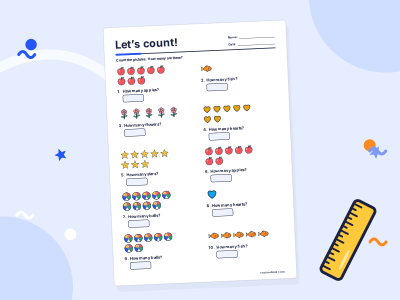
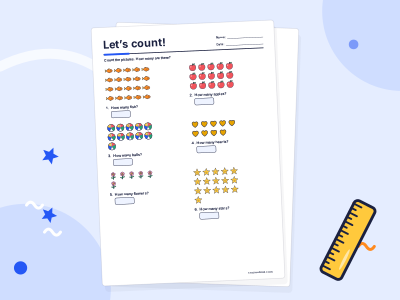
Counting and number pages for ages 3–6
The teens are trickier than they look
Children often sail up to ten and then wobble. That's not because the numbers are bigger. It's because the English words don't help.
- Eleven and twelve give no clue that they mean "ten and one" and "ten and two".
- Thirteen, fourteen and so on say the ones first and the ten second, but we write the ten first: 14 is "four-teen" but written 1 then 4. No wonder some children write 41.
- Thirteen and thirty sound very similar, especially to a young ear.
Some languages make it easier. In Chinese, Japanese and Korean, 14 is said as "ten-four". You can borrow that idea:
"Fourteen is ten and four. Let's make it: one full ten frame, and four more."
Build every teen number with a full ten frame (or a bundle of ten straws held with a hair band) and some loose ones. Say both names: "ten and six, sixteen". Before long, your child sees that every teen is "ten and some more", and 20 is "two tens".
Games for numbers 1 to 20
Short, physical and repeated: that's the formula. Choose one or two a day.
- Stair counting. Count the stairs going up, then count back down from the top. Counting backwards is a separate skill, and stairs make it natural.
- Number line hop. Chalk a line of numbers 0 to 20 on the ground. "Start on 8. Hop forward 2. Where are you?"
- Mystery bag. Put up to 10 small objects in a bag. Your child feels and guesses how many, then counts to check.
- More or fewer. Two handfuls of pasta. Which has more? Estimate first, then count. Estimation builds a feel for size.
- Number hunt. Spot numbers on doors, buses, prices and clocks. Ask "what comes next?"
- Shop. Price toys at 1p to 10p (or the equivalent in your currency) and pay with real coins.
- Race to 20. Roll a dice, add that many counters to a twenty frame (two ten frames). First to fill both wins.
A picture book that plays with counting is a lovely bedtime extra. Try Where Is Number Five? and pause to count the ducks on each page.

Writing numerals comes last
Writing numbers is a handwriting skill, not a maths skill, and it can lag well behind understanding. A child who can't yet write 8 may know perfectly well what eight means.
When you do practise:
- Show where to start. A green dot for the starting point fixes most formation problems.
- Use rhymes. "Across the sky and down from heaven, that's the way to make a seven." Many families have their own.
- Expect reversals. Backwards 2s, 3s, 5s, 7s and 9s are very common until about seven. Model the correct shape calmly and move on.
Our number tracing pages give guided practice with starting dots and arrows.
Common mistakes (ours, not theirs)
- Going too high too fast. Secure understanding to 5, then to 10, then to 20. There's no prize for counting to 100 at four.
- Only using worksheets. Paper is useful later. Real objects come first, always.
- Correcting every count. If your child counts six blocks as seven, say "Let's count together" rather than "No, wrong."
- Forgetting zero. "How many cookies are left?" "None!" is a great maths conversation. Zero is a number.
For more ways to fold numbers into ordinary days, see our ideas for everyday maths at home, and when your child is ready to move on to comparing bigger numbers, try our comparing numbers worksheets.
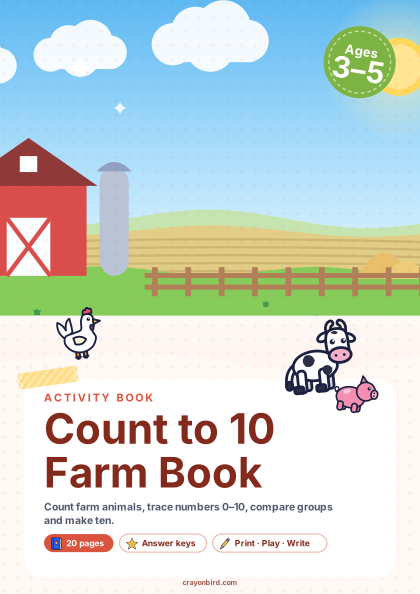
Activity bookAges 3–5
Count farm animals, trace numbers 0–10, compare groups and make ten.
See what’s insideTonight, grab five buttons and a cup and play the hiding game three times. It takes two minutes, and it teaches more about what five really means than any amount of chanting.
Print number sense activities
Common questions
My child can count to 20 but can't count objects. Is that normal?
Very normal. Reciting number words is a memory skill, like a song. Counting objects needs one-to-one matching and the understanding that the last number tells you how many. Practise with small groups of real things, up to five at first.
What is subitising?
It means seeing how many are in a small group instantly, without counting, such as recognising three dots on a dice at a glance. Most people can do it reliably with up to about four items.
When should children learn number bonds?
Bonds to five make a good start at around five, then bonds to ten. In England, children at the end of Reception are expected to recall number bonds up to 5 and some bonds to 10, and to use bonds within 20 in Year 1.
Should I worry if my child writes numbers backwards?
No. Reversals like a backwards 3 or 7 are very common up to about age seven. Model the correct shape, use a starting dot, and don't make a big fuss.
Printables used in this article
Crayonbird Editorial Team
Writers, illustrators and educators
We are the small team that writes, draws and tests Crayonbird’s activities. We try every idea with our own printables, keep advice practical and honest about what doesn’t work, and point to official guidance where it matters. Nothing on this blog is sponsored.
Related articles
Maths
Fractions for Kids: How to Explain Them Visually (Ages 6–11)
Explain fractions with sharing, paper fraction walls and number lines, fix the most common misconceptions, and try hands-on fraction activities for ages 6–11.
Ages 6–118 min read
Maths
How to Learn Times Tables: The Best Order, Patterns and Games
The smartest order to learn times tables, patterns that cut the work in half, games, spaced practice and what the UK Year 4 multiplication check involves.
Ages 6–118 min read
Maths
Mental Maths Strategies for Kids: Partitioning, Bridging and More
Five mental maths strategies every child should know, with worked examples: partitioning, bridging through 10, compensation, doubling and halving.
Ages 6–118 min read