Everyday Maths at Home: Cooking, Shopping, Travel and Games by Age
Simple ways to build maths into cooking, shopping, trips and games for ages 3–11, with what to say at each age and no worksheets required.
On this page
Children learn a surprising amount of maths without ever seeing a worksheet: when they set the table, split a pizza, count down to a birthday or work out if their pocket money covers a toy. The trick is noticing those moments and saying a little more out loud. Here is how to do that in the kitchen, at the shops, on trips and at the games table, with ideas for each age from 3 to 11.
The golden rule: talk, don't test
Everyday maths works when it feels like part of life rather than a quiz sprung on a child in the supermarket. Compare these two:
- "How many apples are in the bag? Come on, count them."
- "I need six apples. I've got… one, two, three, four. How many more do I need?"
The second one gives the child a reason to care about the answer. A few habits make this easy:
- Think aloud. "It's 4:15 and swimming is at 5. That gives us 45 minutes." Children absorb how adults reason with numbers.
- Estimate first. "How many grapes do you think are in this bunch? Let's count and see who was closest." Estimating is an underrated skill, and it's fun because there is no wrong guess.
- Ask "how did you know?" It makes children explain their thinking, which is where understanding grows.
- Be positive about maths. Try not to say "I was always rubbish at maths" in front of your child. Children quickly pick up adult attitudes, and "Let's work it out together" sends a much better message.
In the kitchen
Cooking is the richest everyday maths there is: counting, measuring, fractions, time and following steps in order.

Ages 3–5. Count spoonfuls out loud as they go into the bowl. Set the table with one fork for each person; matching one thing to one person is a key early counting skill. Use cookie cutters and talk about shapes: "This one's a circle, this one has three corners." Ask them to give everyone two crackers.
Ages 5–7. Let them read the numbers on the scales and measuring jug. "We need 200 grams of flour. Tell me when the number says 200." Cut sandwiches into halves and quarters and use the words. Set the oven timer together: "Twelve minutes. Let's watch it count down."
Ages 7–11. Give them real problems:
- "This recipe serves 4 and uses 150 g of flour. We have 6 people coming. How much flour do we need?" (Half as much again: 150 + 75 = 225 g.)
- "The cake needs 35 minutes. It goes in at 4:40. When do we take it out?" (5:15.)
- "We've got 1 kg of rice and each meal uses 250 g. How many meals is that?" (Four.)
Older children can also convert: cups to millilitres, ounces to grams, Fahrenheit to Celsius if you use an older recipe. They'll grumble and then feel very clever.
At the shops and the market
Money is abstract until children handle it. Use whatever currency your family uses; the ideas work for pounds, naira, rupees, dollars or euros.
Ages 3–5. Count items into the bag. Find a number on a sign: "Can you spot a 3?" Compare sizes: "Which bag of potatoes is heavier?" Let them hand over money and get the change, even if they don't understand it yet.
Ages 5–7. Read price labels. "This is 80 pence and that is 1 pound 20. Which is cheaper?" Make small amounts with coins at home first; a pretend shop on the kitchen table with real coins and tins is a wonderful rainy-afternoon game.
Ages 7–11. Hand over a budget. "You have 5 pounds for snacks for the trip. What can you get?" Then let them choose, add up and check the change. Introduce value for money:
"A 500 g pack costs 2.40. A 1 kg pack costs 4.50. Which is better value?"
(Two 500 g packs would cost 4.80, so the big pack saves 30p.) "3 for 2" offers are great for multiplication and fair-sharing problems, and price-per-kilo labels are a gentle introduction to rates.
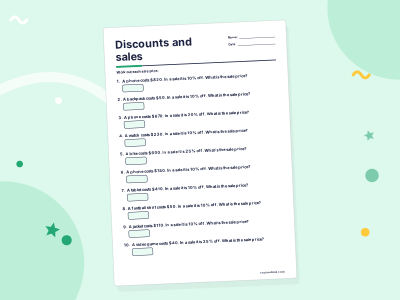
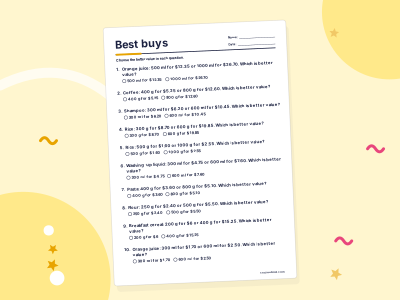
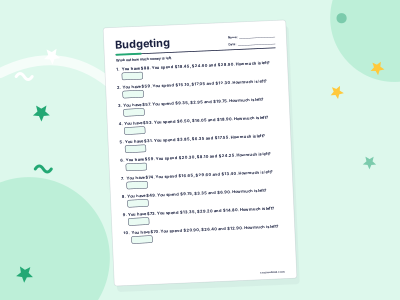
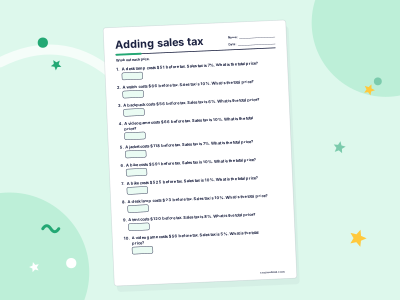
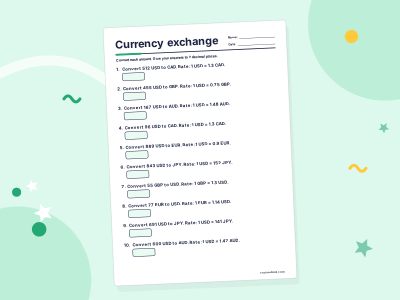
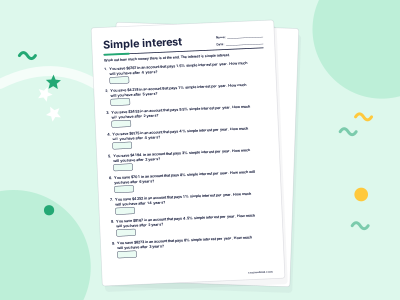
Our money maths worksheets follow the same progression, from recognising coins to working out change.
Money maths to print
On the move
Travel time is full of numbers, and children are a captive audience.
Ages 3–5. Count red cars, or buses, or dogs. Look for numbers on doors, buses and signs. "Our bus is number 12. Can you find a 1 and a 2?"
Ages 5–7. Keep a tally of something: cows, lorries, bridges. Make tally marks in fives. Read bus or train times and ask "How many minutes until it comes?"
Ages 7–11. Use the real trip. "It's 120 kilometres and we're going about 60 kilometres an hour. How long will it take?" Read a timetable to plan which train to catch. Add up number plates, or find the biggest number you can make from the digits. Work out the total cost of a trip for the family.
For more ideas that need nothing but a pencil and the view out of the window, see our guide to travel activities for kids.
Games night
Board and card games are maths practice that children ask for.
- Dice games (ages 3+). Children start by counting every dot, then begin to recognise patterns of dots instantly. That instant recognition, called subitising, is a big step for early number sense.
- Snakes and ladders, ludo and track games (ages 4+). Counting on along a track is exactly how children learn that numbers have an order and a size.
- Dominoes (ages 5+). Matching, counting and early addition when you total the ends.
- Make 10 (ages 5+). Lay out cards face up; take any two that make 10. Number bonds without anyone mentioning number bonds.
- Make 21 (ages 7+). Take turns drawing cards and adding; get as close to 21 as you can without going over. Mental addition at speed, plus a little risk.
- Battleships (ages 7+). Grid references are the start of coordinates.
- Strategy games (ages 6+). Connect Four, draughts and similar games build logical reasoning: "If I go here, what will you do?"
Our printable maths games include board games and bingo cards you can make in five minutes.
 clock
clock bus
bus cake
cake ball
ball
Around the house
Time. Use an analogue clock and talk about it. "When the big hand is on the 6, we'll go." Children aged 5 to 8 need a lot of this before telling the time clicks. Our telling the time pages can back it up.
Sharing fairly. "There are 12 strawberries and 3 of you. How many each?" is division. "Can you cut this into four fair pieces?" is fractions. Our guide to explaining fractions builds on exactly this.
Laundry. Pair socks and count them in twos. Sort by colour or by owner. "How many pairs of socks did Dad lose this week?"
Measuring. Mark heights on a door frame each birthday. Measure toys with a ruler and then estimate before measuring the next one.
Calendars. Count down to holidays. "Your birthday is in 23 days. How many weeks is that, roughly?"
Tidy-up races. "Can you put away 20 things before the timer goes?" It's counting, timing, and a tidier floor.
Three habits that quietly put children off
Correcting too fast. If your 6 year old counts the stairs and says "eleven" when there are twelve, resist jumping in. Say "Let's count them together on the way down" and let them find the difference. A child who spots their own mistake learns more than one who is told.
Always asking, never wondering. If every number conversation starts with you asking a question you already know the answer to, children work out that it's a test. Mix in real puzzles you're genuinely solving: "I'm not sure if we have enough eggs for two cakes. Can you help me check?"
Rushing to the method. Children often find their own ways to solve everyday problems, like counting in fives on their fingers or doubling twice instead of multiplying by four. Ask how they did it before showing yours. Their method might be slower, but it's theirs, and it shows you what they understand.
What to aim for at each age
This isn't a checklist to tick off, just a rough sense of what's typical. Children vary a lot, and school years differ by country.
| Age | Everyday maths to focus on |
|---|---|
| 3–4 | Counting objects one by one, comparing bigger/smaller, simple shapes |
| 4–5 | Counting to 20, recognising numerals, "one more" and "one less" |
| 5–7 | Adding and taking away small numbers, coins, halves and quarters, o'clock and half past |
| 7–9 | Times tables in context, money and change, measuring, telling the time to 5 minutes |
| 9–11 | Budgeting, scaling recipes, timetables, speed and distance, value for money |
For the youngest children, our article on teaching numbers 1 to 20 has more detail on counting, and the early maths collection has gentle printable practice.
Everyday maths this week
- Set the table: one fork, one plate, one cup each
- Estimate, then count, the grapes in a bunch
- Let your child pay for one small thing and check the change
- Bake something and let them read the scales
- Play one dice or card game together
- Count down the days to something exciting
Pick one item from the list and do it today. The aim isn't to turn every moment into a lesson, just to let your child see that numbers are useful, interesting and everywhere.
Common questions
How can I help with maths at home if I'm not confident myself?
You don't need to teach methods. Counting, measuring, estimating and talking about numbers in daily life is exactly what helps, and it's fine to say "Let's work it out together."
Is everyday maths enough, or does my child need worksheets too?
For under-fives, everyday maths and play are enough. Older children benefit from some short written practice as well, but daily-life maths makes that practice make sense.
What is the best everyday activity for maths?
Cooking is hard to beat. It involves counting, measuring, time, fractions and following steps in order, and there is cake at the end.
Crayonbird Editorial Team
Writers, illustrators and educators
We are the small team that writes, draws and tests Crayonbird’s activities. We try every idea with our own printables, keep advice practical and honest about what doesn’t work, and point to official guidance where it matters. Nothing on this blog is sponsored.
Related articles
Maths
Fractions for Kids: How to Explain Them Visually (Ages 6–11)
Explain fractions with sharing, paper fraction walls and number lines, fix the most common misconceptions, and try hands-on fraction activities for ages 6–11.
Ages 6–118 min read
Maths
How to Learn Times Tables: The Best Order, Patterns and Games
The smartest order to learn times tables, patterns that cut the work in half, games, spaced practice and what the UK Year 4 multiplication check involves.
Ages 6–118 min read
Maths
Mental Maths Strategies for Kids: Partitioning, Bridging and More
Five mental maths strategies every child should know, with worked examples: partitioning, bridging through 10, compensation, doubling and halving.
Ages 6–118 min read