Screen-Free Activities for Kids: Ideas by Age and Situation
Practical screen-free activities for ages 3–12, sorted by situation: waiting, quiet time, rainy days, trips and "I'm bored", plus an honest note on screens.
On this page
Most screen time doesn't happen because parents planned it. It happens at 5.30pm when dinner is late, in a waiting room when the appointment is running 40 minutes behind, or on the third wet afternoon of half-term. The trick to using screens less isn't willpower. It's having something else ready for exactly those moments. This guide is organised by situation, with ideas for different ages and a few printables that make the easy option a screen-free one.
A quick, honest word about screens
Screens aren't the enemy. A video call with grandparents, a nature documentary watched together or a well-designed learning game can all be good uses of time. Most families use screens, and most children turn out fine.
For young children, there is clear guidance. The World Health Organization's guidelines for under-fives recommend no sedentary screen time for babies and one-year-olds, and no more than one hour a day for two to four year olds, with less being better. For older children there's no single magic number; most advice focuses on whether screens are pushing out sleep, physical activity, homework and time together.
So the aim here isn't zero screens. It's having enough good alternatives that screens become a choice rather than the default. If you have concerns about your own child's screen habits, sleep or behaviour, your doctor or health visitor is a good person to talk to.
When you're waiting (5 to 20 minutes, no mess)
Doctor's surgeries, restaurants, queues, siblings' swimming lessons. You need things that are quiet, fit in a bag and involve no glitter.
No materials at all:
- I spy, with colours for toddlers ("something red") and first sounds for older children ("something beginning with /t/").
- 20 questions. Think of an animal; your child asks yes/no questions to guess it. Works from about five upwards.
- Finger stories. Your hand is a character. Make it walk up your child's arm, get lost, find its way home.
- The alphabet game. Take turns naming a food (or animal, or country) for each letter of the alphabet. Older children can make it harder by adding a rule: only fruit.
- What's different? Your child closes their eyes while you change one thing (take off a hairband, swap your rings). They spot it.
In a small bag:
- a little notebook and two pencils;
- a pocket-sized activity book or a few folded puzzle pages (mazes, spot the difference, word searches);
- a mini whiteboard for noughts and crosses and hangman;
- a few stickers and a small sticker book for younger children.
 pencil
 notebook
 crayon
 puzzle
Quiet time (30 to 60 minutes, independent)
Many children who've dropped their nap still benefit from a quiet hour in the afternoon, and parents definitely do. The key is that quiet time is independent: your child does it alone, in their room or a calm corner.
A quiet-time box works well. Fill it with five or six things, rotate them weekly, and bring the box out only at quiet time.
- Ages 3–5: board books and picture books, a simple jigsaw, a colouring page and crayons, a set of animal figures, a magnetic drawing board.
- Ages 6–8: chapter books or comics, a sticker mosaic, a puzzle book, a set of building bricks, story cards to make up their own tales.
- Ages 9–12: a longer novel, a sketchbook with a step-by-step drawing lesson, logic puzzles, a craft kit, an audiobook (screen-free if it's on a dedicated player or a speaker with no video).
Start with 15 minutes and build up. Use a simple timer or a sand timer so your child knows when it ends. Our guide to quiet time activities has a fuller list and a gentle way to introduce the routine.
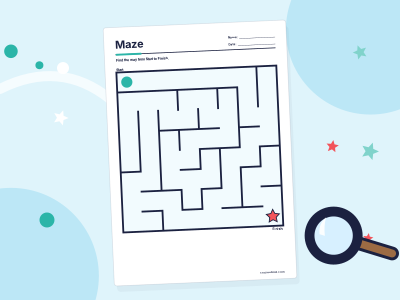
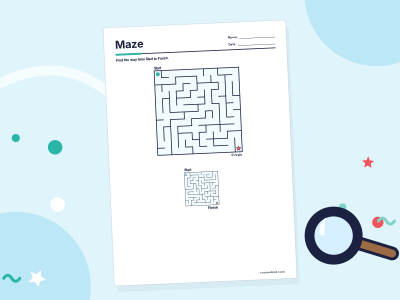
Printable puzzles for quiet time
Rainy days with energy to burn
The problem with rainy days isn't boredom, it's energy with nowhere to go. Start with something physical, then move to something calmer.
Burn off some energy first:
- Indoor obstacle course. Cushions to jump on, a table to crawl under, a chair to go round, a line of tape to walk along. Time each run.
- Animal moves. Bear walks, frog jumps, crab walks, flamingo balances. Shout an animal; everyone moves like it.
- Sock basketball. Rolled-up socks thrown into a laundry basket. Keep score on paper for some sneaky maths.
- Dance freeze. Music on, dance; music off, freeze.
Then settle down with something creative:
- Den building. Sheets over chairs, cushions, a torch. Read books inside it afterwards.
- Junk modelling. Cereal boxes, kitchen roll tubes, tape and glue. Build a robot, a rocket or a castle.
- Kitchen science. Mix bicarbonate of soda and vinegar in a tray and watch it fizz. See what floats and what sinks in the sink.
- Baking. Counting, measuring, stirring, waiting and eating. Pretty much a full curriculum.
We've got a whole article of rainy-day activities if you want more.

Trips by car, train or plane
Long stretches of sitting still are tough for everyone. Plan a mix of talking games, printables and a few surprises.
- Number plate games. Spot the numbers 1 to 20 in order on passing plates. Or make silly phrases from the letters: KDF becomes "kangaroos dance fast".
- Pack an activity folder. A clipboard, a pencil case and a few printables: mazes, colouring, dot-to-dots, i-spy pages. A clipboard makes a car seat into a desk.
- Wrapped surprises. Wrap a few small, cheap items (a new pencil, a sticker sheet, a mini puzzle book) and hand one out every hour.
- Story chain. One person starts a story with a sentence; the next adds one. It always ends up somewhere strange.
- Audiobooks and music. Not a screen, and a long story can carry you through an hour or more.
Our i-spy printables are perfect for trips, and the travel activities article has plenty more ideas by type of trip.
Ideas by age at a glance
| Age | Great screen-free options |
|---|---|
| 3–4 | Play-dough, stickers, simple jigsaws, colouring with chunky crayons, water play, picture books, dressing up |
| 5–6 | Mazes and simple puzzles, step-by-step drawing, building bricks, board games, scavenger hunts, baking |
| 7–8 | Chapter books, comics, craft kits, card games, logic puzzles, writing and illustrating their own stories |
| 9–10 | Model kits, longer novels, origami, cooking a simple meal, word searches and crosswords |
| 11–12 | Sketching, journalling, more complex puzzles, learning a card trick, helping plan a family outing |

When they say "I'm bored"
"I'm bored" is one of the most common things children say, and it's not an emergency. A little boredom is normal, and often the most creative play comes just after it.
Some phrases that help:
- "That's okay. Boredom often turns into a good idea." Calm, matter-of-fact, no rescue.
- "Do you want to choose from the jar?" A jar of ideas written on paper slips (build a den, write a letter to grandma, draw a monster, make a paper plane) gives choice without you having to come up with something.
- "Can you help me?" Peeling vegetables, sorting the recycling, watering plants. Children often find real jobs more interesting than suggested games.
- "What would you do if screens didn't exist?" Older children sometimes enjoy the challenge.
If you'd like a stack of ready-made ideas, our collection of screen-free activities includes printables sorted by age and time needed.
Making the switch without battles
If screens have become the default for a particular time of day, a sudden ban often leads to resistance. A gentler switch tends to work better.
- Pick one moment. Choose a single time when screens happen by habit, such as the after-school hour or the wait for dinner.
- Put something better in its place. Have the replacement ready before the moment arrives: a snack and a colouring page, a board game, a book.
- Join in at first. Ten minutes of your attention makes a new activity much more appealing than a screen.
- Keep screens for later, not never. "We'll watch your programme after dinner" works better than "No more TV."
- Notice what works. Some children love building, some love drawing, some just want to be outside. Lean into what your child chooses.
The hour before dinner
For many families this is the hardest stretch of the day: children are tired and hungry, and you're trying to cook. It's also when the television most often goes on. A few options that work while you're busy:
- Bring them into the kitchen. A stool at the counter and a small job: washing potatoes, tearing herbs, setting the table, counting out cutlery. Younger children can "cook" play-dough beside you with a spare pan.
- A kitchen-table activity. A colouring page, a maze or a sticker scene that's only for this time of day. Keep a small pile in a drawer near the cooker.
- Something to listen to. An audiobook or a story podcast gives tired children something to settle into without a screen.
- A small snack at 5pm. Not glamorous, but a few slices of apple or a cracker often prevent the meltdown that leads to the remote control.
Choose one and stick with it for a fortnight before judging whether it works. New routines usually feel awkward for the first few days.
Tonight, fill a small bag with a notebook, two pencils and three puzzle pages and leave it by the front door. The next time you're stuck waiting, you'll have something better than a phone to hand over.
Browse screen-free printables
Common questions
How much screen time is recommended for young children?
The World Health Organization recommends no sedentary screen time for babies and one-year-olds, and no more than one hour a day for children aged two to four, with less being better. For older children there is no single figure; most guidance focuses on protecting sleep, activity and family time.
What can I do with my child instead of screens?
Have a few ready-made options for the situations where screens usually appear, such as a waiting bag, a quiet-time box and a rainy-day list. Most screen use happens because nothing else is ready at that moment.
How do I handle "I'm bored"?
Acknowledge it calmly and offer two or three choices rather than solving it for them. A little boredom is normal and often leads to children inventing their own games.
Printables used in this article
Crayonbird Editorial Team
Writers, illustrators and educators
We are the small team that writes, draws and tests Crayonbird’s activities. We try every idea with our own printables, keep advice practical and honest about what doesn’t work, and point to official guidance where it matters. Nothing on this blog is sponsored.
Related articles
Parenting and learning
Quiet Time Activities and Busy Bags for Ages 3–8: A Setup Guide
How to set up daily quiet time for 3–8 year olds after naps stop, with busy bag ideas, independent activities, rotation tips and fixes when it isn’t working.
Ages 3–87 min read
Parenting and learning
A Realistic Daily Learning Routine for Preschoolers (15–20 Minutes)
A realistic 15–20 minute daily learning routine for 3–5 year olds at home, with a sample week plan, what to do in each block and how to keep it going.
Ages 3–58 min read
Parenting and learning
Homeschool Schedule for Beginners: Sample Days and Weeks by Age
Realistic homeschool schedules for ages 4–14, with sample days, a weekly rhythm, tips for teaching siblings, and a reminder to check the rules where you live.
Ages 4–148 min read