How to Teach Letter Sounds at Home: A 10-Minute Phonics Routine
A calm 10-minute daily routine for teaching letter sounds to 3–5 year olds at home, with games, what to say, and what to do when the sounds won't stick.
On this page
Teaching letter sounds at home sounds simple until you try it with a three-year-old who would rather be a dinosaur. The good news is that the work fits into ten minutes a day, needs almost no equipment, and goes far better when it feels like a game than a lesson. Here is what to teach, in what order, exactly what to say, and what to try when it isn't sticking.
What "knowing letter sounds" actually means
There are two skills hiding under the word "phonics", and they develop at different speeds.
The first is hearing sounds in spoken words. Can your child tell you that sun starts with /s/? Can they hear that dog and log rhyme? This is all done with ears and mouths, no letters at all.
The second is linking a sound to a written shape: seeing m and saying /m/. Both matter, but the listening skill is the foundation. A child who can't yet hear the /s/ at the start of sock will find the letter s a meaningless squiggle, however many times you point at it.
So if your child is three, or if earlier attempts ended in tears, spend a week or two on listening games before showing a single letter.
Pure sounds, not "buh" and "muh"
How you say each sound matters more than most parents expect. Try to say them "pure", without an extra uh on the end.
- Stretchy sounds can be held for as long as you like: mmm, sss, fff, lll, nnn, rrr, zzz. Hold them for a second or two.
- Bouncy sounds can't be stretched, so keep them short and crisp: /b/, /d/, /g/, /p/, /t/, /k/. Whisper them if the uh keeps creeping in. A whispered /t/ is almost impossible to say as "tuh".
Why bother? Because later, when your child blends sounds into a word, "muh-a-tuh" doesn't sound like mat. "Mmm-a-t" does.
 sun
sun sock
sock snake
snake star
star
Tune the ear first: three listening games
These need nothing but you and a few minutes, so they suit the car, the bath or the queue at the shop.
I spy with sounds. Swap the usual "something beginning with ess" for the sound: "I spy with my little eye something that starts with /mmm/." Give a strong hint at first ("it's on the table and you drink from it", mug). Then let your child have a turn at being the spy.
Robot talk. Talk like a slow robot, splitting a word into sounds, and your child says the whole word. "Touch your h-ea-d." "Where is your n-o-se?" "Can you find the b-a-g?" This is oral blending, and it is the skill that turns letter knowledge into reading later. Start with three-sound words and give lots of help.
Silly rhymes. "Cat, hat, mat, zat!" Made-up words are allowed. Ask: "Does fish rhyme with dish? Does fish rhyme with cake?" Children usually find hearing rhymes easier than producing them, so ask the yes/no version first.
Once your child can play robot talk with short words and spot the first sound in a few words, they are ready to meet letters.
Which letters to teach first (hint: not A, B, C)
Alphabetical order is fine for a song, but it is a poor teaching order. Many phonics programmes start with a small group of very useful letters that combine into dozens of real words straight away. In England, schools follow a systematic synthetic phonics programme, and a common first set is s, a, t, p, i, n. You can read about how those programmes are chosen in the UK government's guidance on phonics teaching programmes.
| Week | New sounds | Words you can already make |
|---|---|---|
| 1 | s, a | as (and lots of listening games) |
| 2 | t, p | sat, pat, tap, at, sap |
| 3 | i, n | sit, pin, tin, nap, pan, tip, ant |
| 4 | m, d | mat, dad, map, dip, mad, and |
| 5 | g, o | dog, got, pot, nod, top, on |
| 6 | c, k | cat, cot, kit, can, cap, kid |
Two new sounds a week is a gentle pace for a four-year-old. Some children go faster; some need three weeks on the first set. Both are fine. The whole point of a short, useful set is that by week three your child can read a real word, and reading a real word is hugely motivating.
If your child's school uses a different order, follow the school. Consistency beats any perfect plan.
The 10-minute routine
Same time, same place, same order, nearly every day. Predictability is what makes it short. Just after breakfast or straight after a snack tend to work better than late afternoon.
Step by step
- Sing the old sounds (2 minutes)Point at the letter cards you've already learned and say each sound together, with an action if your programme uses them (a snake hand for /s/, tapping your head for /t/).
- Meet the new sound (2 minutes)Show the letter, say the sound three times, and trace the shape in the air with a big arm, then on your child's back with one finger.
- Hunt it (2 minutes)Find two things in the room that start with the sound. You can hide a toy or two in advance to make sure the hunt succeeds.
- Write it (2 minutes)One or two letters in a tray of salt or flour, or one row on a tracing page. Stop there.
- Read or blend it (2 minutes)Lay out two or three letter cards and blend them into a word together. Finish on a success, even if you had to do most of it.
Here is roughly what step 2 sounds like in practice:
"This is a new one. It says /p/. Can you say /p/? Put your hand in front of your mouth: /p/. Feel the puff? Let's draw it in the air: down, up, and round."
Use the same short script every time you introduce a new letter. After a few weeks your child will start saying it with you, which is exactly the point.
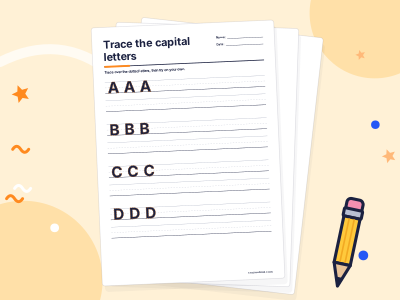
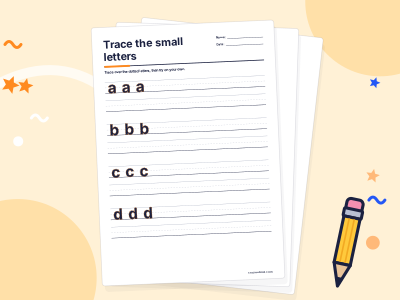
For the writing step, short and chunky is better than a full worksheet. A single row on one of our letter tracing pages is plenty at this age. If pencil control is still very shaky, our guide to pre-writing skills explains what to practise first.
Games that make sounds stick
Rotate these so the routine doesn't go stale. Swap one into step 3 or step 5 each day.
- Sound basket. Put five objects in a basket, three starting with the sound of the week (sock, spoon, sticker) and two that don't (cup, ball). Your child sorts them into "yes" and "no".
- Post it. Cut a slot in a cereal box. Say a sound; your child finds the matching card and posts it. Keeps hands busy and attention up.
- Splat. Lay four letter cards on the floor. Say a sound; your child splats it with a fly swatter or a flat hand. Ridiculous, effective, loud.
- Treasure word. Hide three letter cards around the room that spell a word. Once all three are found, blend them: p-i-n, pin.
- Colour by sound. On a colouring page, colour everything that starts with /s/ in green and /t/ in red. Say each word out loud as you go. Many of our phonics worksheets work the same way.
- Wrong-sound puppet. A puppet "reads" words and makes mistakes ("This says dop!"). Your child corrects it. Children love catching an adult out.

Printable letter sound and tracing pages
When it isn't sticking
Every child hits a patch where the sounds seem to fall straight out of their head. Here are the common sticking points and what tends to help.
"They knew it yesterday." Completely normal. A sound isn't secure until your child has met it on several separate days. Keep yesterday's letters in the review pile for a week before trusting them.
They mix up b and d (or p and q). Expected at four and five, and often at six. Teach the two letters in different weeks rather than side by side, and give each a different "hook": for b, "bat then ball" (the line first, then the round part).
They add "uh" to every sound. Whisper the bouncy sounds together for a week. Whispering takes the voice away, and the uh goes with it.
They can say the sounds but can't blend. Go back to robot talk with no letters at all, and make the gap between sounds tiny: mmmaaat rather than m... a... t. Stretchy sounds blend most easily, so try words like sun, man and fan before bat or dog.
They refuse to sit down at all. Drop the routine for a few days and play only the listening games, on the move. Then come back with a shorter version: three steps instead of five. A five-minute session that happens is better than a ten-minute one that becomes a battle.
Nothing has changed after several months. Some children need more time, and that alone is no cause for alarm at three or four. If your child also struggles to hear rhymes, has had frequent ear infections or speech that is hard to understand, mention it to your nursery, health visitor or doctor. A hearing check is a sensible first step.
Little ways to keep sounds in daily life
The ten-minute slot does the teaching. Everyday talk does the remembering.
- Point out the first sound of your child's name on cereal boxes, signs and number plates.
- When reading a picture book, pause on one big, clear word and sound out the first letter together. A rhythmic book such as Boom, Boom, Awa's Drum is perfect for this.
- In the bath, stick foam letters on the side and ask your child to find "the one that says /a/".
- At dinner, play "I'm thinking of a food that starts with /p/": pasta, peas, potato.
If you're also wondering how phonics fits with the short list of "tricky" words children get sent home with, we've written about sight words versus phonics. And if you'd like letter sounds to sit inside a wider plan, see our daily learning routine for preschoolers.
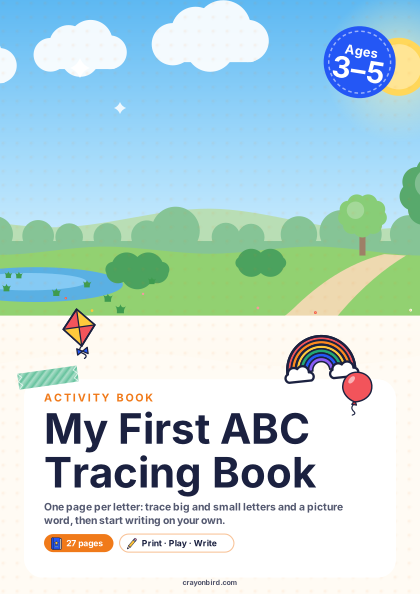
Activity bookAges 3–5
One page per letter: trace big and small letters and a picture word, then start writing on your own.
See what’s insidePick your first two sounds tonight, write them on cards, and play one round of robot talk tomorrow before breakfast. That's the whole first step.
Print free phonics pages
Common questions
At what age should I start teaching letter sounds?
Many children are ready to enjoy simple sound games around three, and to link sounds to letters somewhere between three and a half and five. Listening games come first; letters can wait until your child can hear the first sound in a word.
Should I teach capital letters or lowercase first?
Lowercase. Almost everything your child will read is printed in lowercase, so teach the sound with the small letter and let capitals come later through names and signs.
My child knows all the letter names. Is that a problem?
Not at all. Just add the sound to each name you already use, for example "that's m, it says mmm". Over time, put the sound first.
How do I know if my child is ready to read words?
When your child knows five or six sounds and can blend sounds you say aloud (you say c-a-t, they say cat), try reading a tiny word together with letter cards.
Printables used in this article
Crayonbird Editorial Team
Writers, illustrators and educators
We are the small team that writes, draws and tests Crayonbird’s activities. We try every idea with our own printables, keep advice practical and honest about what doesn’t work, and point to official guidance where it matters. Nothing on this blog is sponsored.
Related articles
Early learning
25 Fine-Motor Activities for Kids, by Age (Using Things You Already Have)
25 everyday fine-motor activities for ages 2–7, sorted by age, using kitchen items, play-dough, pegs and paper, plus signs it's worth asking a professional.
Ages 2–78 min read

Early learning
Kindergarten Readiness Checklist: What Really Matters for Starting School
A practical school readiness checklist for 4–5 year olds: independence, attention, friendships, early reading and maths, plus school start ages worldwide.
Ages 4–58 min read

Reading and writing
Sight Words vs Phonics: How Tricky Words Fit with Learning to Read
What sight words, high-frequency words and tricky words really are, how they fit with systematic phonics, how countries differ, and practice ideas that work.
Ages 4–78 min read