Kindergarten Readiness Checklist: What Really Matters for Starting School
A practical school readiness checklist for 4–5 year olds: independence, attention, friendships, early reading and maths, plus school start ages worldwide.
On this page
Ask a room of parents what a child needs for starting school and you'll hear "knows the alphabet" and "can count to 100". Ask a room of reception and kindergarten teachers and you'll hear something very different: "can put on their own coat", "can wait their turn", "tells me when they need the toilet". This checklist is built around what teachers actually say, with the academic bits in their proper, rather smaller, place.
School starts at very different ages
Before the checklist, a quick reality check: "starting school" means different things in different countries, and a child in their first class may be anywhere from four to seven.
| Country | First year of school | Usual starting age |
|---|---|---|
| England | Reception | Most start in the September after their 4th birthday |
| United States | Kindergarten | Usually 5 (cut-off dates vary by state) |
| France | École maternelle, then CP | Instruction compulsory from 3; formal reading in CP at about 6 |
| Australia | Foundation year (name varies by state) | Around 5 |
| Germany | Grundschule, class 1 | Around 6 |
| India | Class 1 | 6, under the National Education Policy 2020 guidelines |
| Nigeria | Primary 1 | Around 6, often after nursery or kindergarten |
In England, children don't legally have to be in school until the term after their fifth birthday, though most start Reception earlier. The UK government's page on school starting age sets out the rules. In France, instruction has been compulsory from age three since 2019, as explained by the French education ministry.
The point for parents: the four-year-old starting Reception in England and the six-year-old starting class 1 in Germany are not expected to arrive with the same skills. Read the checklist for your child's age, not someone else's.
Independence comes first
A class of 25 or 30 young children has one teacher and, if they're lucky, an assistant. Every child who can manage their own coat frees up a minute. Multiply that by thirty coats, four times a day, and you can see why teachers care.
The skills that matter most:
- Toileting. Going alone, wiping, flushing, pulling clothes back up and washing hands. Accidents in the first weeks are common and teachers expect them, but a child who can mostly manage is far more relaxed.
- Coats and shoes. Getting a coat on (the "flip trick" works for many: lay the coat on the floor upside down, put arms in the sleeves and flip it over the head), and shoes with Velcro or easy buckles. Laces can wait.
- Lunch. Opening a lunchbox, a yoghurt pot, a banana and a water bottle. Practise with the actual containers they'll take.
- Belongings. Recognising their own bag and water bottle, and putting things back in them.
The quickest way to build these is simply to stop doing them for your child, a few weeks before school starts. It will take longer in the mornings at first. Leave ten extra minutes.
 coat
coat shoe
shoe backpack
 cup
cup
Listening and attention
School asks children to listen to an adult who is also talking to 29 other children. That is a big step from home, where most instructions come with eye contact and their own name.
Things that help:
- Two-step instructions. At home, practise "Put your cup in the sink, then fetch your shoes." Build up to three steps if that goes well.
- Sitting for a story. Most first-year classes have a carpet time of ten minutes or so. A daily picture book at home is ideal practice.
- Stop-and-go games. Musical statues, "Simon says" and "red light, green light" build the ability to stop when asked, which is the self-control teachers value most.
- Finishing something small. A short jigsaw, a colouring page or a building, finished before moving on.
It's completely normal for four-year-olds to fidget, drift off and call out. Teachers aren't expecting stillness. They're hoping for a child who can come back when called.
Getting on with other children
Social skills often matter more to a child's happiness at school than anything academic. You can't teach friendship directly, but you can practise the pieces.
- Taking turns. Board games with simple rules are perfect: snakes and ladders, a matching game, a simple dice race.
- Asking to join in. Rehearse the words: "Can I play too?" and what to do if someone says no ("Okay, I'll ask someone else").
- Saying what they need. "I need help", "I don't like that", "Can I have a turn?" Children who can say these to an adult at school cope far better.
- Separating. If your child hasn't spent much time away from you, short stays with a grandparent, a friend or a playgroup in the months before school help a lot.
Picture books about first days give children words for their worries. Try Mateo's First Day and talk about how Mateo feels at the start and the end.

Early reading and writing: less than you might think
You don't need to teach your child to read before school. Schools teach reading from the start, often using a particular phonics programme, and arriving with different habits can sometimes cause confusion.
What genuinely helps:
- Enjoying books. Being read to every day, choosing favourites and talking about the pictures.
- Hearing sounds in words. Spotting rhymes (cat, hat), and hearing the first sound in their name. Our guide to teaching letter sounds at home has games for this.
- Recognising their own name. On a peg, a drawer label or a lunchbox.
- Holding a crayon and making marks. Drawing, colouring, early attempts at their name. Neatness doesn't matter. If grip and control are still very early, see our pre-writing skills guide.
Early maths: understanding beats reciting
Counting to 100 is impressive at a party, but it tells you little about number understanding. These are the things that give children a real head start:
- Counting a small group accurately, touching each object once: "one, two, three, four... four buttons!"
- Recognising small groups without counting, such as the dots on a dice up to three or four.
- Comparing: which pile has more, which tower is taller, which bag is heavier.
- Simple shapes: circle, square, triangle, and spotting them in the world.
- Number words in daily life: "we need two more plates", "you're three, your brother is five".
Our article on teaching numbers 1 to 20 explains how to build that understanding with games.
The checklist
Print this, tick what's already secure, and pick two or three things to work on. No child ticks everything.
Ready for school: what to practise
- Uses the toilet alone and washes hands afterwards
- Puts on a coat and shoes with little help
- Opens a lunchbox, water bottle and simple snack packets
- Recognises their own name written down
- Follows a two-step instruction
- Sits and listens to a short story
- Takes turns in a simple game
- Asks an adult for help using words
- Says goodbye to a parent without long distress (or recovers quickly)
- Counts a small group of objects accurately
- Holds a crayon or pencil and enjoys drawing
- Tidies up toys when asked
Gentle practice pages for the summer before school
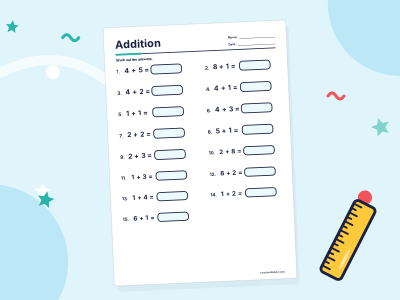
You'll also find more in our back-to-school activities and the School Start pack, which mixes first-day colouring with counting and name practice.
If your child isn't ticking many boxes
That's common, and in most cases it simply reflects age. A child born at the end of the school year can be almost a full year younger than the oldest in the class, and at four that is a quarter of their life. Teachers know this and plan for it.
Some practical steps:
- Focus on independence first. It makes the biggest difference to how settled a child feels.
- Talk to the nursery or preschool. They see your child with other children and will often have useful observations.
- Tell the school. A short note about anything your child finds hard (separation, toileting, noise) helps the teacher prepare.
- Ask about options. Some regions allow a delayed or part-time start. Rules differ, so check locally.
- Get advice if you're worried about development. If you have concerns about speech, hearing, movement or behaviour, speak to your health visitor, doctor or nursery's special educational needs coordinator. Earlier support is easier support.
What the first weeks are really like
Even a child who ticks every box can find the first half-term exhausting. School is loud, busy and full of new rules, and many children hold it together all day and fall apart the minute they see you. Tears at the gate, meltdowns at teatime and a sudden return to baby talk are all common in the first few weeks, and they usually pass.
What helps most is boring and predictable: an early bedtime, a snack waiting at pick-up, and not too many questions straight away. "How was school?" often gets "fine" or silence. Try something specific later on, at bath time or in the car: "Who did you sit next to at lunch?" or "What was the funniest thing that happened today?" Keep weekends quiet for the first month if you can.
If the upset is still intense after six weeks or so, or your child is very anxious about going in, ask the teacher for a quick chat. They will have seen it many times before.
Pick one independence skill from the checklist this week, the coat or the lunchbox, and hand it over to your child completely. That single change will matter more on day one than any worksheet.
Explore back-to-school printables
Common questions
Does my child need to read before starting school?
No. Schools teach reading from the beginning. It helps far more if your child enjoys stories, can listen for a few minutes and can hear sounds and rhymes in spoken words.
What is the most important skill for starting school?
Teachers most often mention independence - going to the toilet alone, managing a coat and shoes, opening a lunchbox - followed by being able to wait, take turns and ask for help.
Can I delay my child's school start?
Rules vary by country and region. In England, a summer-born child can start later than September, and families can request a Reception place the following year, though the school or council does not have to agree. Check your local education authority's rules.
My child can't do everything on this list. Should I worry?
Almost no four-year-old can. Use the list to choose one or two things to practise over the summer. If you have broader concerns about development, talk to your nursery, health visitor or doctor.
Crayonbird Editorial Team
Writers, illustrators and educators
We are the small team that writes, draws and tests Crayonbird’s activities. We try every idea with our own printables, keep advice practical and honest about what doesn’t work, and point to official guidance where it matters. Nothing on this blog is sponsored.
Related articles
Early learning
How to Teach Letter Sounds at Home: A 10-Minute Phonics Routine
A calm 10-minute daily routine for teaching letter sounds to 3–5 year olds at home, with games, what to say, and what to do when the sounds won't stick.
Ages 3–58 min read
Early learning
25 Fine-Motor Activities for Kids, by Age (Using Things You Already Have)
25 everyday fine-motor activities for ages 2–7, sorted by age, using kitchen items, play-dough, pegs and paper, plus signs it's worth asking a professional.
Ages 2–78 min read
Maths
Teaching Numbers 1 to 20: Building Real Number Sense in 3–6 Year Olds
How to teach numbers 1 to 20 so children understand quantity, not just recite: counting principles, subitising, number bonds, the tricky teens and games.
Ages 3–68 min read