Sight Words vs Phonics: How Tricky Words Fit with Learning to Read
What sight words, high-frequency words and tricky words really are, how they fit with systematic phonics, how countries differ, and practice ideas that work.
On this page
Every few weeks a new list comes home in a book bag: the, said, was, you, they, my. Some parents are told these are "sight words" to memorise. Others hear they're "tricky words" to be taught through phonics. If you've ever wondered which approach is right, and whether drilling flashcards helps or harms, you're not alone. This article explains what these words are, how they fit with phonics, how practice differs around the world, and how to help at home without undoing the good work happening at school.
Three labels for overlapping lists
Part of the confusion is that the same words get different names, and the same name means different things.
High-frequency words are simply the words that turn up most often in books: the, and, a, to, said, in, he, I, of, it, was, you. A small number of these words make up a large share of everything children read. That's why teachers care about them.
Tricky words (called common exception words in England's national curriculum) are common words that don't follow the phonics a child has learned so far. The, said, was, you, one, come and some are classic examples.
Sight words is the slipperiest term. Some people use it to mean "words to memorise as a whole" (often from long published lists). Reading researchers often use it differently: any word a reader recognises instantly, without needing to sound it out. In that sense, every word you're reading right now is a sight word for you, and you got there mostly by decoding each one a few times until it stuck.
That second meaning is the important one. The goal isn't to memorise words by shape. It's to read words so often, and connect their letters and sounds so firmly, that they become automatic.
Most "sight words" can be sounded out
Here's the part that surprises many parents: plenty of the words on high-frequency lists are completely regular.
| Fully decodable | Mostly decodable, one tricky bit | Genuinely unusual |
|---|---|---|
| and, it, in, can, big, had, him, not, got, up, get, but | said (ai says /e/), was (a says /o/), of (f says /v/), to (o says /oo/), he, she, we, me (the e says /ee/, not the /e/ children learn first), the (the e is a quick /uh/ or /ee/) | one, once, eye |
The first column needs no special treatment at all. A child who knows the letter sounds can read it, and and can by blending, and should. Teaching them as shapes to memorise wastes the phonics your child already has.
The middle column is where most "tricky" words actually live. Only one part is unusual. In said, the /s/ and /d/ are perfectly regular; only the ai in the middle is odd. So you teach that one odd bit, not the whole word as a picture.
The last column is small. These are words worth simply remembering, and there are fewer of them than most lists suggest.
 pig
pig hen
hen bus
bus cup
cup
How it's done in England
In England, the Department for Education expects schools to teach reading through systematic synthetic phonics (SSP). Children are taught letter sounds in a planned order and how to blend them into words from the start of Reception. Schools choose a programme from a list validated by the government, and the expectation is that they follow it closely. The DfE's reading framework sets out this approach in detail.
Within SSP, tricky words aren't ignored. They're taught in a set order, a few at a time, alongside the sounds. Teachers typically point out which part of a word is regular and which part is "the tricky bit", and children practise reading and spelling them in short daily sessions. Over time, as children learn more spellings, some words stop being tricky: he and she become regular once children learn that e can make an /ee/ sound.
Children in Year 1 in England take a short phonics screening check, reading a list of real words and made-up "alien" words aloud. The made-up words exist precisely to see whether children can decode, rather than relying on memorised words.
How it's done elsewhere
Approaches differ, and it's worth being fair about this.
In the United States, the Common Core kindergarten standards, used in many states, include reading "common high-frequency words by sight" (examples given are the, of, to, you, she, my, is, are, do, does) alongside phonics and word-analysis skills. Many classrooms have used published high-frequency lists. In recent years many US states and districts have moved towards more structured, phonics-first teaching, and the idea of teaching high-frequency words by connecting their letters and sounds, often called "heart words", has spread widely.
In Australia, Canada, Ireland and elsewhere in the English-speaking world, practice varies by region and school, with a general shift towards explicit, systematic phonics.
In languages with very regular spelling, such as Spanish, Italian, Finnish or Indonesian, the "tricky words" issue barely exists. Once children know the letter sounds, they can read almost anything. That's why children in those countries often decode fluently quite quickly. English, with its irregular spelling history, simply takes longer.
In multilingual homes (very common in Nigeria, India and much of the Arab world), children may be learning to read in more than one script at once. Keeping the approaches clear and separate for each language helps.
Whatever system your child's school uses, follow its lead at home. Consistency matters more than which list is "best".
Teaching a tricky word in two minutes
Here's a simple routine for one new tricky word, using said as the example.
Step by step
- Say it and use it"This word is said. 'Mum said it's time for lunch.' Can you say a sentence with said?"
- Sound it outPoint to each part: /s/ ... /e/ ... /d/. "Which letters are making each sound?"
- Spot the tricky bit"The /s/ and /d/ are just what we'd expect. The /e/ is spelled ai here. That's the tricky bit." Draw a small heart over ai to show it's the part to learn by heart.
- Read it three waysOn its own, in a short phrase ("he said"), then in a sentence.
- Write itYour child writes said from memory, saying the sounds as they write. Check the tricky bit together.
That's it. Come back to the word briefly on the next three or four days. Once it's read instantly on several separate days, it can leave the practice pile.
Why drilling long lists by shape goes wrong
Long lists of words learned as whole shapes can seem to work at first. A child memorises 50 words and reads early books smoothly. Then the books get harder and the strategy collapses, because nobody can memorise thousands of words as pictures.
Common warning signs:
- Guessing from the first letter. Reading house as horse or home, because they look roughly similar.
- Guessing from the picture. Saying pony when the word is horse, because there's a picture of one.
- Getting stuck on new words with no way to work them out.
- Spelling that doesn't follow sounds, such as random letters for words they "know".
If you see these, steer gently back to sounding out. "Let's check: look at all the letters. What sounds do they make?" Praise careful decoding, even when it's slow. Speed comes with practice.
Flashcards aren't the problem in themselves; it's how they're used. Short, cheerful flashcard games with a small number of words, where the child looks at every letter, are fine. Our guide to using flashcards properly has more on that.
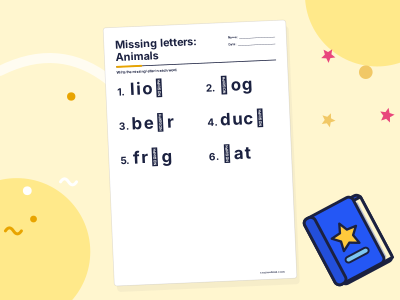
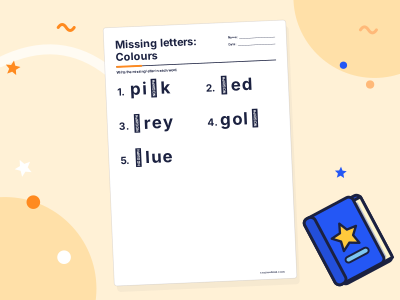
Phonics and word-building practice pages
Practice ideas that work
Short, frequent and varied: three or four minutes a day beats a long weekly session.
- Word hunt. Pick one tricky word and hunt for it in a picture book. Count how many times said appears.
- Splat it. Write five current words on sticky notes on the wall. Say one; your child splats it with a hand or a fly swatter.
- Rainbow writing. Write the word in pencil, then trace over it three times in different colours, saying the sounds each time.
- Silly sentences. Make up sentences using two or three tricky words: "The dog said he was a cat." The sillier the better.
- Sound buttons. Under a word, draw a dot for each single-letter sound and a line for each two-letter sound. For said: dot (s), line (ai), dot (d). Then read it by touching each button.
- Real books. Decodable books from school are designed to use only the sounds and tricky words your child has learned so far. Reading them proudly, again and again, is excellent practice.
Our sight words collection is grouped into small sets in a sensible order, and the Sight Words 1 pack gathers the first set into games and short reading practice. If your child is still securing the basic sounds, start with our guide to teaching letter sounds at home.

Putting it all together at home
The balance for most families looks like this. Phonics does the heavy lifting: letter sounds, blending, segmenting for spelling. Tricky words are a small extra, taught a few at a time with the tricky bit pointed out, not memorised as shapes. And lots of reading together, from decodable books to bedtime stories, gives every word the repetition it needs to become automatic.
Once your child is reading words confidently, the next step is understanding what they read. Our article on reading comprehension strategies picks up from there.
Ask your child's teacher which three tricky words the class is working on this week, write them on sticky notes, and play splat for two minutes after school. It's a small, cheerful habit that pays off for years.
Print free phonics worksheets
Common questions
Are sight words and tricky words the same thing?
Not quite. High-frequency words are simply the most common words in print. Tricky words, called common exception words in England, are common words with a spelling that doesn't follow the phonics a child has learned so far. Sight words can mean either, depending on who is using the term.
Should my child memorise a list of sight words?
Learning to read common words quickly is useful, but most of them can be sounded out. Teach children to decode the regular parts and remember only the unusual part, rather than memorising the whole word as a shape.
How many tricky words should a child learn at once?
Two or three at a time is plenty for four and five year olds. Add new ones when the current words are read instantly on several different days.
Why does my child's school not send home sight word lists?
Many schools, especially in England, teach common words through their phonics programme in a set order, alongside the sounds children are learning. Ask the teacher which words are current and practise those.
Crayonbird Editorial Team
Writers, illustrators and educators
We are the small team that writes, draws and tests Crayonbird’s activities. We try every idea with our own printables, keep advice practical and honest about what doesn’t work, and point to official guidance where it matters. Nothing on this blog is sponsored.
Related articles
Reading and writing
Handwriting Tips for Reluctant Writers: Grip, Posture and Letter Families
Practical handwriting help for children who hate writing: posture, pencil grip, letter formation families, five-minute practice and when to ask an OT.
Ages 5–108 min read
Early learning
How to Teach Letter Sounds at Home: A 10-Minute Phonics Routine
A calm 10-minute daily routine for teaching letter sounds to 3–5 year olds at home, with games, what to say, and what to do when the sounds won't stick.
Ages 3–58 min read
Reading and writing
Pre-Writing Skills: What Children Need Before Handwriting
Lines, shapes, scissors and pencil grip: the pre-writing skills children need before letters, in the order they develop, with activities for each stage.
Ages 2–58 min read