How to Use Flashcards Properly: The Leitner System and Better Cards
How to make flashcards that test real understanding, run the Leitner box system, space your reviews and choose between paper and apps, for ages 9 to 18.
On this page
Flashcards are one of the best study tools there is, and one of the most badly used. Most people flip through a pile, glance at the answer, think "yeah, I knew that", and move on. That's not much better than rereading notes. Used properly, with honest self-testing and a review schedule, the same cards can do a huge amount of work. Here's how to make good cards, how to run the Leitner box system, and how to adapt it from age 9 to 18.
Why flashcards work (when they do)
Flashcards work because of two things that learning research supports strongly: testing yourself, and spreading your reviews out over time. A well-known 2013 review of study techniques rated both practice testing and spaced practice as highly useful, well above rereading and highlighting. The Association for Psychological Science's summary of that review is worth a quick read.
Notice that neither of those is "having flashcards". A card only works when you:
- Try to answer before you look. The effort of remembering is what strengthens the memory.
- Check honestly. "Sort of" is a no.
- See it again just before you'd forget it. Too soon is wasted time; too late and you're learning it from scratch.
Everything else in this guide is about making those three things easy.
 box
box notebook
 pencil
 scissors
 clock
clock star
star
What makes a good card
Bad cards are the main reason flashcards fail. Here are the rules that matter most.
One idea per card. A card asking "Describe the causes of the First World War" with a paragraph on the back is a mini essay, not a flashcard. Split it up: "What does the M in the MAIN causes stand for?" (Militarism), "Which alliance were Britain, France and Russia in?" (the Triple Entente).
Ask a question, not a topic. "Photosynthesis" on the front tells your brain nothing. "What gas do plants take in for photosynthesis?" does (carbon dioxide).
Make it two-way when it matters. For vocabulary, make cards in both directions: el perro → the dog and the dog → el perro. Recognising a word and producing it are different skills.
Use fill-the-gap cards for facts in context. "The powerhouse of the cell is the ______" is better than a card that just says "mitochondria" and asks what it does.
Add a picture where it helps. A tiny sketch of a heart's chambers or a flag beats words alone. You don't need to be good at drawing.
Write it in your own words. Copying a textbook definition word for word means you're memorising the wording rather than the idea.
| Weak card | Better card |
|---|---|
| Front: Osmosis | Front: What moves during osmosis, and which way? Back: Water, from a dilute solution to a more concentrated one, through a partially permeable membrane. |
| Front: French verbs | Front: "We go" in French? Back: nous allons |
| Front: 7 × 8 (age 9) | Fine as it is. Short, single facts are exactly what flashcards are for. |
| Front: Macbeth | Front: Who says "Fair is foul, and foul is fair"? Back: The witches (Act 1, Scene 1) |
The Leitner system, step by step
The Leitner system was devised by Sebastian Leitner, a German science writer, in the 1970s. It's a simple way to do spaced repetition with paper cards: cards you know well get reviewed less often, and cards you get wrong come back quickly.
You need five boxes, envelopes or sections of a shoebox, labelled 1 to 5.
Step by step
- Start every new card in Box 1All your new cards go here.
- Set a schedule for each boxA common one: Box 1 every day, Box 2 every two days, Box 3 twice a week, Box 4 once a week, Box 5 every two weeks.
- Test yourself on the boxes that are dueSay or write the answer before you turn the card over.
- Right? Move it up one boxA card in Box 2 you got right goes to Box 3.
- Wrong? Send it back to Box 1Wherever it was. This is the rule that makes the system work.
- Cards that leave Box 5Go into a "retired" pile you check once before the exam.
After a couple of weeks you'll notice something reassuring: Box 1 shrinks, Box 4 and Box 5 fill up, and daily sessions get quicker because you only see the cards you actually need.
What the first two weeks look like
It helps to see the system running. Imagine a 13-year-old learning 30 Spanish words for a test in three weeks, using the schedule above.
Day 1. She makes 15 cards and puts them all in Box 1. She tests herself: 6 right, 9 wrong. The 6 go to Box 2; the 9 stay in Box 1.
Day 2. She reviews Box 1 (the 9 she missed) and gets 5 right, which move to Box 2. Box 2 isn't due until tomorrow. She adds the other 15 new cards to Box 1. The session takes about ten minutes.
Day 3. Box 1 and Box 2 are both due. Some Box 2 cards move to Box 3, a couple slip back to Box 1. Mesa (table) keeps coming back; she rewrites the card with a tiny drawing of a table, and it finally sticks.
Day 7. Box 1 has only five or six stubborn cards. Most cards are in Boxes 2 and 3. Sessions are shorter because she isn't reviewing words she knows well every day.
Day 14. The first cards reach Box 5. She does one practice test from her textbook and gets 26 out of 30. The four she missed go back to Box 1 for the final week.
Notice that she never reviews all 30 cards every day. The boxes decide, which is exactly what makes the method efficient.
How to actually test yourself
This is the part people skip. A review session should feel effortful.
- Answer out loud or on scrap paper before you flip. Thinking "I know this" doesn't count. Committing to an answer stops you fooling yourself.
- Be strict. If the back says "nous allons" and you said "nous allez", it's wrong. Back to Box 1.
- Shuffle. If cards always appear in the same order, you start remembering the order rather than the answers.
- Flip the direction sometimes. Read the answer and give the question. It's surprisingly hard, and very useful for definitions.
- Stop at about 20–30 minutes. After that, attention fades. Two short sessions beat one long one.
For parents of younger children: run the session as a game rather than a quiz. Keep a "won" pile and a "try again" pile, and stop while it's still fun. Five minutes of times tables at breakfast is plenty for a nine-year-old.

Paper or digital?
Both work. They suit different people and situations.
| Paper cards | Flashcard apps | |
|---|---|---|
| Scheduling | You manage the boxes yourself | The app decides what's due |
| Making cards | Slower, but writing by hand can help memory | Faster to type; easy to add pictures |
| Portability | A small stack fits in a pocket | Always on your phone |
| Distraction | None | Notifications are one swipe away |
| Best for | Younger students, people who like writing, short courses | Large decks (languages, medicine-style content), long courses |
A sensible approach is to start on paper, especially under 13, and move to an app if your deck grows into the hundreds. If you use an app, make your own cards or check shared decks carefully. Other people's cards often contain mistakes, and making cards is part of the learning.
Flashcards by age
Ages 9–11. Times tables, spelling words, capital cities and key vocabulary. Keep cards very short, run sessions with an adult, and use three boxes instead of five. Our guide on how to learn times tables shows how to pair cards with games, and the capital cities pages work well as a starting deck.
Ages 12–14. Science keywords, foreign language vocabulary, key dates and formulas. Students can now make their own cards; check the first few together to make sure they're asking real questions. The vocabulary pages are a good source of words.
Ages 15–18. Definitions examiners expect word for word, equations, quotations for literature essays, and processes broken into steps. Flashcards fit inside a bigger revision plan: use them for the facts, and past papers for applying them. Our guides on how to revise for exams and making a revision timetable show where flashcards fit.
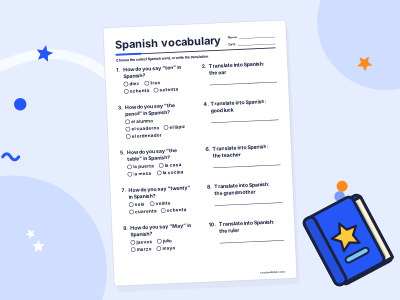
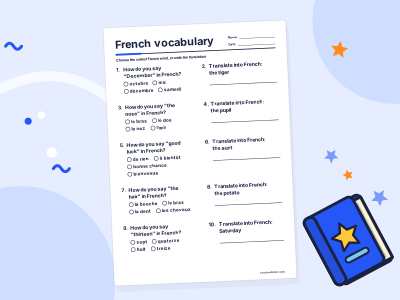
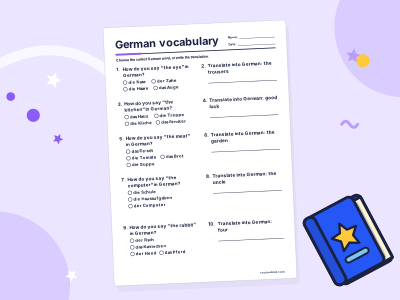
Printable flashcards to start your deck
Common mistakes
- Making cards the night before. Card-making is useful, but the benefit comes from weeks of reviewing them.
- Too much on one card. If the back has more than about a sentence, split it.
- Only reviewing the easy ones. It's tempting to keep flipping cards you know because it feels good. The Leitner boxes stop you.
- Never retiring cards. If a card has been right five times over a month, it's earned a rest.
- Using cards for everything. Flashcards are great for facts and definitions. They won't teach you to write an essay or solve a multi-step problem. Use practice questions for that.
Tonight, make ten cards on one topic you're learning right now, following the one-idea rule. Put them in Box 1, test yourself tomorrow, and move them along. In a week you'll know exactly which ones you really know. For ready-made decks, start with the revision flashcards collection.
Print revision flashcards
Common questions
How many flashcards should I review a day?
Review every card that is due according to your schedule rather than aiming for a fixed number. For most students, 20 to 30 minutes a day is enough, and adding about 10 to 20 new cards a day keeps the pile manageable.
Are flashcard apps better than paper cards?
Neither is automatically better. Apps handle the scheduling for you, while writing paper cards by hand helps some people remember. What matters most is testing yourself honestly and reviewing on a schedule.
What age can children start using flashcards?
Children aged about 7 to 9 can use simple flashcards for times tables and spellings with an adult running the session. From around 10 or 11, most can make and review their own cards with a bit of guidance.
Crayonbird Editorial Team
Writers, illustrators and educators
We are the small team that writes, draws and tests Crayonbird’s activities. We try every idea with our own printables, keep advice practical and honest about what doesn’t work, and point to official guidance where it matters. Nothing on this blog is sponsored.
Related articles
Teens and study skills
How to Revise for Exams: Techniques That Actually Work (Ages 13–18)
Active recall, spaced repetition, interleaving, practice papers and sleep, explained with real examples so teens can revise smarter instead of just longer.
Ages 13–188 min read
Teens and study skills
How to Make a Revision Timetable You'll Actually Stick To
A step-by-step guide for teens to building a revision timetable, with an example week, how to adjust it when things slip, and how to avoid burning out.
Ages 13–188 min read
Art and creativity
The Real Benefits of Colouring for Children (and How to Get More from It)
What colouring genuinely does for children's hands, focus and calm, what it doesn't, and simple ways to turn a colouring page into a learning activity.
Ages 2–108 min read