How to Revise for Exams: Techniques That Actually Work (Ages 13–18)
Active recall, spaced repetition, interleaving, practice papers and sleep, explained with real examples so teens can revise smarter instead of just longer.
On this page
Most students revise by reading their notes, highlighting the important bits, and reading them again. It feels productive, and it's one of the least effective ways to prepare for an exam. This guide covers the techniques with the strongest evidence behind them, shows exactly what they look like with real questions, and gives you a session plan you can use tonight.
It works for GCSEs and A levels, WAEC and NECO, CBSE boards, the bac, AP exams, end-of-year tests or anything else that involves remembering things under pressure.
Why rereading feels good and doesn't work
When you reread a page, it feels familiar. Familiar feels like "I know this". But recognising information when it's in front of you is a different skill from producing it from memory on a blank exam paper, which is what you will actually have to do.
That's why the most useful techniques feel harder. A large 2013 review of ten common study techniques by Dunlosky and colleagues rated two as highly useful: practice testing and spreading study out over time. Rereading, highlighting and summarising came out near the bottom. The Association for Psychological Science summary of that review is a short, readable overview.
The rule of thumb: if revision feels easy, you are probably not learning much from it. Struggling to remember something, then checking, is the bit that works.
 notebook
 pencil
 clock
clock book
book computer
 magnifying glass
Active recall: close the book and pull it out
Active recall means testing yourself before you look at the answer. Every time you drag information out of your memory, you make it easier to find next time.
There are several ways to do it. Pick the one that fits the subject.
The blank page (sometimes called "blurting"). Read a topic for ten minutes. Close everything. Write down everything you can remember on a blank sheet, in any order: facts, diagrams, keywords. Then open your notes and add what you missed in a different colour. The different-colour bits are what you revise next time.
Questions, not notes. Turn your notes into questions. Instead of writing "Photosynthesis produces glucose and oxygen", write:
- What are the products of photosynthesis?
- Where in the cell does photosynthesis happen?
- Why does a plant kept in the dark stop producing starch?
The last one is the kind that gets marks, because it asks you to explain, not just list.
Explain it to someone younger. Try explaining a topic out loud as if to a ten-year-old. Where you get stuck or start waving your hands, there's a gap. This works well for history and science: "So the reason the war started was…"
Maths and physics: do problems, don't read worked examples. Cover the solution and try first. If you can solve 3x + 7 = 22 (it's x = 5), move on to something harder rather than doing ten more of the same.
Spaced repetition: little and often, on a schedule
You forget things quickly after first learning them, then more slowly each time you review them. Spaced repetition uses that pattern: you review a topic just as it's starting to fade, and each review makes it stick for longer.
A simple schedule after you first learn a topic:
| Review | When |
|---|---|
| 1st | The next day |
| 2nd | Three days later |
| 3rd | One week later |
| 4th | Two weeks later |
| 5th | A month later |
You don't need to be exact. The point is that cramming one topic for four hours on Sunday is worse than four one-hour sessions spread across two weeks, even though it's the same total time.
This is also why starting early matters. Spacing needs days and weeks to work, so a revision plan that starts three nights before the exam can't use it. If you need help planning the gaps, our guide on how to make a revision timetable builds spacing into a weekly plan.
Interleaving: mix topics instead of blocking them
Most textbooks give you twenty questions on the same thing in a row. You get into a rhythm, and by question ten you are on autopilot. The exam won't be like that. It mixes topics, and part of the challenge is working out which method a question needs.
Interleaving means mixing related topics within a session. Instead of:
- 15 questions on simultaneous equations
try:
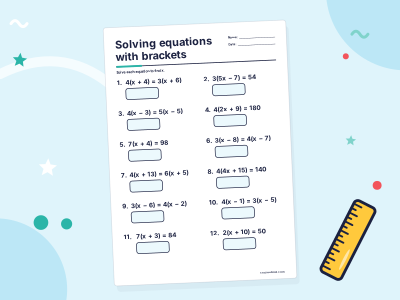
- 5 on simultaneous equations, 5 on quadratics, 5 on inequalities, shuffled
It feels slower and more frustrating. That's normal, and it's the point: you are practising choosing the method, not just applying it.
It works beyond maths. In chemistry, mix bonding, moles and rates questions. In a language, mix past, present and future tense translations: I went to the beach (Je suis allé(e) à la plage), I go to the beach, I will go to the beach.
Don't interleave everything at once while you are first learning a topic. Learn it in a block, then mix it with others in later reviews.
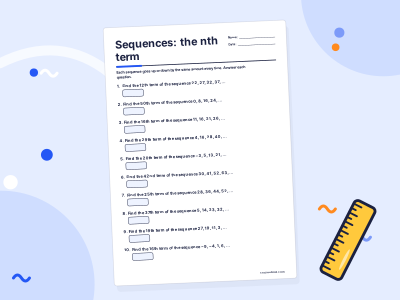
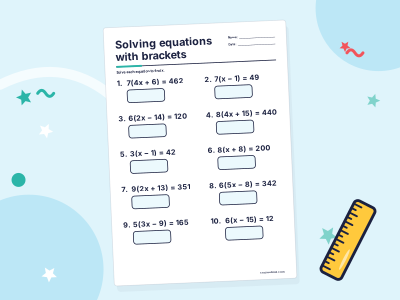
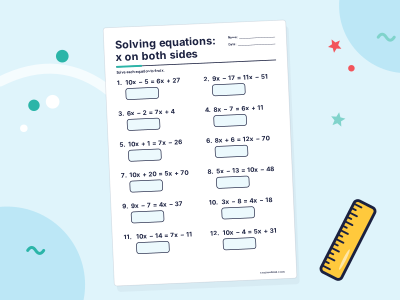
Mixed algebra practice to test yourself on
Practice papers: the nearest thing to the real exam
Past papers and practice papers combine everything above: recall, mixed topics, timing and exam technique. They are the most valuable revision you can do in the last few weeks, as long as you use them properly.
Step by step
- Do it under real conditionsTimed, no notes, phone in another room. Doing a paper with your notes open tells you almost nothing.
- Mark it with the mark scheme, honestlyMark schemes show you exactly what examiners give marks for, which is often more specific than you expect.
- Keep an error logFor every lost mark, write the question, what went wrong and the fix.
- Redo the wrong questions a few days laterWithout looking at your first attempt.
An error log might look like this:
| Question | What went wrong | Fix |
|---|---|---|
| Q4 (rates of reaction) | Described the graph but didn't explain it | Always add "because…" with particles/collisions |
| Q7 (essay) | Ran out of time | Spend max 1 minute per mark |
| Q9 (percentages) | Calculated 15% instead of 115% | Underline "increase" in the question |
After three or four papers, patterns appear. Most students lose marks in the same few ways again and again, and fixing those is quicker than learning a whole new topic.
Find timed papers in our exam practice collection.
Make it meaningful: ask "why" and draw it
Two more techniques help information stick, particularly in subjects with lots of connected ideas.
Ask why and how. For every fact, ask why it's true or how it connects to something else. "Iron rusts faster in salt water. Why? Because the dissolved salt makes the water conduct better, which speeds up the reaction." Explaining the link makes both facts easier to remember.
Draw it. Turn processes into flow charts, timelines or labelled diagrams, then try to redraw them from memory. A diagram of the water cycle or the causes of a revolution is easier to recall than a paragraph about it. Mind maps work well if you build them from memory first and check afterwards, rather than copying them neatly from your notes.

Sleep, breaks and the night before
Revision techniques only work if your brain has the energy to use them.
Protect your sleep. Sleep is when your brain consolidates what you learnt during the day. The NHS advice on exam stress notes that most teenagers need 8 to 10 hours a night and that all-night cramming is usually a bad idea. Cutting sleep to fit in more revision is like skipping meals to have more time for training.
Take real breaks. Work in blocks of 25–50 minutes with 5–10 minute breaks. A break means getting up, moving and not scrolling, because scrolling fills your head with new information right when you want it to settle the old.
Move your body. A walk, a run or a kickabout between sessions helps with stress and concentration.
The night before: do a light review of key points, flashcards or your error log, then stop. Pack your bag, check the time and place, and go to bed at your normal time. Learning a new topic the night before rarely helps and often adds panic.
A 60-minute session you can do tonight
Here's how the techniques fit together in one hour:
- 5 minutes — warm up with recall. Write down everything you remember from last session's topic. Check it.
- 20 minutes — learn something new. Read or watch a short explanation of today's topic, making question-style notes.
- 5 minutes — break. Stand up, get water.
- 20 minutes — test yourself. Close the notes. Answer your questions or do mixed practice questions. Mark them.
- 10 minutes — fix and plan. Add mistakes to your error log, make two or three flashcards for anything you got wrong, and write down what to review next time.
That's it. No highlighters needed. Over a few weeks, an hour like this beats an evening of rereading by a long way.
For printable planners, Cornell note pages and review checklists, look at the Exam Revision Planner & Study Skills Pack or browse the Brainteen section. Start small: pick one subject, write ten questions on your last topic, and test yourself tomorrow before you look at your notes.
Get free study tools
Common questions
What is the most effective way to revise?
Testing yourself (active recall) spread out over days and weeks (spaced repetition). Both are rated highly in research reviews, and both beat rereading and highlighting.
How many hours a day should I revise?
It depends on how close the exams are and how much else you have on, but quality matters more than hours. Two or three focused hours with breaks usually beat six distracted ones, especially if you protect your sleep.
Is it worth staying up late to revise the night before an exam?
Usually not. Sleep helps you remember what you have learnt, and an all-nighter tends to make the exam itself harder. A short review of key points and an early night is a better plan.
Do practice papers really help?
Yes, if you use them properly: under timed conditions, marked honestly with the mark scheme, and followed by fixing the mistakes. They combine recall, timing practice and exam technique in one go.
Crayonbird Editorial Team
Writers, illustrators and educators
We are the small team that writes, draws and tests Crayonbird’s activities. We try every idea with our own printables, keep advice practical and honest about what doesn’t work, and point to official guidance where it matters. Nothing on this blog is sponsored.
Related articles
Teens and study skills
How to Use Flashcards Properly: The Leitner System and Better Cards
How to make flashcards that test real understanding, run the Leitner box system, space your reviews and choose between paper and apps, for ages 9 to 18.
Ages 9–188 min read
Teens and study skills
How to Make a Revision Timetable You'll Actually Stick To
A step-by-step guide for teens to building a revision timetable, with an example week, how to adjust it when things slip, and how to avoid burning out.
Ages 13–188 min read

Art and creativity
The Real Benefits of Colouring for Children (and How to Get More from It)
What colouring genuinely does for children's hands, focus and calm, what it doesn't, and simple ways to turn a colouring page into a learning activity.
Ages 2–108 min read