How to Make a Revision Timetable You'll Actually Stick To
A step-by-step guide for teens to building a revision timetable, with an example week, how to adjust it when things slip, and how to avoid burning out.
On this page
A revision timetable is supposed to make exams feel manageable. Too often it becomes a beautiful colour-coded chart that falls apart by Wednesday. The difference is usually not willpower. It's that the plan was built for a perfect week that never happens. This guide walks you through building a timetable that fits your real life, with an example week, a simple way to adjust it, and the warning signs that you are doing too much.
Before you start: three lists
Spend half an hour making three lists before you draw a single grid. It's the most useful half hour of the whole plan.
1. Your exams. Every subject, every paper, with dates and times. Put them in date order. If you don't have the exact timetable yet, use your best estimate and update it later.
2. Your topics. For each subject, break the course into topics small enough to revise in one session. "Biology" is too big. "Cell structure", "Osmosis and diffusion" and "Enzymes" are about right. Your course specification, syllabus or the contents page of your textbook is a good starting point.
3. Your fixed time. Everything that is already booked: school or college, travel, a part-time job, sports training, religious commitments, family meals, the evening you always see your grandparents. Be honest. A timetable that ignores your Saturday shift won't survive the first Saturday.
 clock
clock notebook
 pencil
 desk
desk lamp
lamp book
book
Rate every topic red, amber or green
Go through your topic list and give each one a colour:
- Red: I don't understand this, or I can't remember any of it.
- Amber: I sort of get it, but I'd lose marks on it.
- Green: I could answer an exam question on this now.
Be harsh. "Green" means you could do it without notes today, not that you remember the lesson being fine.
This rating tells you where your time should go. Red topics get the most sessions, amber get some, green get a quick check every couple of weeks so they stay green. Without it, most people spend their time on the topics they already like, which feels great and doesn't move their grades much.
Build the timetable step by step
Step by step
- Count your weeksWork out how many weeks you have until the first exam. Write them across the top of a page.
- Block out fixed timeShade in everything from your third list. What's left is your real revision time, and it's often less than you think.
- Choose your session lengthA session of two or three 25–50 minute blocks with short breaks works for most people. Mark the slots where a session fits.
- Share slots between subjectsGive more slots to subjects with more red topics and to exams that come first. A rough split is fine; you'll adjust it.
- Place topics, not subjectsWrite "Chemistry: moles" in a slot, not just "Chemistry". A vague slot leads to a vague session.
- Build in spacingSchedule each topic again a few days later, then a week or so after that. Reviewing something across several sessions beats one long session on it.
- Leave buffer slots and a day offOne or two empty slots a week to catch up, and at least one evening or half-day with no revision at all.
The spacing step matters more than it looks. Coming back to a topic after a gap, and testing yourself on it, is one of the best-supported revision techniques. Our guide on how to revise for exams explains why and shows what to do inside each session.
An example week
Here is one week for a student about seven weeks before a major set of exams (GCSEs in Year 11 in England, WAEC in SS3 in Nigeria, or end-of-year finals in the US). They study maths, English, biology, chemistry and history, have school until 3:30 pm, football training on Tuesday, and a part-time job on Saturday morning.
| Day | Slot 1 | Slot 2 | Slot 3 |
|---|---|---|---|
| Monday | Maths: quadratics (new) | Biology: enzymes (review) | — |
| Tuesday | Football training | Chemistry: moles (new) | — |
| Wednesday | History: causes of WW1 (new) | Maths: quadratics (review) | Flashcards (15 min) |
| Thursday | English: poetry comparison | Chemistry: bonding (review) | — |
| Friday | Maths: mixed practice | Free evening | — |
| Saturday | Work (morning) | Biology: osmosis (new) | History: timed essay |
| Sunday | Past paper: maths (timed) | Weekly review (15 min) | Rest of day off |
A few things to notice:
- No day has more than three slots. On a school day, two is usually plenty.
- New topics and reviews are mixed. Quadratics appears on Monday and again on Wednesday. Next week it will appear once more, in a mixed practice session.
- Friday evening is free. That's not laziness; it's what makes Monday possible.
- There's a weekly review on Sunday. That's where the plan gets adjusted.
- A past paper appears once a week. As exams get closer, past papers should take up more of the plan.
Short slots work too. A 15-minute flashcard review on the bus counts. Our guide to using flashcards properly shows how to make those minutes count.

How much revision is enough
There's no magic number of hours, and anyone who gives you one doesn't know your week. Some rough guidance:
- On school days, one to two hours is realistic for most students in the main revision period. More than that and you'll be tired the next day.
- At weekends and in the holidays, three to five hours spread across the day is a solid amount, with proper breaks.
- In the last couple of weeks, you may do more, but sleep still comes first.
The better question is: did I get something done? A focused 45 minutes of testing yourself is worth more than three hours of half-reading notes with your phone buzzing. If you finish a session and can't say what you learnt, the session was too vague or too distracted.
Adjusting the plan when life happens
No timetable survives a whole revision period unchanged. You'll get ill, a topic will take longer than you planned, or a friend's birthday will land on a Thursday. A good plan expects this.
Do a weekly review. Fifteen minutes on Sunday: tick what you did, re-rate topics (some reds should now be amber), and adjust next week. Move time from subjects that are going well to subjects that aren't.
Use the "missed session" rule. If you miss a session, move it to a buffer slot. If there's no buffer left that week, decide what's least important and drop it. Never try to fit two missed sessions into one evening; that's how plans collapse.
Don't restart from scratch. Falling behind is not a reason to make a brand-new timetable every week. Small adjustments keep the plan alive; constant rewrites turn planning into a way to avoid revising.
Watch for "fake green". If a past paper shows you're losing marks on a topic you rated green, rate it amber again. The plan should follow your results, not your feelings.
Once the exams start
Your timetable needs a second version for the exam period itself. Revision doesn't stop, but it changes shape.
Work backwards from each paper. Look at your exam dates and plan the day or two before each one around that subject: light review of your flashcards, your error log and one or two past questions. This is not the time for brand-new topics.
Plan the gaps. If you have three days between two exams, split them: most of the time on the next exam, a little on the one after, and a proper break.
Protect the evening before. Stop revising at a sensible time, get your equipment ready, check the time and room, and go to bed at your usual hour.
After each exam, let it go. Comparing answers outside the exam hall rarely helps. Have a short break, eat something, then look at what's next. You can't change the last paper, but you can still prepare for the next one.
Days with two exams. Revise both lightly the day before, and use the gap between them on the day to eat, rest and glance at your key notes for the second paper rather than starting anything new.
A simple exam-period grid, with each paper written in and the review slots before it, takes ten minutes to draw and saves a lot of last-minute panic.
Avoiding burnout
Burnout during exam season is common, and it often comes from plans that are too full rather than students who are too lazy. Signs to look out for:
- You're tired even after a night's sleep.
- You read the same page three times and nothing goes in.
- You feel guilty every moment you're not revising.
- You've stopped seeing friends or doing anything you enjoy.
If that sounds familiar, the fix is less revision, not more. Take a full day off. Put your day off back in the plan if you removed it. Get outside, see people, do some exercise. Keep your sleep regular; the NHS advice on exam stress notes that most teenagers need 8 to 10 hours a night and recommends drawing up a revision schedule together with a parent.
Templates that make it easier
You can draw a timetable on any sheet of paper, but a template saves time and makes the weekly review quicker. The Exam Revision Planner & Study Skills Pack includes timetables, revision checklists, weekly planners and Cornell note pages designed for exactly this process.
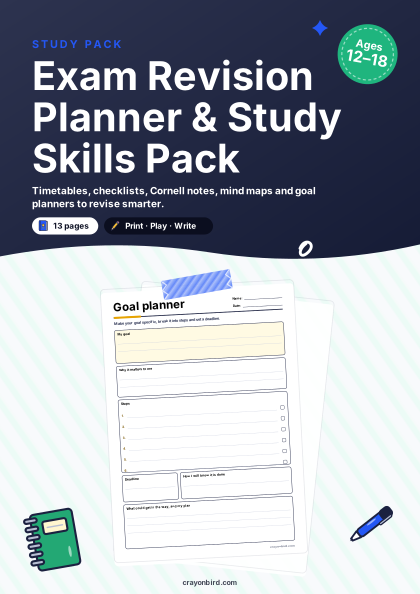
Activity bookAges 12–18
Exam Revision Planner & Study Skills Pack
Timetables, checklists, Cornell notes, mind maps and goal planners to revise smarter.
See what’s insideFor the sessions themselves, mix in timed questions from the exam practice collection and subject practice like the pages below.
Chemistry practice to slot into your sessions
Tonight, make just the three lists: exams, topics and fixed time. Tomorrow, rate the topics red, amber and green. By the weekend you'll have a plan that fits the life you actually have.
Common questions
How far in advance should I make a revision timetable?
For major exams, six to ten weeks ahead gives you time to cover everything and review it more than once. For smaller tests, one to two weeks is usually enough.
How long should each revision session be?
Most people focus best in blocks of 25 to 50 minutes with a short break in between. Two or three blocks make a good session.
What should I do if I fall behind my revision timetable?
Don't try to make up every missed session at once. Move the most important topics forward, drop or shorten the least important ones, and use the buffer slots you built in.
Printables used in this article
Crayonbird Editorial Team
Writers, illustrators and educators
We are the small team that writes, draws and tests Crayonbird’s activities. We try every idea with our own printables, keep advice practical and honest about what doesn’t work, and point to official guidance where it matters. Nothing on this blog is sponsored.
Related articles

Teens and study skills
How to Revise for Exams: Techniques That Actually Work (Ages 13–18)
Active recall, spaced repetition, interleaving, practice papers and sleep, explained with real examples so teens can revise smarter instead of just longer.
Ages 13–188 min read
Teens and study skills
How to Use Flashcards Properly: The Leitner System and Better Cards
How to make flashcards that test real understanding, run the Leitner box system, space your reviews and choose between paper and apps, for ages 9 to 18.
Ages 9–188 min read

Art and creativity
The Real Benefits of Colouring for Children (and How to Get More from It)
What colouring genuinely does for children's hands, focus and calm, what it doesn't, and simple ways to turn a colouring page into a learning activity.
Ages 2–108 min read