Reading Aloud at Bedtime: How to Do It Well (Ages 2–10)
Why reading aloud matters from toddlers to 10-year-olds, how to choose books, do voices and use dialogic reading, plus a bedtime routine that holds up.
On this page
Reading aloud is one of the few parenting jobs that is both good for children and pleasant for adults, and it still gets squeezed out by tired evenings and "just one more episode". This guide covers why it's worth protecting, which books suit which ages, how to read so children actually listen, and a simple bedtime routine that survives real life.
Why reading aloud matters, even after they can read
For babies and toddlers, being read to is a steady stream of language, rhythm and closeness. The American Academy of Pediatrics now recommends shared reading from birth, continuing at least through kindergarten, because of what it does for language, relationships and readiness for school.
The benefit doesn't stop once a child can read on their own. Three things carry on:
- Listening runs ahead of reading. A 7 year old who is reading short chapter books alone can follow a much richer story when you do the decoding. That gap usually stays open until around 10 or 11.
- Books use words that conversation doesn't. Everyday talk is full of put, get and thing. Stories give children trembled, glimmering and reluctantly, in context, with a picture to help.
- It's practice for understanding. The predicting, wondering and retelling that make up good reading comprehension are much easier to build when your child isn't also working out every word.
And it is ten calm minutes a day of undivided attention, which most children notice and value more than adults expect.
Choosing the right books for each age
Children need a mix: favourites they know by heart, new books that stretch them, and the occasional one they picked purely for the cover.
| Age | What works | What to look for |
|---|---|---|
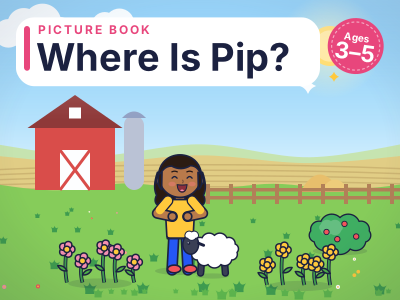
| 2–3 | Very short books, read many times | Rhythm, rhyme, repeated lines ("Where is Pip?"), one clear picture per page, flaps |
| 3–5 | Simple stories with a problem to solve | A character they can root for, a refrain they can join in with, counting and noticing |
| 5–7 | Longer picture books, early chapter books | Funny moments, a bit of suspense, characters their own age |
| 7–10 | Chapter books and longer read-alouds | Books slightly above what they can read alone, cliffhanger chapter endings |
A useful rule of thumb: read aloud a level above what they read alone. If your 8 year old is reading short illustrated chapter books, you can read them something longer with fewer pictures. They'll ask questions, and that's the point.
Variety matters too. Rotate in non-fiction (animals, space, how things work), poetry, folk tales from different countries, and stories with children who look and live differently from yours.
Read in your strongest language. If your family speaks Yoruba, Hindi, Arabic or Portuguese at home and your child goes to school in English, read bedtime stories in the language you speak most comfortably. Rich, confident storytelling in a home language builds vocabulary and comprehension that carry over to the school language; a stilted reading in a language you're less sure of doesn't help as much. Many parents simply look at an English picture book and tell the story in their own words, which counts completely. Bilingual families often split it: one parent, one language, or English books at weekends and home-language stories on weeknights.

How to read aloud so children actually listen
You don't need to be an actor. A few small habits make a big difference.
Slow down. Most adults read aloud too fast, especially when tired. Aim for about two-thirds of your normal speed. Children need time to look at the pictures and picture the scene.
Pause before the page turn. "And behind the door was…" Then wait a beat. Those two seconds are where anticipation lives.
Use your volume. Go quiet for the tense bits; children lean in. Speed up for chases, slow right down for the last page.
Keep voices simple and consistent. You don't need accents. Give each character one feature: the giant is low and slow, the mouse is high and quick, Grandma speaks very softly. Stick with it every time the character speaks, and your child will start to know who's talking before you say.
Read the pictures too. In good picture books, the illustrations carry half the story. "Look, she's smiling, but the cat isn't. Why not?"
Let them hold the book or turn the pages. For toddlers especially, being in charge of the page turn keeps them involved.
Dialogic reading: turning listeners into talkers
Dialogic reading is a well-researched approach, developed by psychologist Grover Whitehurst and colleagues, in which the adult gradually hands the storytelling over to the child. It is especially useful for 2 to 5 year olds, though the ideas work at any age. The core is a short loop often called PEER:
- Prompt your child to say something about the book.
- Evaluate what they say ("Yes, it is a dog!").
- Expand it by adding a little ("It's a big, muddy dog").
- Repeat: ask them to say the longer version back.
The prompts themselves come in five flavours, remembered as CROWD:
- Completion: leave a gap at the end of a rhyme. "The cat sat on the…"
- Recall: after the story, "What happened when the kite got stuck?"
- Open-ended: point at a busy picture. "Tell me what's going on here."
- Wh- questions: "What's this called?" "Where is the duck going?"
- Distancing: link to their life. "Remember when we lost something at the park?"
Two cautions. First, don't do it on every page or every night; some evenings should just be the story, start to finish. Second, if your child doesn't answer, give the answer cheerfully and move on. "I think it's a lighthouse. It flashes to warn ships." No pressure, no pause that feels like a test.
Using Crayonbird picture books
Our picture books are short, illustrated stories written for different ages, and each one can be read on screen or printed and stapled into a little book. A few that work well at bedtime:
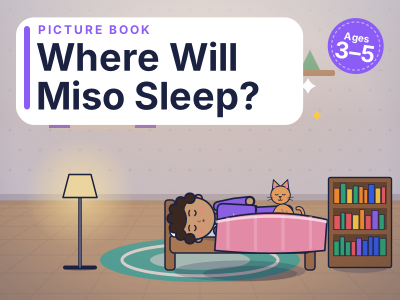
- Ages 3–5: Where Will Miso Sleep? has a repeated question that toddlers start answering by the third reading. Goodnight, Little Llama is a gentle wind-down.
- Ages 5–7: Tiny Turtles Find the Sea has a small amount of suspense and a satisfying ending.
- Ages 7–10: Pages the Library Cat is longer and rewards a "what do you think happens next?" pause.
 moon
moon star
star owl
owl bed
bed
A practical note on screens: for the bedtime story itself, print the book or read earlier in the evening on screen. Children's health guidance generally favours printed books and screen-free wind-down time before sleep, and a stapled printout is also much easier for a small child to hold and "read" back to you the next day. Many families print a book, read it on screen together at the weekend, then keep the paper copy in the bedtime basket.
Short stories to read tonight
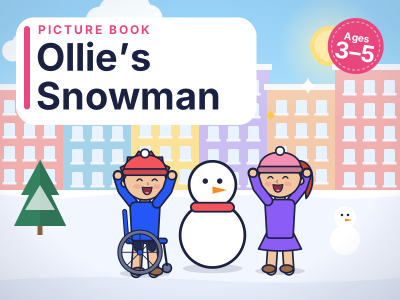
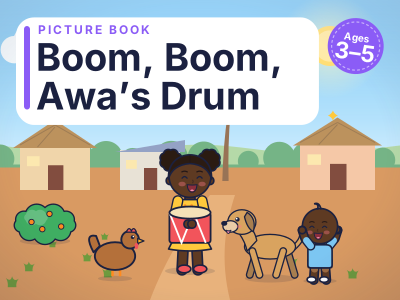
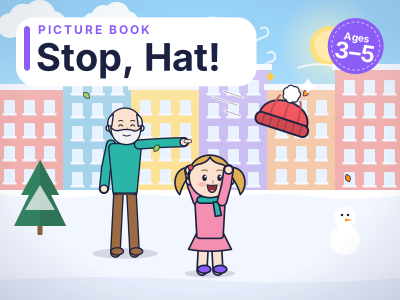
You'll find more in the bedtime stories collection, grouped by age and length.
A bedtime routine that holds up
Bedtime stories survive best when they are a fixed part of the routine, not a reward that can be taken away. A shape that works for most families:
Step by step
- Wind down firstBath, teeth, pyjamas, then stories. Reading is the last calm step before lights out, not a way to fill time while teeth are still to be brushed.
- Choose in advanceTwo books for toddlers, one chapter for older children. Agree the number before you start; it heads off most of the "one more" negotiations.
- ReadTen to twenty minutes, sitting together in good light.
- One sentence of talk"What was your favourite bit?" Then stop.
- Lights outA quiet song, or a sentence you always say. The ending ritual matters as much as the story.
Siblings of different ages? Read the younger child's picture book with both, then give the older child a chapter alone, or let the older one read the picture book to the younger one. Many 7 year olds love being the reader.
Wriggling listeners? Some children listen better with something in their hands. A soft toy, a fidget or a simple colouring sheet from the Bedtime Colouring pack can help a restless 4 year old stay with the story. Squirming isn't the same as not listening.
The fortieth reading of the same book? Children who know a book by heart start to "read" it with you, filling in words and turning pages at the right moment. That is early reading. Let them finish your sentences.
Exhausted yourself? A shorter book read warmly beats a long one read in a monotone. On the worst nights, ask your child to tell you the story from the pictures.
A bedtime book basket
- Two or three current favourites
- One new book for this week
- One non-fiction book (animals, space, how things work)
- A printed picture book they can hold and "read" back
- A small torch for reading in the dark tent you'll inevitably be asked to build
When your child starts reading alone
Around 5 to 7, as children learn letter sounds and start blending words, it's tempting to make every bedtime a reading practice session. Keep the two separate. Do the reading-book practice earlier in the day, when everyone has more patience, and keep bedtime for being read to. If your child wants to read a page to you, let them, then take over. If you're at the very start of that stage, our guide to teaching letter sounds at home covers the daytime side.
Tonight, try one small change: slow down, and pause before every page turn. Watch what your child's face does in that pause.
Common questions
At what age should I stop reading aloud to my child?
There is no cut-off. Children can understand far more complex stories by listening than they can read alone, often until 10 or 11, so keep going as long as you both enjoy it.
My toddler wants the same book every night. Is that a problem?
No. Repetition is how young children learn the language of a book, predict what comes next and eventually join in. Offer a second, new book alongside the favourite rather than replacing it.
Is reading a story on a screen as good as a printed book?
The talk matters more than the format, so chat and point at the pictures either way. Paediatric guidance favours printed books for young children, so it's worth printing a few favourites for bedtime itself.
How long should a bedtime story last?
Ten to twenty minutes suits most families. For toddlers, two short picture books; for 7 to 10 year olds, one chapter of a longer book.
Crayonbird Editorial Team
Writers, illustrators and educators
We are the small team that writes, draws and tests Crayonbird’s activities. We try every idea with our own printables, keep advice practical and honest about what doesn’t work, and point to official guidance where it matters. Nothing on this blog is sponsored.
Related articles
Reading and writing
Handwriting Tips for Reluctant Writers: Grip, Posture and Letter Families
Practical handwriting help for children who hate writing: posture, pencil grip, letter formation families, five-minute practice and when to ask an OT.
Ages 5–108 min read
Reading and writing
Pre-Writing Skills: What Children Need Before Handwriting
Lines, shapes, scissors and pencil grip: the pre-writing skills children need before letters, in the order they develop, with activities for each stage.
Ages 2–58 min read
Reading and writing
Reading Comprehension Strategies for Kids (Ages 6–11): A Parent's Guide
Predicting, questioning, retelling and inference explained for parents of 6–11s, with question stems, scripts and ways to help without quizzing.
Ages 6–118 min read