Crayonbird
Menu

Phonics · Ages 4–6 · 30 minutes

Introducing tricky words

Children read and begin to spell a small set of common tricky words by noticing which parts follow the sounds they know and which part is tricky, then read them in sentences.

Success criteria

  • I can find the tricky part of a word
  • I can read the tricky word quickly
  • I can spot the tricky word in a sentence

Key vocabulary

  • tricky word
  • tricky part
  • sound
  • letter
  • sentence

You will need

  • word cards for the tricky words in your programme
  • a large card with a highlighted tricky part
  • mini whiteboards
  • a feely bag
  • Reception· England
  • Kindergarten· United States

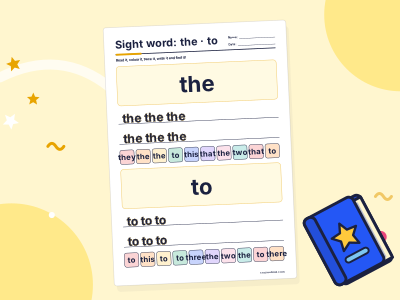
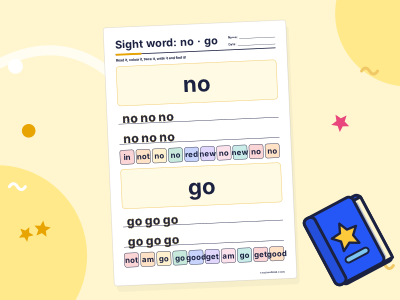
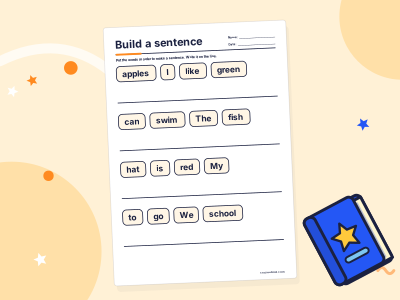
Practice sheets

Generated fresh each time you press a button, and marked instantly on screen.

The lesson at a glance

30 minutes in all. Timings are a guide: follow your class.

  1. Step 1: Starter

    Read the tricky words taught last week, if any, then six decodable words at speed.
    Revisit and review, 6 minutes
  2. Step 2: Teach

    Write to large on the board.
    12 minutes
  3. Step 3: Guided practice

    Flash and find: stick the four word cards around the room.
    8 minutes. Practise
  4. Step 4: Independent practice

    Use the practice buttons below.
    Apply
  5. Step 5: Plenary

    Hold up word cards, mixing the new tricky words with decodable ones.
    3 minutes
  6. Step 6: Assessment for learning

    Show each tricky word on its own, out of order.
  7. Step 7: Differentiation

    Support: one new tricky word per day, not four.
  8. Step 8: Common misconceptions

    Sounding out the tricky part: "t-h-e".
  9. Step 9: Home link

    Write this week's tricky words on sticky notes around the house and ask your child to collect and read them.

Tricky words, also called common exception words, are frequent words where some letters don't make the sounds children have learnt so far. This plan uses the, to, no, go as examples. Swap in whichever words come next in your school's programme order. The routine works for any of them.

1.Starter

Revisit and review, 6 minutes

Read the tricky words taught last week, if any, then six decodable words at speed. Then play "Feely bag": pull out a word card. If children can sound it out, they blend it. If it's tricky, they say "Tricky!" and read it straight away.

"Most words we can sound out. A few have a tricky bit. Today we're going to catch one."

2.Teach

12 minutes

Write to large on the board.

"Let's try sound talk first, like always. /t/... that's right, t says /t/. /o/... /t/ /o/, 'tot'? That doesn't sound like a word. This o is being tricky. In this word it says /oo/: to."

Draw a heart, or circle, around the tricky letter.

Step by step

  1. Read it with sound talkPress the sound buttons for the letters that behave. Children always try to decode first.
  2. Find the tricky part"Which letter isn't making the sound we expect?" Circle it.
  3. Say the wordRead the whole word normally three times: normal voice, whisper, giant voice.
  4. Write itChildren write the word on whiteboards, saying each letter, and circle the tricky part in a different colour.
  5. Use itSay a sentence: "I am going to the park." Children put a hand up when they hear to.

Repeat for the ("the e is tricky here"), then no and go ("o says its name, /oa/, in these words").


The rest of the plan

Guided and independent practice, the plenary, assessment for learning, differentiation, common misconceptions and the home link are free with a Crayonbird account.

  1. Guided practice8 minutes. Practise
  2. Independent practiceApply
  3. Plenary3 minutes
  4. Assessment for learning
  5. Differentiation
  6. Common misconceptions
  7. Home link

Learning Wiki

Blending

Blending means saying the sounds in a written word one after another and pushing them together to hear the whole word, like /c/ /a/ /t/ → cat.

Digraphs

A digraph is two letters that make one sound, like sh in ship, ch in chip, ck in duck or ai in rain.

Phonics

Phonics teaches children to read and spell by linking sounds (phonemes) with the letters that write them (graphemes), then blending and segmenting those sounds.

  • Phonics · Ages 4–6 · 30 min

    Blending sounds to read CVC words

    Children read consonant–vowel–consonant words by saying each sound in order and blending them, then read a short decodable sentence.

  • Phonics · Ages 4–5 · 30 min

    First letter sounds - s, a, t, p, i, n

    Children say the pure sounds /s/ /a/ /t/ /p/ /i/ /n/, match each sound to its letter, and blend them to read first words such as sat, pin and tap.