Crayonbird
Menu

Phonics · Ages 4–5 · 30 minutes

First letter sounds - s, a, t, p, i, n

Children say the pure sounds /s/ /a/ /t/ /p/ /i/ /n/, match each sound to its letter, and blend them to read first words such as sat, pin and tap.

Success criteria

  • I can say the sound for each letter
  • I can point to the letter when I hear its sound
  • I can blend sounds to read a short word

Key vocabulary

  • sound
  • letter
  • blend
  • word
  • sound talk

You will need

  • large letter cards s a t p i n
  • a bag of small objects or pictures
  • magnetic letters
  • mini whiteboards and pens
  • Reception· England

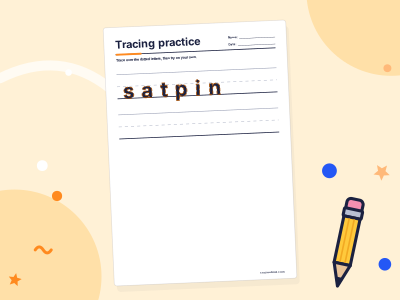
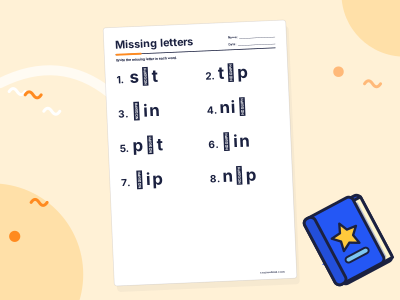
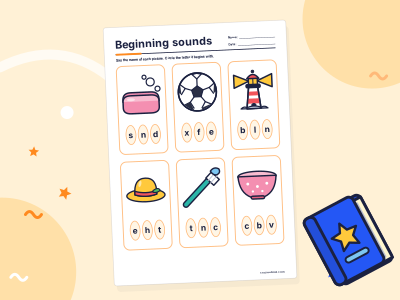
Practice sheets

Generated fresh each time you press a button, and marked instantly on screen.

The lesson at a glance

30 minutes in all. Timings are a guide: follow your class.

  1. Step 1: Starter

    Sit in a circle with a "sound bag" of real objects: a sock, a spoon, a toy ant, a tin, a pen, a toy pig.
    Revisit and review, 5 minutes
  2. Step 2: Teach

    Show one letter card at a time.
    12 minutes
  3. Step 3: Guided practice

    Give each pair magnetic letters s, a, t, p, i, n.
    8 minutes. Practise
  4. Step 4: Independent practice

    Use the practice buttons on this page.
    Apply
  5. Step 5: Plenary

    Play "Which sound is hiding?" Put the six cards face down and turn one over slowly.
    3 minutes
  6. Step 6: Assessment for learning

    Listen to each child say all six sounds from a shuffled pile.
  7. Step 7: Differentiation

    Support: teach s, a, t first and hold back the rest.
  8. Step 8: Common misconceptions

    Adding "uh": "suh" or "puh".
  9. Step 9: Home link

    Play I spy using sounds, not letter names: "I spy something beginning with /s/."

This plan covers the first set of six sounds. Most classes meet one or two new sounds a day, so run the Teach section once for each new sound across the week, then use the whole plan as the end-of-set review. The order s, a, t, p, i, n is common, but follow your school's programme order if it differs.

1.Starter

Revisit and review, 5 minutes

Sit in a circle with a "sound bag" of real objects: a sock, a spoon, a toy ant, a tin, a pen, a toy pig. Pull one out slowly.

"Listen to my mouth: /sss/... sock. Sock starts with /s/. Your turn."

Children echo the sound, then the word. Ask, "Does spoon start with /s/ too?" Thumbs up or down. Keep this oral. Children don't need letters yet, just the sound at the start of a word.

  • sun
  • ant
  • tent
  • pig
  • igloo
  • net
One picture for each sound. Say the word, then say only the first sound.

2.Teach

12 minutes

Show one letter card at a time. Use the same routine for every sound so children know what's coming.

Step by step

  1. See itHold up the card. "This letter makes the sound /t/."
  2. Say itChildren say it three times: loud, whisper, robot voice. Listen for a clean sound with no "uh" on the end.
  3. Feel it"When I say /t/, my tongue taps behind my top teeth. Short and quick." For /s/: "Smile and let the air hiss out, like a snake."
  4. Write itModel the letter in the air with a big arm, saying the formation as you go: "Over the top, round and back" for s.
  5. Find itShow three pictures. "Which one starts with /t/? Tent!"

Once three sounds are known, model your first blend. Write sat on the board and draw a dot (a sound button) under each letter.

"Sound talk: press each button and say the sound. /s/ /a/ /t/. Now push them together: sat. I can read a word!"

Repeat with tap and pin once those letters are taught.

The rest of the plan

Guided and independent practice, the plenary, assessment for learning, differentiation, common misconceptions and the home link are free with a Crayonbird account.

  1. Guided practice8 minutes. Practise
  2. Independent practiceApply
  3. Plenary3 minutes
  4. Assessment for learning
  5. Differentiation
  6. Common misconceptions
  7. Home link

Learning Wiki

Blending

Blending means saying the sounds in a written word one after another and pushing them together to hear the whole word, like /c/ /a/ /t/ → cat.

Digraphs

A digraph is two letters that make one sound, like sh in ship, ch in chip, ck in duck or ai in rain.

Phonics

Phonics teaches children to read and spell by linking sounds (phonemes) with the letters that write them (graphemes), then blending and segmenting those sounds.

  • Phonics · Ages 4–5 · 25 min

    Hearing and making rhyming words

    Children hear when two words rhyme, spot the odd one out in a set, and suggest a rhyming word of their own, real or silly.

  • Phonics · Ages 4–6 · 30 min

    Blending sounds to read CVC words

    Children read consonant–vowel–consonant words by saying each sound in order and blending them, then read a short decodable sentence.

