Crayonbird
Menu

Phonics · Ages 4–6 · 30 minutes

Digraphs sh, ch and th - two letters, one sound

Children recognise sh, ch and th as two letters that make one sound, read and spell words containing them, and read a decodable sentence.

Success criteria

  • I can say the sound for sh and ch and th
  • I can draw one sound button under two letters
  • I can read and write words with these sounds

Key vocabulary

  • digraph
  • sound
  • sound buttons
  • blend
  • segment

You will need

  • grapheme cards sh ch th
  • word cards
  • mini whiteboards
  • a small torch or pointer
  • Reception· England
  • Kindergarten· United States

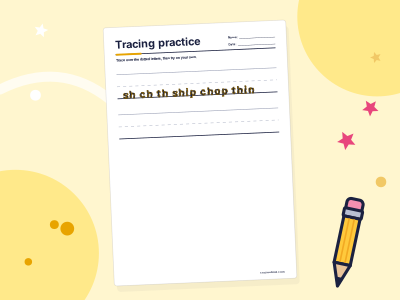
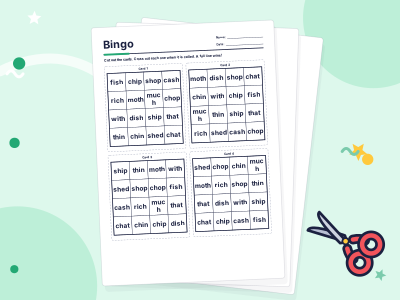
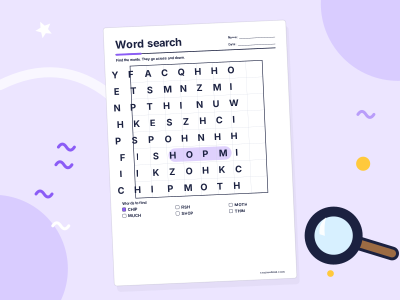
Practice sheets

Generated fresh each time you press a button, and marked instantly on screen.

The lesson at a glance

30 minutes in all. Timings are a guide: follow your class.

  1. Step 1: Starter

    Flash all the single-letter sounds taught so far, then read six CVC words at speed: hop, sit, cat, hen, bus, nut.
    Revisit and review, 6 minutes
  2. Step 2: Teach

    Show the card sh. "These two letters are friends.
    12 minutes
  3. Step 3: Guided practice

    Sound-button sort: show word cards one at a time: shop, chin, moth, cash, much, that, shed, rich.
    8 minutes. Practise
  4. Step 4: Independent practice

    Use the practice buttons.
    Apply
  5. Step 5: Plenary

    "Digraph detective": shine a torch or pointer on words around the room or in a big book.
    3 minutes
  6. Step 6: Assessment for learning

    Ask individuals to read shop, chin, with.
  7. Step 7: Differentiation

    Support: teach sh alone first, the easiest to hear.
  8. Step 8: Common misconceptions

    Reading each letter separately: "s-h-i-p".
  9. Step 9: Home link

    Go on a /sh/ /ch/ /th/ hunt at home and list three things you find: fish fingers, a chair, a toothbrush.

Children should already blend CVC words confidently before this lesson. The plan introduces three digraphs together for review. Many classes teach one a day, so split the Teach section across three days if that matches your school's programme order.

1.Starter

Revisit and review, 6 minutes

Flash all the single-letter sounds taught so far, then read six CVC words at speed: hop, sit, cat, hen, bus, nut. End with a question to set up today's idea.

"Here are an s and an h. Watch what happens when they stand next to each other..."

  • ship
  • fish
  • shell
  • chair
  • cherry
  • cheese
Listen only, no reading needed. Can you hear /sh/ or /ch/ in each word?

2.Teach

12 minutes

Show the card sh.

"These two letters are friends. When they stand together, they don't say /s/ and /h/. They make one new sound: /sh/. Two letters, one sound. That's called a digraph."

Children say /sh/ with a finger on their lips, the "be quiet" sound. Write ship. Draw a line under sh and a dot under i and p.

"The line tells me two letters make one sound. So ship has three sounds: /sh/ /i/ /p/. Ship."

Repeat for ch (chip: "a quick sneeze sound, /ch/") and th (thin).

The rest of the plan

Guided and independent practice, the plenary, assessment for learning, differentiation, common misconceptions and the home link are free with a Crayonbird account.

  1. Guided practice8 minutes. Practise
  2. Independent practiceApply
  3. Plenary3 minutes
  4. Assessment for learning
  5. Differentiation
  6. Common misconceptions
  7. Home link

Learning Wiki

Blending

Blending means saying the sounds in a written word one after another and pushing them together to hear the whole word, like /c/ /a/ /t/ → cat.

Digraphs

A digraph is two letters that make one sound, like sh in ship, ch in chip, ck in duck or ai in rain.

Phonics

Phonics teaches children to read and spell by linking sounds (phonemes) with the letters that write them (graphemes), then blending and segmenting those sounds.

  • Phonics · Ages 4–6 · 30 min

    Blending sounds to read CVC words

    Children read consonant–vowel–consonant words by saying each sound in order and blending them, then read a short decodable sentence.

  • Phonics · Ages 4–6 · 30 min

    Introducing tricky words

    Children read and begin to spell a small set of common tricky words by noticing which parts follow the sounds they know and which part is tricky, then read them in sentences.

  • Phonics · Ages 4–5 · 30 min

    First letter sounds - s, a, t, p, i, n

    Children say the pure sounds /s/ /a/ /t/ /p/ /i/ /n/, match each sound to its letter, and blend them to read first words such as sat, pin and tap.