Phonics and early reading
What is a digraph?
Quick answer
A digraph is two letters that make one sound, like sh in ship, ch in chip, ck in duck or ai in rain.
In one sentence
A digraph is a pair of letters that work together to make a single sound.
Explained
The word "digraph" means "two writings": di = two, graph = written. In fish, the letters s and h do not say /s/ and /h/ separately. Together they say one new sound, /sh/. That pair is a digraph.
Consonant digraphs are made from consonant letters: sh (ship), ch (chin), th (thin, this), ck (duck), ng (ring), qu (queen), wh (when), ph (phone).
Vowel digraphs spell a vowel sound: ai (rain), ee (feet), oa (boat), oo (moon, book), ar (car), or (fork), ow (cow, snow), oi (coin).
There are two close relatives. A trigraph is three letters for one sound, such as igh in night or air in chair. A split digraph is two vowel letters split by a consonant, such as a-e in cake or i-e in bike. In the US this is often called "silent e" or "magic e"; the idea is the same.
When children read a digraph they must spot the pair first, a key step in phonics. Many teachers draw a short line under a digraph (and a dot under single letters) as sound buttons, so children see that sh-o-p has three sounds, not four.
 fish
fish shell
shell sheep
sheep chair
chair duck
duck sock
sock
Examples
| Word | Digraph | Sounds |
|---|---|---|
| shop | sh | sh – o – p |
| chin | ch | ch – i – n |
| sock | ck | s – o – ck |
| ring | ng | r – i – ng |
| feet | ee | f – ee – t |
| coin | oi | c – oi – n |
Common mistakes
- Sounding each letter. Reading ship as "s-h-i-p" gives nonsense; look for the pair first.
- Mixing voiced and unvoiced th. This (buzzy, voiced) and thin (quiet, unvoiced) both use th. Feel your throat to hear the difference.
- Thinking a digraph always says the same thing. ow says one sound in cow and another in snow; try both and pick the real word.
Quick quiz
Digraphs
Check what you know with 4 quick questions.
Question 1 of 4
Which word contains a digraph?
Practise it
Try it
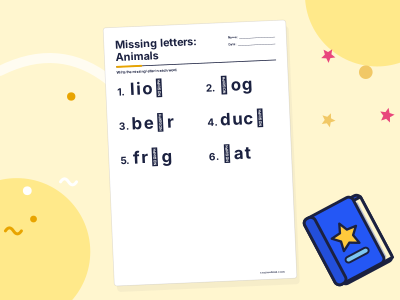
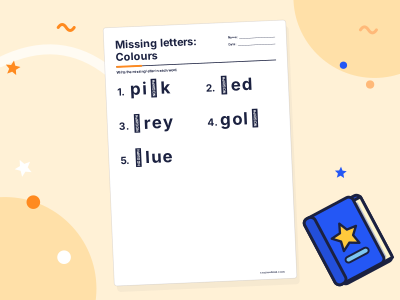
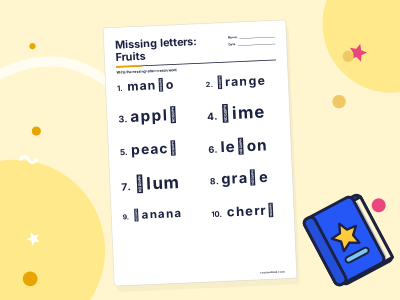
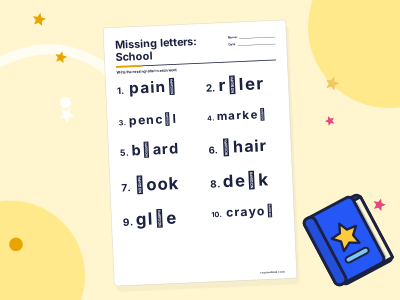
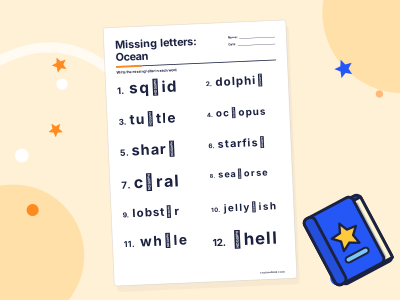
Spot the missing digraph
For grown-ups
Related topics
Phonics
Phonics teaches children to read and spell by linking sounds (phonemes) with the letters that write them (graphemes), then blending and segmenting those sounds.
Blending
Blending means saying the sounds in a written word one after another and pushing them together to hear the whole word, like /c/ /a/ /t/ → cat.
Segmenting
Segmenting means breaking a spoken word into its separate sounds so you can spell it, like hearing dog as /d/ /o/ /g/ and writing a letter for each sound.
Vowels and consonants
The vowel letters are a, e, i, o and u (and sometimes y); all the other letters are consonants. Almost every English word needs a vowel sound.
Tricky words
Tricky words are common words with a part that does not follow the phonics children know yet, like the, said, was and you. Children sound out the regular part and learn the tricky bit.
Syllables
A syllable is a beat in a word, built around one vowel sound. Cat has one syllable, rab-bit has two, el-e-phant has three.