Crayonbird
Menu

Phonics · Ages 4–5 · 25 minutes

Hearing and making rhyming words

Children hear when two words rhyme, spot the odd one out in a set, and suggest a rhyming word of their own, real or silly.

Success criteria

  • I can hear when two words rhyme
  • I can find the word that does not rhyme
  • I can think of a word that rhymes

Key vocabulary

  • rhyme
  • sound
  • end
  • same
  • different

You will need

  • a familiar nursery rhyme
  • picture cards of rhyming pairs
  • a puppet
  • a bag or box
  • Reception· England
  • Pre-K· United States

Practice sheets

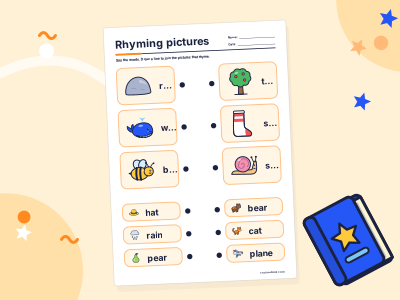
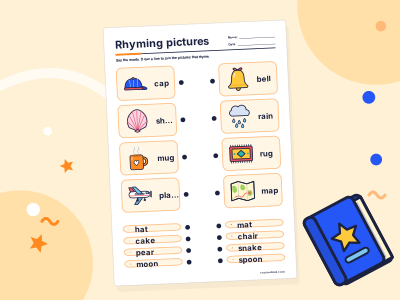
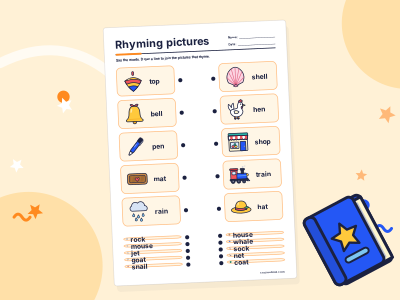
Generated fresh each time you press a button, and marked instantly on screen.

The lesson at a glance

25 minutes in all. Timings are a guide: follow your class.

  1. Step 1: Starter

    Sing or chant a nursery rhyme the class already knows, such as Hickory Dickory Dock.
    5 minutes
  2. Step 2: Teach

    Show the pictures in pairs.
    10 minutes
  3. Step 3: Guided practice

    Thumbs up, thumbs down: say two words.
    5 minutes
  4. Step 4: Independent practice

    Use the practice buttons.
  5. Step 5: Plenary

    "Rhyme chain": sit in a circle.
    3 minutes
  6. Step 6: Assessment for learning

    Rhyme develops in three steps.
  7. Step 7: Differentiation

    Support: use real objects rather than pictures.
  8. Step 8: Common misconceptions

    Mistaking same start for rhyme: "sun and sock rhyme." Many children notice beginnings first.
  9. Step 9: Home link

    Read a rhyming picture book and pause before the rhyming word so your child can fill it in.

Rhyme is about listening, not letters. Children don't need to read for any part of this lesson. It suits the early weeks of school, or a small group alongside letter-sound teaching.

1.Starter

5 minutes

Sing or chant a nursery rhyme the class already knows, such as Hickory Dickory Dock. Sing it again, but stop before the rhyming word and let the children fill it in:

"Hickory dickory dock, the mouse ran up the..." "Clock!"

"Dock, clock. They sound the same at the end. That's a rhyme."

Do the same with one or two other rhymes. Children are often surprised that they can already do this.

2.Teach

10 minutes
  • map
  • cap
  • clock
  • sock
  • frog
  • log
Three rhyming pairs. Say them in twos: map, cap... clock, sock... frog, log.

Show the pictures in pairs. Say each pair slowly and stretch the end: "m-ap, c-ap."

"When words rhyme, the beginning changes but the end stays the same. Listen: ap, ap."

Then bring in the puppet, who gets things wrong.

"Puppet says sock and sun rhyme! Do they? Sock, sun... they start the same, but the end is different. Not a rhyme. Silly puppet!"


The rest of the plan

Guided and independent practice, the plenary, assessment for learning, differentiation, common misconceptions and the home link are free with a Crayonbird account.

  1. Guided practice5 minutes
  2. Independent practice
  3. Plenary3 minutes
  4. Assessment for learning
  5. Differentiation
  6. Common misconceptions
  7. Home link

Learning Wiki

Blending

Blending means saying the sounds in a written word one after another and pushing them together to hear the whole word, like /c/ /a/ /t/ → cat.

Digraphs

A digraph is two letters that make one sound, like sh in ship, ch in chip, ck in duck or ai in rain.

Phonics

Phonics teaches children to read and spell by linking sounds (phonemes) with the letters that write them (graphemes), then blending and segmenting those sounds.

  • Phonics · Ages 4–5 · 30 min

    First letter sounds - s, a, t, p, i, n

    Children say the pure sounds /s/ /a/ /t/ /p/ /i/ /n/, match each sound to its letter, and blend them to read first words such as sat, pin and tap.

  • Phonics · Ages 4–6 · 30 min

    Blending sounds to read CVC words

    Children read consonant–vowel–consonant words by saying each sound in order and blending them, then read a short decodable sentence.