Crayonbird
Menu

Maths · Ages 11–12 · 55 minutes

Solving simple equations

Pupils solve one- and two-step linear equations by doing the same inverse operation to both sides, and check solutions by substituting back.

Success criteria

  • I can use inverse operations to solve a one-step equation
  • I can solve a two-step equation in the right order
  • I can check my answer by substituting

Key vocabulary

  • equation
  • unknown
  • solve
  • inverse operation
  • balance
  • substitute
  • solution
  • both sides

You will need

  • a balance scale or a drawn balance
  • cups and cubes (cups hide the unknown)
  • mini whiteboards
  • Year 7· England
  • Grade 6· United States
  • JSS 1· Nigeria
  • Class 7· India

Practice sheets

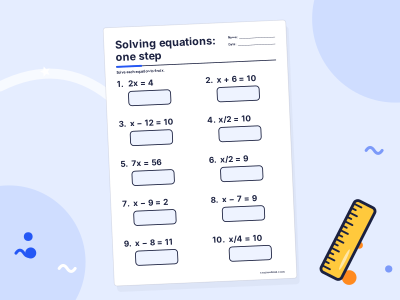
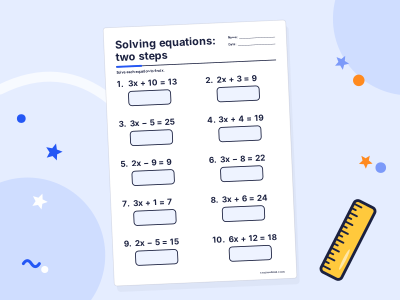
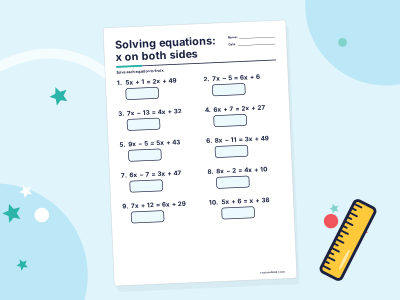
Generated fresh each time you press a button, and marked instantly on screen.

The lesson at a glance

55 minutes in all. Timings are a guide: follow your class.

  1. Step 1: Starter

    "I'm thinking of a number.
    7 minutes
  2. Step 2: Teach

    Draw a balance. On the left, a cup (hiding x cubes) and 5 loose cubes.
    15 minutes
  3. Step 3: Guided practice

    On whiteboards, pupils show every line: x − 8 = 15 4x = 36 x/5 = 7 2x + 9 = 25 5x − 3 = 32 7 + 2x = 21 (same as 2x + 7 = 21; the order of the addition doesn't matter) After each, one pupil substitutes their answer back.
    10 minutes
  4. Step 4: Independent practice

    Use the practice buttons above.
    18 minutes
  5. Step 5: Plenary

    Show a worked solution with an error: 4x + 6 = 30 4x = 36 x = 9 "Where's the mistake?" (Adding 6 instead of subtracting it.) "How would substituting have caught it?" (4 × 9 + 6 = 42, not 30.)
    5 minutes
  6. Step 6: Assessment for learning

    Look for pupils who: choose the correct inverse operation; undo operations in reverse order; apply each operation to both sides; check by substituting without being asked.
  7. Step 7: Differentiation

    Pupils who need support should use cups and cubes for the first few one-step equations, and a "think of a number" flowchart for two-step ones.
  8. Step 8: Common misconceptions

    Doing the operation to one side only.
  9. Step 9: Home link

    Play "think of a number" at home: one person does two steps to a secret number, and the other works backwards to find it.

1.Starter

7 minutes

"I'm thinking of a number. I multiply it by 3 and add 4. I get 19. What's my number?" Take answers and, more importantly, methods. Most pupils will work backwards: 19 − 4 = 15, 15 ÷ 3 = 5. "You just solved an equation. Today we write that thinking down so it works for any number, not just easy ones."

2.Teach

15 minutes

Draw a balance. On the left, a cup (hiding x cubes) and 5 loose cubes. On the right, 12 cubes. "This is x + 5 = 12. The scale balances, so both sides are equal."

"To find what's in the cup, I need the cup alone on one side. If I take 5 cubes off the left, the scale tips, unless I also take 5 off the right." Do it. "x = 7."

"That's the one rule of equations: whatever you do to one side, do to the other. And choose the inverse of what's been done to x."

Now a two-step equation: 3x + 4 = 19.

"Two things have happened to x: it was multiplied by 3, then 4 was added. To undo them, I go in reverse order. Socks go on before shoes, but shoes come off first. Undo the last thing first."

  • "Subtract 4 from both sides: 3x = 15."
  • "Divide both sides by 3: x = 5."
  • "Check: 3 × 5 + 4 = 19. ✓"

Step by step

  1. Spot what's been done to xAnd in which order.
  2. Undo the last operation firstDo the inverse to both sides.
  3. Keep going until x is aloneWrite each step on a new line.
  4. Substitute to checkPut your answer back into the original equation.

The rest of the plan

Guided and independent practice, the plenary, assessment for learning, differentiation, common misconceptions and the home link are free with a Crayonbird account.

  1. Guided practice10 minutes
  2. Independent practice18 minutes
  3. Plenary5 minutes
  4. Assessment for learning
  5. Differentiation
  6. Common misconceptions
  7. Home link

Learning Wiki

Algebra

Algebra is maths that uses letters, like x or n, to stand for numbers we don't know yet or numbers that can change. For example, if n + 3 = 10, then n = 7.

Equations

An equation says two things are equal, using an = sign, like 2x + 1 = 9. Solving it means finding the value of the letter that makes it true, here x = 4.

Percentages

A percentage is a number out of 100, written with the sign %. So 25% means 25 out of every 100, which is the same as one quarter.

  • Maths · Ages 11–12 · 55 min

    Mean, median, mode and range

    Pupils calculate the mean, median, mode and range of a small data set and explain what each one tells you about the data.

  • Maths · Ages 10–11 · 50 min

    Angles in a triangle

    Pupils show that the angles in a triangle add up to 180°, use this and angles on a straight line to find missing angles, and give a reason for each step.

  • Maths · Ages 10–11 · 55 min

    Area and perimeter

    Pupils find the perimeter and area of rectangles and right-angled triangles, use the correct units, and explain the difference between the two measures.