Crayonbird
Menu

Maths · Ages 11–12 · 55 minutes

Mean, median, mode and range

Pupils calculate the mean, median, mode and range of a small data set and explain what each one tells you about the data.

Success criteria

  • I can find the mode and the range
  • I can find the median by ordering the data
  • I can calculate the mean and say which average fits best

Key vocabulary

  • data
  • average
  • mean
  • median
  • mode
  • range
  • order
  • outlier
  • spread

You will need

  • cards with numbers for ordering
  • a set of class data (for example, hand spans in cm or shoe sizes)
  • mini whiteboards
  • calculators for checking
  • Year 7· England
  • Grade 6· United States
  • JSS 1· Nigeria
  • Class 7· India

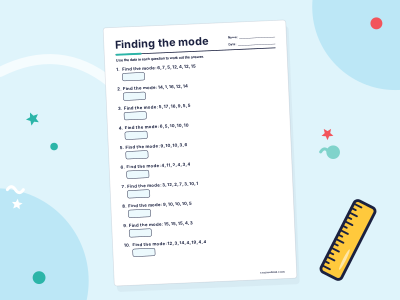
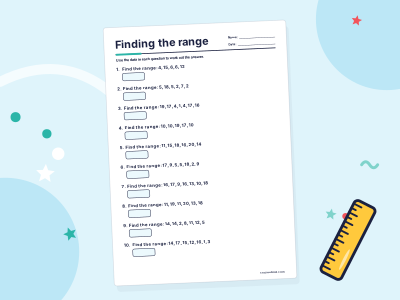
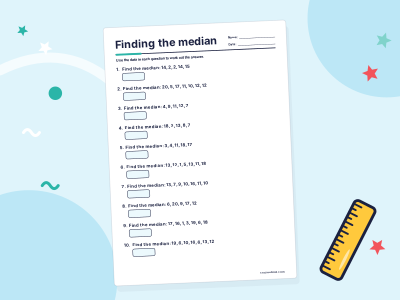
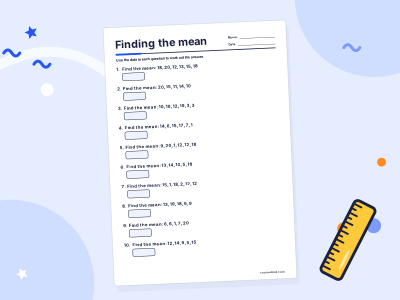
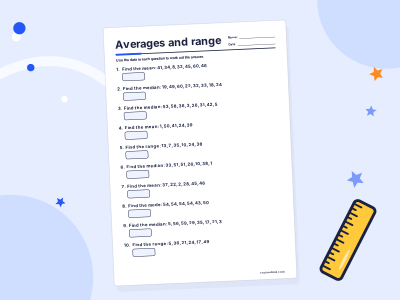
Practice sheets

Generated fresh each time you press a button, and marked instantly on screen.

The lesson at a glance

55 minutes in all. Timings are a guide: follow your class.

  1. Step 1: Starter

    Seven pupils each measure their hand span and write it on a card: for example 16, 18, 15, 18, 17, 21, 14.
    8 minutes
  2. Step 2: Teach

    Use the hand-span cards.
    15 minutes
  3. Step 3: Guided practice

    On whiteboards, for the data set 3, 7, 7, 2, 9, 5, 10, 5, 6: order it; find the mode (two modes: 5 and 7); find the median (6); find the mean (54 ÷ 9 = 6); find the range (8).
    10 minutes
  4. Step 4: Independent practice

    Use the practice buttons above.
    17 minutes
  5. Step 5: Plenary

    "A shop sells shoes in sizes 3 to 10.
    5 minutes
  6. Step 6: Assessment for learning

    Look for pupils who: order the data before finding the median; divide by the number of values (not by 2 or by the largest value) for the mean; understand range as a spread, not an average.
  7. Step 7: Differentiation

    Pupils who need support should use number cards they can physically order and pair up from each end to find the median.
  8. Step 8: Common misconceptions

    Finding the median without ordering the data.
  9. Step 9: Home link

    Record the time it takes to get ready for school each day for a week, then find the mean, median, mode and range together.

1.Starter

8 minutes

Seven pupils each measure their hand span and write it on a card: for example 16, 18, 15, 18, 17, 21, 14. Hold them up, unsorted. "What is a typical hand span in this group?" Take answers and ask how they decided. Some will pick the most common number, some the middle one, some will try to "even them out". All three are averages.

2.Teach

15 minutes

Use the hand-span cards.

"Mode: the most common value. 18 appears twice, so the mode is 18."

"Median: the middle value once the data is in order." Pupils at the front arrange themselves: 14, 15, 16, 17, 18, 18, 21. "The middle one is the 4th of 7: 17. With an even number of values, there are two middle values, and the median is halfway between them."

"Mean: share the total out equally. Add them all: 119. Divide by how many: 119 ÷ 7 = 17."

"Range: not an average. It tells us how spread out the data is. Biggest minus smallest: 21 − 14 = 7."

Step by step

  1. Order the data firstIt makes the median, mode and range much easier.
  2. ModeThe value that appears most often. There can be more than one, or none.
  3. MedianThe middle value. For an even count, the halfway point between the two middle values.
  4. MeanAdd all the values and divide by how many there are.
  5. RangeLargest minus smallest.

Then add a new pupil with a hand span of 45 (a teacher, perhaps). "What happens to each average?" The mean jumps to 20.5; the median moves only to 17.5. "An unusual value, called an outlier, pulls the mean but barely moves the median."


The rest of the plan

Guided and independent practice, the plenary, assessment for learning, differentiation, common misconceptions and the home link are free with a Crayonbird account.

  1. Guided practice10 minutes
  2. Independent practice17 minutes
  3. Plenary5 minutes
  4. Assessment for learning
  5. Differentiation
  6. Common misconceptions
  7. Home link

Learning Wiki

Mean, median and mode

Mean, median and mode are three kinds of average. The mean shares the total out equally, the median is the middle value in order, and the mode is the most common value.

Percentages

A percentage is a number out of 100, written with the sign %. So 25% means 25 out of every 100, which is the same as one quarter.

Prime numbers

A prime number is a whole number greater than 1 that has exactly two factors, 1 and itself. The first primes are 2, 3, 5, 7, 11 and 13.

  • Maths · Ages 11–12 · 55 min

    Solving simple equations

    Pupils solve one- and two-step linear equations by doing the same inverse operation to both sides, and check solutions by substituting back.

  • Maths · Ages 10–11 · 50 min

    Angles in a triangle

    Pupils show that the angles in a triangle add up to 180°, use this and angles on a straight line to find missing angles, and give a reason for each step.

  • Maths · Ages 10–11 · 55 min

    Area and perimeter

    Pupils find the perimeter and area of rectangles and right-angled triangles, use the correct units, and explain the difference between the two measures.