Crayonbird
Menu

English · Ages 5–6 · 50 minutes

Retelling a story in order

Children retell a familiar story in the right order using time words, naming the characters and setting and including the important events.

Success criteria

  • I can name the characters and the setting
  • I can tell the story in the right order
  • I can use time words like first and next and then

Key vocabulary

  • character
  • setting
  • beginning
  • middle
  • end
  • first
  • next
  • then
  • finally

You will need

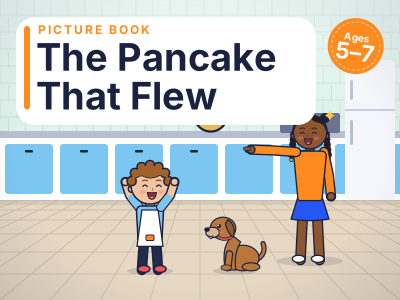
  • the story The Pancake That Flew
  • a frying pan and a paper pancake as props
  • picture cards of key events
  • a washing line and pegs
  • Year 1· England
  • Kindergarten· United States

Practice sheets

Generated fresh each time you press a button, and marked instantly on screen.

The lesson at a glance

50 minutes in all. Timings are a guide: follow your class.

  1. Step 1: Starter

    Hold up the frying pan and paper pancake.
    7 minutes
  2. Step 2: Teach

    "When we retell a story, we tell it again in our own words.
    12 minutes
  3. Step 3: Guided practice

    Pass the pan: sit in a circle.
    10 minutes
  4. Step 4: Independent practice

    Use the practice buttons.
    15 minutes
  5. Step 5: Plenary

    Two children retell the story to the class using their sheets.
    5 minutes
  6. Step 6: Assessment for learning

    Listen to individual retellings.
  7. Step 7: Differentiation

    Support: retell with three cards (beginning, middle, end) rather than five, and handle the props during the retelling.
  8. Step 8: Common misconceptions

    Retelling everything: some children try to recite the whole book word for word.
  9. Step 9: Home link

    After reading a bedtime story, ask your child to tell it back to you in three parts: beginning, middle and end.

This lesson works best once children have heard the story at least once before, for example at story time the day before. Retelling is easier when the story is familiar.

1.Starter

7 minutes

Hold up the frying pan and paper pancake. "Who remembers what happened to Ezra's pancake?"

Take a few ideas, then read The Pancake That Flew aloud again. As you read, flip the paper pancake at "One… two… THREE!" and hold it up "on the lamp".

"Who was in the story? Where did it happen?"

Write two headings: Characters (Ezra, Mama Lotte, Mum Grace, Bami the dog) and Setting (their kitchen in Amsterdam).

2.Teach

12 minutes

"When we retell a story, we tell it again in our own words. We don't need every word from the book, just the important parts, in the right order."

Put five picture cards on the board, jumbled:

  1. Ezra and his mums make pancakes on Saturday.
  2. Ezra does a giant flip.
  3. The pancake gets stuck on the lamp.
  4. The pancake drops into Bami's mouth.
  5. Ezra does a gentle flip and they eat pancakes with strawberries.

"Hmm, these are in a muddle. What happened first?" Peg them on the washing line in order with the class's help.

Then model a retelling, touching each card and stressing the time words:

"First, Ezra and his two mums made pancakes. Next, Ezra said he would do the biggest flip ever. Then the pancake flew up and got stuck on the lamp! After that, it fell into Bami's mouth. Finally, Ezra did a gentle flip and they all ate pancakes."

Write the time words on cards and peg them above the pictures.

The rest of the plan

Guided and independent practice, the plenary, assessment for learning, differentiation, common misconceptions and the home link are free with a Crayonbird account.

  1. Guided practice10 minutes
  2. Independent practice15 minutes
  3. Plenary5 minutes
  4. Assessment for learning
  5. Differentiation
  6. Common misconceptions
  7. Home link

Learning Wiki

Alphabet

The alphabet is the set of 26 letters we use to write English, from a to z, each with a name, a sound and a capital and lowercase shape.

Capital letters

Use a capital letter at the start of every sentence, for names (proper nouns), for the word I, and at the start of direct speech and most titles.

Full stops

A full stop (called a period in the US) is the dot that ends a sentence that is a statement or a calm command. It tells the reader the idea is finished.

  • English · Ages 5–6 · 45 min

    Question marks and exclamation marks

    Children recognise question marks and exclamation marks in a text, read them with the right voice, and end their own questions and exclamations correctly.

  • English · Ages 6–7 · 50 min

    Joining ideas with and, because and but

    Children use the conjunctions and, because and but to join two ideas into one sentence, choosing the one that fits the meaning.