English
When do you use capital letters?
Quick answer
Use a capital letter at the start of every sentence, for names (proper nouns), for the word I, and at the start of direct speech and most titles.
In one sentence
Capital letters (also called uppercase letters) mark the start of a sentence and the names of particular people, places and things.
Explained
Every letter of the alphabet has a capital form and a lowercase form: A a, B b, G g, Q q. Most of what we write is lowercase. Capitals are kept for special jobs, so readers notice them.
Use a capital letter:
- At the start of every sentence. The bus was late.
- For proper nouns: names of people, pets, places, days, months, festivals, languages and organisations. Fatima, Rome, Tuesday, April, Diwali, Spanish. See proper nouns.
- For the word I, wherever it appears. Can I come too?
- At the start of direct speech, even in the middle of a sentence. Dad said, "Time for bed."
- For titles and headings: The Tiny Seed, Mrs Okafor, Doctor Lee.
- For many abbreviations: UK, USA, BBC, NASA.
Do not use capitals for ordinary nouns just because they feel important (my Teacher, the School), for seasons (spring, summer), or for every word in a sentence. WRITING IN ALL CAPITALS looks like shouting.
Handwriting matters too. Capitals sit on the line and reach the full height of tall letters, and in most school handwriting styles they are not joined to the next letter.
 pencil
 book
book globe
globe
Examples
- On Saturday, Maya and I visited Grandma in Kano.
- We celebrate Eid with our cousins.
- "Look out!" shouted Jack.
- My favourite book is The Robot Helper.
- We go swimming in summer. (no capital for summer)
Common mistakes
- A small i. Always I, even in a text message.
- Capitals in the middle of words (bAnana), often from mixing letter shapes. Practise lowercase letters until they are automatic.
- Forgetting the capital after a full stop. Each new sentence needs one; see full stops.
- Capitalising seasons or school subjects. maths and science are lower case; English and French get capitals because they are languages.
Quick quiz
Capital letters
Check what you know with 4 quick questions.
Question 1 of 4
Which sentence uses capital letters correctly?
Practise it
Try it
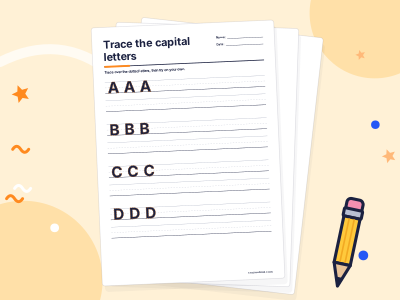
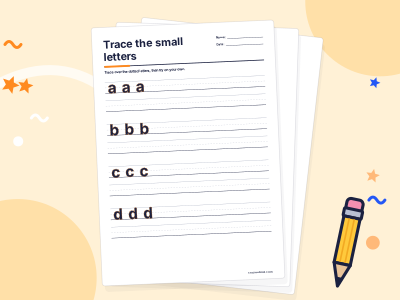
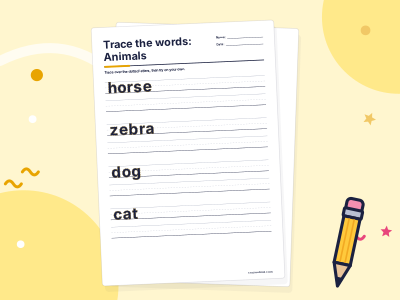
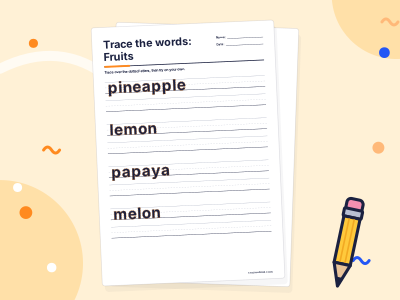
Practise capital and lowercase letters
For grown-ups
Related topics
Proper nouns
A proper noun is the name of one particular person, place, day, month or thing, like Zainab, Paris or Tuesday. Proper nouns always begin with a capital letter.
Sentences
A sentence is a group of words that makes complete sense on its own. It starts with a capital letter, ends with a full stop, question mark or exclamation mark, and usually has a verb.
Full stops
A full stop (called a period in the US) is the dot that ends a sentence that is a statement or a calm command. It tells the reader the idea is finished.
Inverted commas
Inverted commas, also called speech marks or quotation marks, go around the exact words someone says, like "Come here," said Mum.
Alphabet
The alphabet is the set of 26 letters we use to write English, from a to z, each with a name, a sound and a capital and lowercase shape.
Question marks
A question mark (?) goes at the end of a sentence that asks a direct question, like Where are my shoes? It replaces the full stop.