English
What is the alphabet?
Quick answer
The alphabet is the set of 26 letters we use to write English, from a to z, each with a name, a sound and a capital and lowercase shape.
In one sentence
The alphabet is the 26 letters we use to write every English word, always kept in the same order from a to z.
Explained
Every letter has three things a child needs to learn. It has a name (the letter b is called "bee"), it stands for at least one sound (b says /b/, as in bat), and it has two shapes: a capital, or uppercase, letter (B) and a lowercase letter (b).
Names and sounds are not the same. The letter w is called "double-u" but it says /w/ at the start of wet. When children read and spell, the sound is what they use. When they talk about letters, or put words in order, they use the name.
The order of the alphabet matters because dictionaries, glossaries, register lists and indexes all use it. To put words in alphabetical order, compare the first letters. If they match, compare the second letters: bag comes before bed because a comes before e.
One small difference: in the UK, Nigeria, India, Australia and Canada the last letter is usually called "zed"; in the US it is "zee". Both are correct.
 apple
apple ball
ball cat
cat dog
dog egg
egg
Examples
| Letter name | Capital | Lowercase | Sound | Word |
|---|---|---|---|---|
| ay | A | a | /a/ | ant |
| bee | B | b | /b/ | bus |
| em | M | m | /m/ | map |
| ess | S | s | /s/ | sun |
| zed / zee | Z | z | /z/ | zebra |
Alphabetical order in action: ant, bee, cat, dog or sand, sea, sock, sun.
Common mistakes
- Mixing up b and d. Try "the bat comes before the ball": draw the bat (the stick) first, then the ball for b.
- Running l-m-n-o-p together in the alphabet song. Slow that line down and point to each letter.
- Saying the letter name when sounding out. "Cee-ay-tee" does not blend into cat; the sounds /c/ /a/ /t/ do. See phonics.
- Using only capitals. Most of what children read is lowercase, so learn both shapes together.
Quick quiz
Alphabet
Check what you know with 4 quick questions.
Question 1 of 4
How many letters are in the English alphabet?
Practise it
Try it
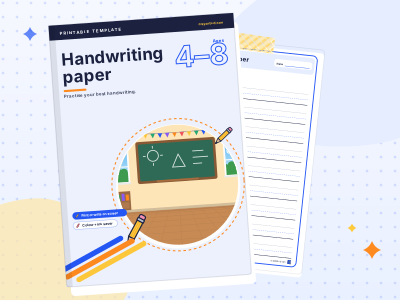
Practise forming every letter
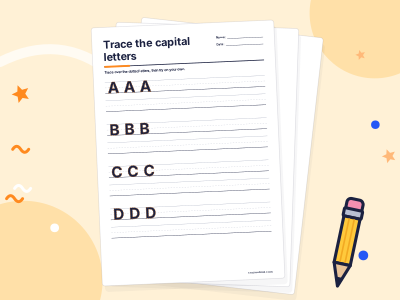
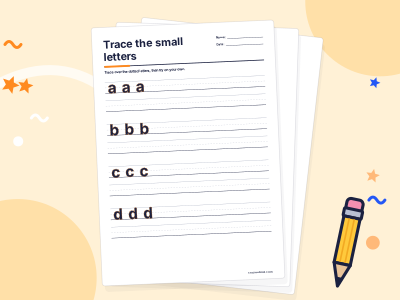
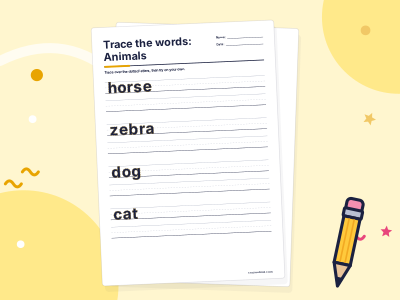
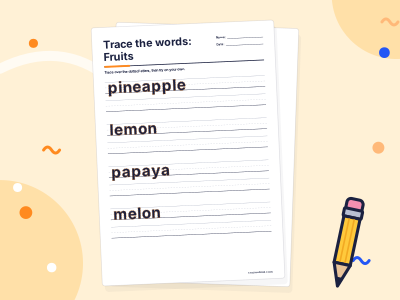
For grown-ups
Related topics
Vowels and consonants
The vowel letters are a, e, i, o and u (and sometimes y); all the other letters are consonants. Almost every English word needs a vowel sound.
Phonics
Phonics teaches children to read and spell by linking sounds (phonemes) with the letters that write them (graphemes), then blending and segmenting those sounds.
Capital letters
Use a capital letter at the start of every sentence, for names (proper nouns), for the word I, and at the start of direct speech and most titles.
Rhyme
Words rhyme when their ending sounds match, like cat and hat, or light and bite. Rhymes depend on sound, not spelling.
Adjectives
An adjective is a word that describes a noun, telling you what kind, which one or how many, like a huge elephant, a sour lemon or three red balloons.
Adverbs
An adverb gives more information about a verb, adjective or another adverb, telling how, when, where or how often, like slowly, tomorrow, outside or always.