Crayonbird
Menu

English · Ages 5–6 · 45 minutes

Question marks and exclamation marks

Children recognise question marks and exclamation marks in a text, read them with the right voice, and end their own questions and exclamations correctly.

Success criteria

  • I can spot a question mark and an exclamation mark
  • I can read them with the right voice
  • I can write a question that ends with a question mark

Key vocabulary

  • question
  • question mark
  • exclamation mark
  • full stop
  • sentence
  • ask

You will need

  • large cards showing . ? and !
  • a puppet or toy
  • a picture of a busy scene
  • mini whiteboards
  • Year 1· England
  • Kindergarten· United States

Practice sheets

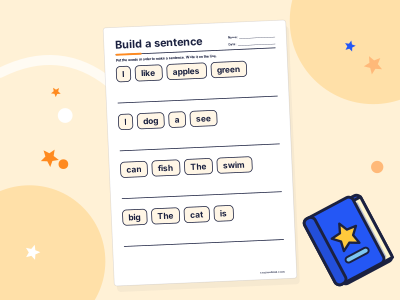
Generated fresh each time you press a button, and marked instantly on screen.

The lesson at a glance

45 minutes in all. Timings are a guide: follow your class.

  1. Step 1: Starter

    Bring in a puppet. "Puppet has come to visit, and you can ask it anything.
    6 minutes
  2. Step 2: Teach

    Show the three cards: .
    12 minutes
  3. Step 3: Guided practice

    Which ending? Read sentences aloud without showing them.
    8 minutes
  4. Step 4: Independent practice

    Use the practice buttons below.
    12 minutes
  5. Step 5: Plenary

    Hot-seat: one child holds the puppet.
    5 minutes
  6. Step 6: Assessment for learning

    When reading aloud, does the child's voice change at ?
  7. Step 7: Differentiation

    Support: focus on question marks only.
  8. Step 8: Common misconceptions

    Any sentence with a question word is a question: I know where it is.
  9. Step 9: Home link

    Read a picture book together and let your child do the voices when there's a question mark or an exclamation mark.

1.Starter

6 minutes

Bring in a puppet. "Puppet has come to visit, and you can ask it anything. What would you like to know?"

Children ask: "What's your name?" "Where do you live?" "Do you like pizza?" Have the puppet answer each one.

"You all did something clever. You asked. When we ask, our voice goes up at the end. Listen: Do you like pizza? We are waiting for an answer."

2.Teach

12 minutes

Show the three cards: . ? !

"We know the full stop. It ends a telling sentence. Today we're meeting two more ways to end a sentence."

Question mark (?): "This ends a sentence that asks something. It needs an answer. Lots of questions start with a question word."

Write the question words on the board as children say them: who, what, where, when, why, how. Then show that questions can start other ways too: Can you swim? Is it raining? Do you like cats?

Exclamation mark (!): "This shows a big feeling: surprise, excitement, fear, or something said loudly."

Model reading three versions of the same words:

  • It is a dog. (calm)
  • Is it a dog? (voice goes up)
  • It is a dog! (surprised, wide eyes)

Children copy each voice.

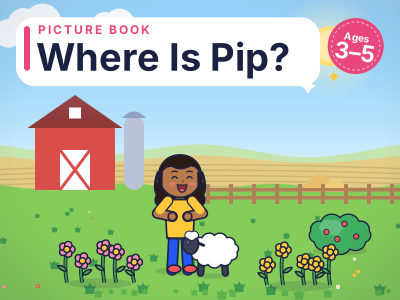
Share Where Is Pip? (the first practice text), reading it aloud with expression: Is Pip behind the haystack? No! It is the brown hen.

"What did you hear my voice do? Who can find a question mark? An exclamation mark?"

The rest of the plan

Guided and independent practice, the plenary, assessment for learning, differentiation, common misconceptions and the home link are free with a Crayonbird account.

  1. Guided practice8 minutes
  2. Independent practice12 minutes
  3. Plenary5 minutes
  4. Assessment for learning
  5. Differentiation
  6. Common misconceptions
  7. Home link

Learning Wiki

Alphabet

The alphabet is the set of 26 letters we use to write English, from a to z, each with a name, a sound and a capital and lowercase shape.

Capital letters

Use a capital letter at the start of every sentence, for names (proper nouns), for the word I, and at the start of direct speech and most titles.

Full stops

A full stop (called a period in the US) is the dot that ends a sentence that is a statement or a calm command. It tells the reader the idea is finished.

  • English · Ages 5–6 · 50 min

    Retelling a story in order

    Children retell a familiar story in the right order using time words, naming the characters and setting and including the important events.

  • English · Ages 6–7 · 50 min

    Joining ideas with and, because and but

    Children use the conjunctions and, because and but to join two ideas into one sentence, choosing the one that fits the meaning.