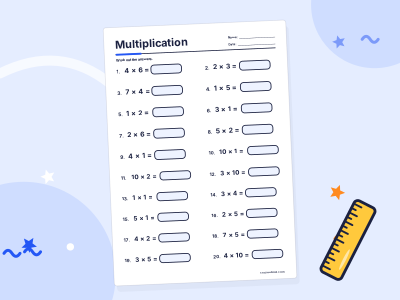
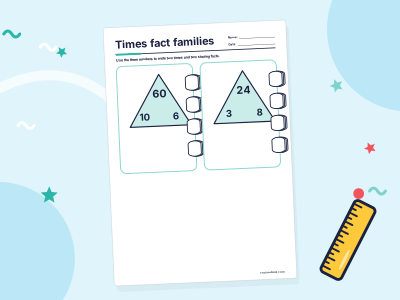
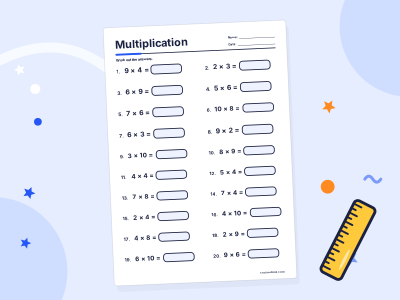
Multiplication
Multiplication is adding equal groups quickly. 4 × 3 means 4 groups of 3 (or 3 groups of 4), which makes 12. The answer is called the product.
Maths · Ages 7–8 · 50 minutes
Children use arrays to represent multiplication, write two multiplication facts for each array and use an array to work out a fact they don't know.
Generated fresh each time you press a button, and marked instantly on screen.
Show a picture of an egg box with 2 rows of 6. "How many eggs? Don't count in ones." Take answers and methods: 6 + 6, 2 lots of 6, counting in 2s down the columns. Celebrate every method that works.
Quick recall on whiteboards: 5 × 2, 3 × 10, 4 × 5.
Build an array with counters: 3 rows of 4.
"An array is objects arranged in rows and columns. Rows go across, like seats in a cinema. Columns go up and down, like pillars. This array has 3 rows with 4 in each row. So it's 3 × 4 = 12."
Turn the board (or the tray) a quarter turn. "Now how many rows? 4 rows of 3. Did the number of counters change? No. So 4 × 3 = 12 too. One array, two facts."
Step by step
Now the useful part. Draw a 6 × 7 array on squared paper. "I don't know 6 × 7 yet. But I can split the array." Draw a line after 5 rows. "5 rows of 7 is 35. 1 more row of 7 is 7. 35 + 7 = 42. So 6 × 7 = 42."