Crayonbird
Menu

Maths · Ages 7–8 · 50 minutes

Division as sharing and grouping

Children solve division by sharing into equal groups and by making groups of a given size, and use multiplication facts to find the answer faster.

Success criteria

  • I can share equally
  • I can make equal groups of a size
  • I can use a times fact to divide

Key vocabulary

  • divide
  • share
  • group
  • equal
  • each
  • remainder
  • inverse

You will need

  • counters
  • paper plates or hoops
  • cubes
  • mini whiteboards
  • a bag of 20 small items
  • Year 3· England
  • Grade 2· United States
  • Primary 3· Nigeria
  • Class 3· India

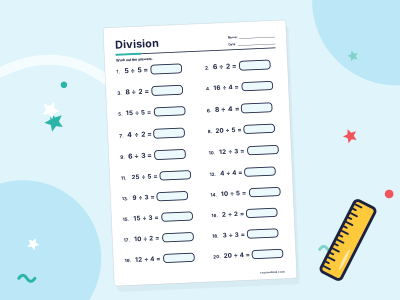
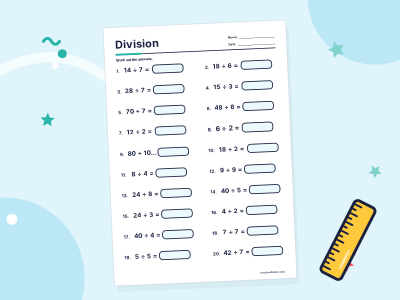
Practice sheets

Generated fresh each time you press a button, and marked instantly on screen.

The lesson at a glance

50 minutes in all. Timings are a guide: follow your class.

  1. Step 1: Starter

    Two quick stories, acted out with children: "I have 12 cookies and 3 friends.
    8 minutes
  2. Step 2: Teach

    Sharing. Put 3 plates on the table and deal 15 counters one at a time: "one for you, one for you, one for you", round and round.
    12 minutes
  3. Step 3: Guided practice

    Pairs with counters and plates.
    10 minutes
  4. Step 4: Independent practice

    Use the practice buttons above.
    15 minutes
  5. Step 5: Plenary

    Write 24 ÷ 4 = ? and ask for two stories: one sharing, one grouping.
    5 minutes
  6. Step 6: Assessment for learning

    Look for children who: share one at a time and check the groups are equal; choose grouping when the group size is given; use multiplication facts to divide without modelling.
  7. Step 7: Differentiation

    Children who need support should model every question with counters and plates.
  8. Step 8: Common misconceptions

    Sharing unequally. Fix: deal one at a time, round and round, and check every group at the end.
  9. Step 9: Home link

    When serving food, ask your child to share it equally, such as 12 grapes between 3 bowls, and say the division fact.

1.Starter

8 minutes

Two quick stories, acted out with children:

  • "I have 12 cookies and 3 friends. I want to share them fairly. How many each?"
  • "I have 12 cookies. I put them in bags of 3. How many bags?"

Write 12 ÷ 3 = 4 for both. "Two different stories, same number sentence. Let's find out why."

2.Teach

12 minutes

Sharing. Put 3 plates on the table and deal 15 counters one at a time: "one for you, one for you, one for you", round and round. "Each plate has 5. 15 shared between 3 is 5. 15 ÷ 3 = 5."

Grouping. Start again with 15 counters. "This time I make groups of 3." Pull out groups of three and count the groups: 5 groups. "15 ÷ 3 = 5 again."

"Sharing asks: how many in each group? Grouping asks: how many groups? Division answers both."

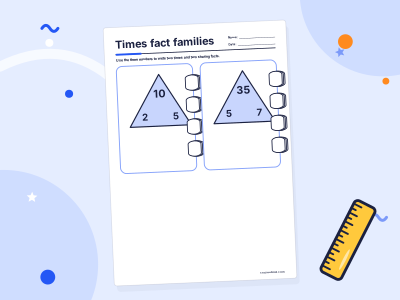
Then show the shortcut. "If I know 3 × 5 = 15, I know 15 ÷ 3 = 5. Division undoes multiplication. That's called the inverse."

Step by step

  1. Read the questionDo you know the number of groups (share) or the size of each group (group)?
  2. Model itDeal out or make groups with counters, or draw it.
  3. Check with a times factAnswer × the number you divided by should give you the number you started with.

Finish with one that doesn't work out: 14 ÷ 3. Group in 3s: 4 groups, 2 left over. "That's a remainder. We'll do more with those another day, but it's good to know it can happen."


The rest of the plan

Guided and independent practice, the plenary, assessment for learning, differentiation, common misconceptions and the home link are free with a Crayonbird account.

  1. Guided practice10 minutes
  2. Independent practice15 minutes
  3. Plenary5 minutes
  4. Assessment for learning
  5. Differentiation
  6. Common misconceptions
  7. Home link

Learning Wiki

Division

Division is sharing into equal groups, or finding how many groups fit. The sign is ÷, so 12 ÷ 3 = 4. The answer is called the quotient.

Pictograms

A pictogram shows data using small pictures or symbols. A key tells you what each picture is worth, such as one apple standing for 2 apples. In the US it is often called a picture graph.

Subtraction

Subtraction is taking one amount away from another, or finding the difference between two numbers. The sign is −, so 9 − 4 = 5.

  • Maths · Ages 7–8 · 55 min

    Tally charts and bar charts

    Children collect data with a tally chart, draw a bar chart from it with a labelled scale, and answer "how many more" questions from the chart.

  • Maths · Ages 7–8 · 50 min

    Column addition with exchanging

    Children add two-digit numbers using the column method, lining up digits by place value and exchanging ten ones for one ten.

  • Maths · Ages 7–8 · 50 min

    Measuring length in centimetres and metres

    Children measure lengths accurately with a ruler starting from zero, record them in centimetres and metres, and add lengths to find a total.