Crayonbird
Menu

Maths · Ages 7–8 · 50 minutes

Measuring length in centimetres and metres

Children measure lengths accurately with a ruler starting from zero, record them in centimetres and metres, and add lengths to find a total.

Success criteria

  • I can line up the zero with the end of the object
  • I can read a length in cm
  • I can add lengths together

Key vocabulary

  • length
  • measure
  • ruler
  • centimetre
  • cm
  • metre
  • m
  • estimate
  • total
  • perimeter

You will need

  • 30 cm rulers
  • metre sticks
  • tape measures
  • a set of classroom objects to measure (pencils, books, scissors)
  • string
  • mini whiteboards
  • Year 3· England
  • Grade 2· United States
  • Primary 3· Nigeria
  • Class 3· India

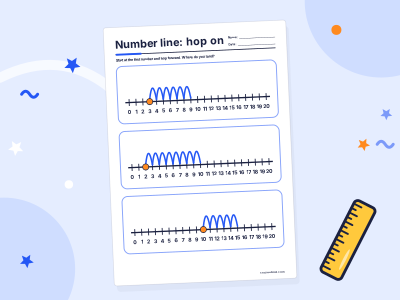
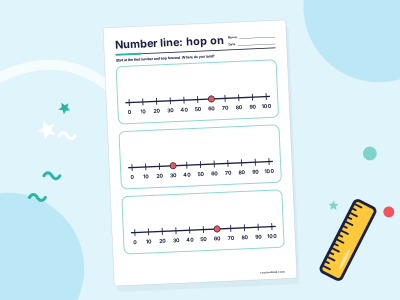
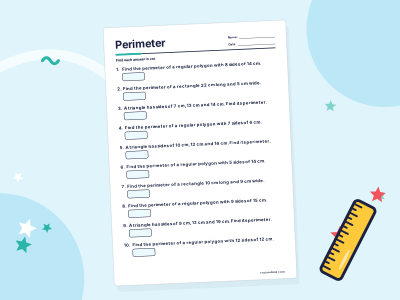
Practice sheets

Generated fresh each time you press a button, and marked instantly on screen.

The lesson at a glance

50 minutes in all. Timings are a guide: follow your class.

  1. Step 1: Starter

    Hold up a pencil. "How long do you think this is?" Children write an estimate in cm on whiteboards.
    8 minutes
  2. Step 2: Teach

    Put a ruler under a visualiser or draw a large one on the board.
    12 minutes
  3. Step 3: Guided practice

    Pairs measure four things: a pencil, a book, a pair of scissors and a hand span.
    10 minutes
  4. Step 4: Independent practice

    Use the practice buttons above.
    15 minutes
  5. Step 5: Plenary

    Show a ruler photo with an object lined up at 2 and reaching 9.
    5 minutes
  6. Step 6: Assessment for learning

    Look for children who: line up the zero, not the end of the ruler; write the unit every time; choose cm or m sensibly; make estimates that get closer as the lesson goes on.
  7. Step 7: Differentiation

    Children who need support should measure objects that are a whole number of centimetres long, chosen in advance.
  8. Step 8: Common misconceptions

    Starting from the end of the ruler instead of 0.
  9. Step 9: Home link

    Measure things at home with a tape measure, such as a bed, a door or a shoe, and guess first.

1.Starter

8 minutes

Hold up a pencil. "How long do you think this is?" Children write an estimate in cm on whiteboards. Take a few, then ask: "How could we find out for sure?"

Show a ruler that has a gap before the zero. "Where does the measuring start: at the very end of the ruler, or somewhere else?" Leave the question for the teach.

2.Teach

12 minutes

Put a ruler under a visualiser or draw a large one on the board.

"A ruler is a number line. Each gap between numbers is one centimetre. The measuring starts at zero, not at the end of the plastic."

Line up a pencil with the zero. "The end of the pencil lines up with 0. The tip reaches 14. So it's 14 centimetres. We write 14 cm."

Now show a common mistake: line the pencil up at 1. "My friend got 15. Why?" (They started at 1, so they counted one centimetre too many.)

Step by step

  1. Line up the zeroThe end of the object sits exactly on 0.
  2. Keep it straightThe object lies along the ruler, not at an angle.
  3. Read the number at the other endAnd write the unit: cm or m.

Introduce metres with a metre stick. "100 centimetres make 1 metre. We use metres for bigger things, like the length of the classroom."

Then add lengths. "A table is 80 cm long. Another table is 70 cm. Pushed together, how long?" Count on in tens on a 0–200 number line: 80, 90, 100... 150. "150 cm. That's 1 metre and 50 centimetres."


The rest of the plan

Guided and independent practice, the plenary, assessment for learning, differentiation, common misconceptions and the home link are free with a Crayonbird account.

  1. Guided practice10 minutes
  2. Independent practice15 minutes
  3. Plenary5 minutes
  4. Assessment for learning
  5. Differentiation
  6. Common misconceptions
  7. Home link

Learning Wiki

Perimeter

Perimeter is the total distance all the way around the outside of a flat shape. For a rectangle 5 cm long and 3 cm wide, it is 5 + 3 + 5 + 3 = 16 cm.

Angles

An angle measures the amount of turn between two lines that meet at a point. Angles are measured in degrees (°); a right angle is 90° and a full turn is 360°.

Area

Area is the amount of flat space inside a shape, measured in square units like cm² or m². A rectangle 4 cm by 3 cm has an area of 4 × 3 = 12 cm².

  • Maths · Ages 7–8 · 55 min

    Tally charts and bar charts

    Children collect data with a tally chart, draw a bar chart from it with a labelled scale, and answer "how many more" questions from the chart.

  • Maths · Ages 7–8 · 50 min

    Column addition with exchanging

    Children add two-digit numbers using the column method, lining up digits by place value and exchanging ten ones for one ten.

  • Maths · Ages 7–8 · 50 min

    Division as sharing and grouping

    Children solve division by sharing into equal groups and by making groups of a given size, and use multiplication facts to find the answer faster.