Maths
How do you use the quadratic formula, and what does the discriminant tell you?
Quick answer
The quadratic formula x = (−b ± √(b² − 4ac)) / 2a solves any equation ax² + bx + c = 0. The discriminant b² − 4ac tells you whether there are two, one or no real solutions.



In one sentence
The quadratic formula gives both solutions of any quadratic equation, and the discriminant, the part under the square root, tells you in advance how many real solutions there are.
Explained
Every quadratic equation can be written as ax² + bx + c = 0, with a ≠ 0. The quadratic formula solves it in one go:
x = (−b ± √(b² − 4ac)) / 2a
The sign ± ("plus or minus") means you calculate twice: once with + and once with −. That gives the two solutions, often called x₁ and x₂, or the roots of the equation. The page on quadratic equations compares the formula with factorising; this page takes the formula itself apart.
 notebook
 pencil
 rocket
Two halves of the formula. Split the fraction into two parts:
x = −b/2a ± √(b² − 4ac)/2a
The first part, −b/2a, is the x-coordinate of the vertex of the parabola y = ax² + bx + c: the middle of the curve. The second part is how far each solution lies from that middle, once to the right and once to the left. That is why the two solutions are always symmetrical around the vertex, and why they always add up to −b/a.
The discriminant. The expression under the root, b² − 4ac, is called the discriminant (in many countries it is written Δ, the Greek capital letter delta, or D). It "discriminates" between the possible cases before you do any more work:
- b² − 4ac > 0: two different real solutions. The parabola crosses the x-axis twice. If the discriminant is also a perfect square (1, 4, 9, 16 …) and a, b, c are whole numbers, the solutions are whole numbers or fractions, and the quadratic could also be factorised. If not, the answers contain a square root (a surd), like 2 ± √3.
- b² − 4ac = 0: one repeated solution, x = −b/2a. The parabola just touches the x-axis at its vertex.
- b² − 4ac < 0: no real solutions, because a negative number has no real square root. The parabola never reaches the x-axis. (Later, with complex numbers, these equations do get solutions.)
Where the formula comes from. It is what you get by completing the square on ax² + bx + c = 0. Divide by a, move c/a across, and add (b/2a)² to both sides: (x + b/2a)² = (b² − 4ac)/4a². Take the square root of both sides, remembering ±, and subtract b/2a. The result is the formula. So the formula is not magic: it is completing the square done once, for every quadratic at the same time.
A quick check. For any quadratic with solutions x₁ and x₂: x₁ + x₂ = −b/a and x₁ × x₂ = c/a. After solving, add and multiply your answers. If they do not match, look for a sign error.
Examples
| Equation | a, b, c | b² − 4ac | What it tells you | Solutions |
|---|---|---|---|---|
| x² − 3x − 10 = 0 | 1, −3, −10 | 9 + 40 = 49 | two, whole numbers (49 = 7²) | (3 ± 7)/2: x = 5 or x = −2 |
| 2x² + x − 6 = 0 | 2, 1, −6 | 1 + 48 = 49 | two, rational | (−1 ± 7)/4: x = 3/2 or x = −2 |
| 4x² − 12x + 9 = 0 | 4, −12, 9 | 144 − 144 = 0 | one repeated | x = 12/8 = 3/2 |
| x² + 6x + 7 = 0 | 1, 6, 7 | 36 − 28 = 8 | two, with surds | x = −3 ± √2 |
| 3x² + 2x + 1 = 0 | 3, 2, 1 | 4 − 12 = −8 | none | no real solutions |
Worked example: solve 2x² − 4x − 3 = 0. Here a = 2, b = −4 and c = −3. The discriminant is (−4)² − 4 × 2 × (−3) = 16 + 24 = 40, which is positive, so there are two solutions. √40 = √(4 × 10) = 2√10. So x = (4 ± 2√10)/4 = (2 ± √10)/2, which is about x ≈ 2.58 or x ≈ −0.58. Check: 2.58 + (−0.58) = 2 = −b/a = 4/2 ✓, and the exact product is (4 − 10)/4 = −3/2 = c/a ✓.
Common mistakes
- Squaring a negative b wrongly. If b = −4, then b² = (−4)² = 16, never −16. On a calculator, use brackets.
- Missing a double negative in −4ac. If c is negative, −4ac becomes positive: −4 × 2 × (−3) = +24.
- Dividing only part of the top by 2a. The whole of −b ± √(b² − 4ac) sits over 2a. Write one long fraction line.
- Cancelling only one term. (4 ± 2√10)/4 is (2 ± √10)/2: divide every term by 2. It is not 1 ± 2√10.
- Forgetting to make one side zero. For 5x² − 2x = 1, first rewrite it as 5x² − 2x − 1 = 0, so c = −1.
Step by step
Step by step
- Set it to zeroRearrange the equation into ax² + bx + c = 0.
- List a, b and cWrite them down with their signs, for example a = 2, b = −4, c = −3.
- Find the discriminantWork out b² − 4ac. Positive: two solutions. Zero: one. Negative: stop, no real solutions.
- Take the square rootFind √(b² − 4ac). Simplify the surd if you need an exact answer, or use a calculator for decimals.
- Do + and −X₁ = (−b + √(b² − 4ac)) / 2a and x₂ = (−b − √(b² − 4ac)) / 2a.
- CheckDo the solutions add up to −b/a and multiply to c/a? Or substitute them back into the equation.
Practice questions
Use the formula and the discriminant
Try each one, then check your answer.
- Find the discriminant of x² + 5x + 4 = 0.
Show answer
5² − 4 × 1 × 4 = 25 − 16 = 9 - Find the discriminant of 2x² − 3x + 5 = 0.
Show answer
(−3)² − 4 × 2 × 5 = 9 − 40 = −31 - How many real solutions does x² − 10x + 25 = 0 have?
Show answer
100 − 100 = 0, so one (repeated): x = 5 - How many real solutions does 3x² + x − 2 = 0 have?
Show answer
1 + 24 = 25 > 0, so two - How many real solutions does x² + 4x + 9 = 0 have?
Show answer
16 − 36 = −20 < 0, so none - Solve x² + 5x + 4 = 0 with the formula.
Show answer
x = (−5 ± √9)/2 = (−5 ± 3)/2, so x = −1 or x = −4 - Solve x² − 2x − 8 = 0.
Show answer
b² − 4ac = 4 + 32 = 36; x = (2 ± 6)/2, so x = 4 or x = −2 - Solve 3x² + x − 2 = 0.
Show answer
b² − 4ac = 25; x = (−1 ± 5)/6, so x = 2/3 or x = −1 - Solve 4x² + 4x + 1 = 0.
Show answer
b² − 4ac = 16 − 16 = 0; x = −4/8, so x = −1/2 (repeated) - Solve x² − 4x + 1 = 0, giving exact answers.
Show answer
b² − 4ac = 16 − 4 = 12 and √12 = 2√3; x = (4 ± 2√3)/2, so x = 2 ± √3 - Solve x² + 2x − 4 = 0, giving exact answers.
Show answer
b² − 4ac = 4 + 16 = 20 and √20 = 2√5; x = (−2 ± 2√5)/2, so x = −1 ± √5 - Solve 2x² + 3x − 1 = 0 to 2 decimal places.
Show answer
b² − 4ac = 9 + 8 = 17; x = (−3 ± √17)/4, so x ≈ 0.28 or x ≈ −1.78 - Solve 5x² − 2x = 1, giving exact answers.
Show answer
5x² − 2x − 1 = 0; b² − 4ac = 4 + 20 = 24 and √24 = 2√6; x = (2 ± 2√6)/10, so x = (1 ± √6)/5 (≈ 0.69 or −0.29) - For which values of k does x² + kx + 16 = 0 have exactly one solution?
Show answer
k² − 64 = 0, so k = 8 or k = −8 - For which values of c does x² − 6x + c = 0 have two real solutions?
Show answer
36 − 4c > 0, so c < 9 - Without solving, find the sum and the product of the solutions of 3x² − 12x + 5 = 0.
Show answer
Sum = −b/a = 12/3 = 4; product = c/a = 5/3
Word problems
The formula in real life
Try each one, then check your answer.
- A ball is thrown from 2 m above the ground. Its height after t seconds is h = −5t² + 15t + 2 metres. When does it land, to 2 decimal places?
Show answer
−5t² + 15t + 2 = 0, so 5t² − 15t − 2 = 0; b² − 4ac = 225 + 40 = 265; t = (15 ± √265)/10. Time cannot be negative, so t ≈ 3.13 seconds - Can the same ball reach 15 m?
Show answer
−5t² + 15t + 2 = 15 gives 5t² − 15t + 13 = 0; b² − 4ac = 225 − 260 = −35 < 0, so no (its highest point is 13.25 m, at t = 1.5 s) - A rectangle is 2 cm longer than it is wide and has an area of 20 cm². How wide is it, to 2 decimal places?
Show answer
x(x + 2) = 20, so x² + 2x − 20 = 0; b² − 4ac = 4 + 80 = 84; x = (−2 + √84)/2, so x ≈ 3.58 cm (and 5.58 cm long) - A 10 m by 6 m garden has a path of equal width x all round it. Garden and path together cover 96 m². How wide is the path?
Show answer
(10 + 2x)(6 + 2x) = 96, so 4x² + 32x − 36 = 0, or x² + 8x − 9 = 0; b² − 4ac = 64 + 36 = 100; x = (−8 ± 10)/2. A width is positive, so x = 1 m - A number plus its square makes 30. What could the number be?
Show answer
n² + n − 30 = 0; b² − 4ac = 1 + 120 = 121; n = (−1 ± 11)/2, so n = 5 or n = −6
Questions people ask
What is the discriminant, and how do you find it?
It is b² − 4ac, the expression under the square root in the quadratic formula. Read a, b and c from ax² + bx + c = 0 and calculate it. Its sign tells you the number of real solutions: positive two, zero one, negative none.
What does a negative discriminant mean?
The equation has no real solutions, because you cannot take the square root of a negative number using real numbers. On a graph, the parabola stays completely above or completely below the x-axis.
What is the quadratic formula called in other countries?
The formula is the same everywhere, but the name changes. In Brazil it is the "fórmula de Bhaskara", after the 12th-century Indian mathematician Bhāskara II, even though people solved quadratics long before him. In Germany it is the "Mitternachtsformel" (midnight formula) or abc-Formel, in Spain and Mexico the "fórmula general", in Italy the "formula risolutiva", and in India it is often called Sridharacharya's formula.
How do you remember the quadratic formula?
Many students sing it to the tune of "Pop Goes the Weasel": "x equals negative b, plus or minus the square root, of b squared minus four a c, all over two a." Writing it at the top of the page before each question also helps it stick.
How do you do the quadratic formula on a calculator?
Calculate the discriminant first and write it down. Then type (−b + √D) ÷ (2a) and (−b − √D) ÷ (2a), with brackets around the whole top and the whole bottom. Many scientific calculators have an equation mode that solves ax² + bx + c = 0 directly, and on a graphing calculator such as the TI-84 you can graph the parabola and use "zero" in the CALC menu. Use these to check, not to skip the working.
What is the quadratic formula used for in real life?
Anywhere a quantity depends on a square: the flight of a ball or a rocket in physics, areas of rectangles and frames, stopping distances, and the shape of arches and satellite dishes. It finds when a projectile lands or which width gives a certain area.
Quick quiz
The quadratic formula and the discriminant
Check what you know with 5 quick questions.
Question 1 of 5
What is the discriminant of x² − 3x − 10 = 0?
Practise it
Try it
Practise the quadratic formula with unlimited questions
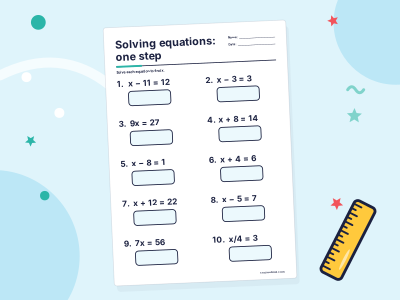
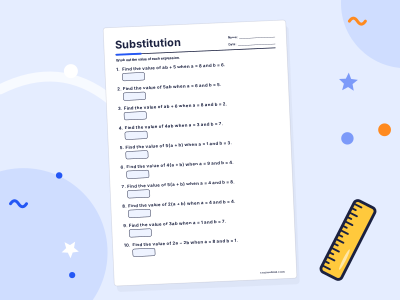
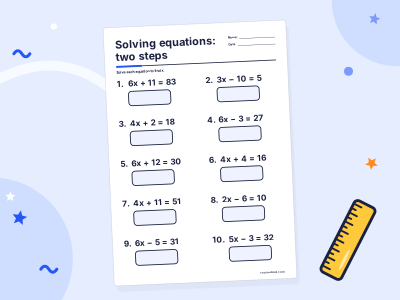
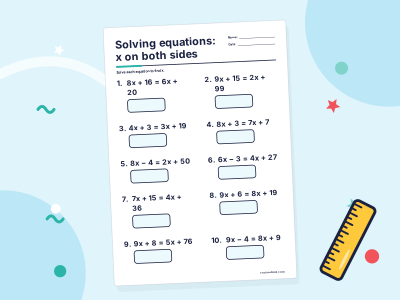
Algebra worksheets


Practise it step by step in a full course: Grade 10 Maths
For grown-ups
Related topics

Quadratic equations and the quadratic formula
A quadratic equation looks like ax² + bx + c = 0. The quadratic formula x = (−b ± √(b² − 4ac)) ÷ 2a solves every one, and b² − 4ac tells you how many solutions there are.

Completing the square
Completing the square rewrites x² + bx + c as (x + b/2)² − (b/2)² + c. It solves quadratics, finds the vertex (turning point) of a parabola and proves the quadratic formula.

Square roots
The square root of a number is the value that, multiplied by itself, gives that number. The square root of 25 is 5, because 5 × 5 = 25. The sign is √.
Vertex of a parabola
The vertex is the turning point of a parabola: its lowest or highest point. For y = ax² + bx + c it is at x = −b/2a; put that x back into the equation to get y.

x-intercepts and y-intercepts
The y-intercept is where a graph crosses the y-axis: put x = 0. An x-intercept is where it crosses the x-axis: put y = 0. For y = 2x − 6 they are (0, −6) and (3, 0).

Algebra
Algebra is maths that uses letters, like x or n, to stand for numbers we don't know yet or numbers that can change. For example, if n + 3 = 10, then n = 7.