Maths
What is the quadratic formula, and how do you solve quadratic equations?
Quick answer
A quadratic equation looks like ax² + bx + c = 0. The quadratic formula x = (−b ± √(b² − 4ac)) ÷ 2a solves every one, and b² − 4ac tells you how many solutions there are.


In one sentence
A quadratic equation has an x² term, like x² − 5x + 6 = 0, and you solve it by factorising, by taking square roots, or with the quadratic formula.
Explained
A quadratic equation is any equation that can be written as
ax² + bx + c = 0, where a is not 0.
The highest power of x is 2 (that is what "quadratic" means: from the Latin quadratus, "square"). Here a, b and c are numbers called the coefficients. In 3x² + 2x − 8 = 0, a = 3, b = 2 and c = −8. Unlike the linear equations you met first, a quadratic usually has two solutions (also called roots).
 ball
 rocket
 bridge
Why two? Think of a ball thrown up in the air. Its height follows a curve called a parabola. If you ask "when is the ball 15 m high?", there are two answers: once on the way up and once on the way down. On a graph, the solutions of ax² + bx + c = 0 are the points where the parabola y = ax² + bx + c crosses the x-axis, so you can see them with coordinates.
There are three main ways to solve a quadratic:
- Square roots, when there is no x term: x² = 49 gives x = 7 or x = −7. Remember the negative answer.
- Factorising, when the equation splits into two brackets: x² − 5x + 6 = (x − 2)(x − 3) = 0. A product is zero only if one factor is zero, so x = 2 or x = 3.
- The quadratic formula, which works for every quadratic, even when it will not factorise:
x = (−b ± √(b² − 4ac)) ÷ 2a
In words: "x equals minus b, plus or minus the square root of b squared minus four a c, all over two a". The ± means you do the calculation twice, once with + and once with −, to get both answers. (A fourth method, completing the square, is how the formula is proved; see the questions below.)
The part under the square root, b² − 4ac, is called the discriminant. It tells you how many real solutions there are before you finish:
- b² − 4ac > 0: two different solutions (the parabola crosses the x-axis twice).
- b² − 4ac = 0: one repeated solution (the parabola just touches the axis).
- b² − 4ac < 0: no real solutions, because negative numbers have no real square root (the parabola misses the axis).
Examples
| Equation | a, b, c | b² − 4ac | Solutions |
|---|---|---|---|
| x² − 5x + 6 = 0 | 1, −5, 6 | 25 − 24 = 1 | x = 2 or x = 3 |
| x² − 6x + 9 = 0 | 1, −6, 9 | 36 − 36 = 0 | x = 3 (repeated) |
| 2x² + 3x − 2 = 0 | 2, 3, −2 | 9 + 16 = 25 | x = ½ or x = −2 |
| x² + 2x + 5 = 0 | 1, 2, 5 | 4 − 20 = −16 | no real solutions |
| x² − 2x − 1 = 0 | 1, −2, −1 | 4 + 4 = 8 | x = 1 ± √2 |
Worked example: solve 2x² − 7x + 3 = 0 with the formula. a = 2, b = −7, c = 3. The discriminant is (−7)² − 4 × 2 × 3 = 49 − 24 = 25, and √25 = 5. So x = (7 ± 5) ÷ 4, which gives x = 12 ÷ 4 = 3 or x = 2 ÷ 4 = ½. Check: 2(3)² − 7(3) + 3 = 18 − 21 + 3 = 0. ✓
Common mistakes
- Losing the sign of b. If b = −7, then −b = +7. Write the brackets in: −(−7) = 7.
- Squaring a negative wrongly. (−7)² = 49, not −49. On a calculator, type (−7)² with brackets; −7² gives −49.
- Dividing only part of the top by 2a. The whole of −b ± √(b² − 4ac) is divided by 2a, not just the square root.
- Not getting zero on one side first. For x² = 3x + 4, rearrange to x² − 3x − 4 = 0 before you read off a, b and c.
- Dividing by x and losing a solution. From x² = 5x, dividing by x gives only x = 5. Factorise instead: x(x − 5) = 0, so x = 0 or x = 5.
Step by step
Step by step
- RearrangeGet everything on one side so the equation reads ax² + bx + c = 0.
- Read off a, b and cInclude their signs. If there is no x term, b = 0; if there is no number on its own, c = 0.
- Work out the discriminantCalculate b² − 4ac. If it is negative, stop: there are no real solutions.
- Use the formulaX = (−b ± √(b² − 4ac)) ÷ 2a. Do it once with + and once with −.
- CheckPut each answer back into the original equation. In a word problem, also check that the answer makes sense (a length cannot be negative).
If the numbers are small, try factorising first: look for two numbers that multiply to c and add to b (for x² + 5x + 6, that is 2 and 3). If you cannot find them quickly, switch to the formula.
Practice questions
Solve the quadratic equations
Try each one, then check your answer.
- Solve x² = 49.
Show answer
x = 7 or x = −7 - Solve x² − 16 = 0.
Show answer
x² = 16, so x = 4 or x = −4 - Solve (x − 3)(x + 5) = 0.
Show answer
x = 3 or x = −5 - Solve x² + 5x + 6 = 0.
Show answer
(x + 2)(x + 3) = 0, so x = −2 or x = −3 - Solve x² − 7x + 12 = 0.
Show answer
(x − 3)(x − 4) = 0, so x = 3 or x = 4 - Solve x² − 4x = 0.
Show answer
x(x − 4) = 0, so x = 0 or x = 4 - Solve x² + 2x − 15 = 0.
Show answer
(x + 5)(x − 3) = 0, so x = −5 or x = 3 - Solve 2x² − 8 = 0.
Show answer
2x² = 8, x² = 4, so x = 2 or x = −2 - How many real solutions does x² + 3x + 7 = 0 have?
Show answer
b² − 4ac = 9 − 28 = −19 < 0, so none - Solve 2x² + 5x − 3 = 0 with the formula.
Show answer
b² − 4ac = 25 + 24 = 49; x = (−5 ± 7) ÷ 4, so x = ½ or x = −3 - Solve 3x² − 10x + 3 = 0.
Show answer
b² − 4ac = 100 − 36 = 64; x = (10 ± 8) ÷ 6, so x = 3 or x = ⅓ - Solve x² − 6x + 9 = 0.
Show answer
b² − 4ac = 36 − 36 = 0; (x − 3)² = 0, so x = 3 (repeated) - Solve x² + 4x + 1 = 0, giving exact answers.
Show answer
b² − 4ac = 16 − 4 = 12; x = (−4 ± √12) ÷ 2 = (−4 ± 2√3) ÷ 2, so x = −2 ± √3 - Solve x² − 3x − 5 = 0 to 2 decimal places.
Show answer
b² − 4ac = 9 + 20 = 29; x = (3 ± √29) ÷ 2, so x ≈ 4.19 or x ≈ −1.19 - Solve x² = 3x + 10.
Show answer
x² − 3x − 10 = 0, (x − 5)(x + 2) = 0, so x = 5 or x = −2 - For what value of k does x² + 6x + k = 0 have exactly one solution?
Show answer
The discriminant must be 0: 36 − 4k = 0, so k = 9
Word problems
Quadratics in real life
Try each one, then check your answer.
- A rectangle is 3 m longer than it is wide, and its area is 40 m². How wide is it?
Show answer
x(x + 3) = 40, x² + 3x − 40 = 0, (x + 8)(x − 5) = 0. A width cannot be negative, so it is 5 m wide (and 8 m long) - A ball is thrown upwards. Its height after t seconds is h = 20t − 5t² metres. When does it land?
Show answer
20t − 5t² = 0, 5t(4 − t) = 0, so t = 0 (the throw) or t = 4 seconds - For the same ball, when is it 15 m above the ground?
Show answer
20t − 5t² = 15, so 5t² − 20t + 15 = 0, t² − 4t + 3 = 0, (t − 1)(t − 3) = 0: after 1 s (going up) and after 3 s (coming down) - Two consecutive whole numbers multiply to 132. What are they?
Show answer
n(n + 1) = 132, n² + n − 132 = 0, (n + 12)(n − 11) = 0, so 11 and 12 (or −12 and −11) - A square photo gets a frame 2 cm wide all the way round. With the frame it covers 196 cm². How big is the photo?
Show answer
(x + 4)² = 196, so x + 4 = 14 (a length is positive) and the photo is 10 cm by 10 cm
Questions people ask
What is the quadratic formula?
x = (−b ± √(b² − 4ac)) ÷ 2a. It gives the solutions of any equation ax² + bx + c = 0. In words: "minus b, plus or minus the square root of b squared minus four a c, all over two a".
What is the quadratic formula used for?
To solve quadratic equations, especially ones that do not factorise, and to find where a parabola crosses the x-axis. In real life it answers questions about things that follow a curved path or grow with a square: the flight of a ball, areas, braking distances and some profit calculations.
What is the discriminant?
It is b² − 4ac, the part under the square root. Positive means two real solutions, zero means one repeated solution, negative means no real solutions.
How do you remember the quadratic formula?
Many students sing it to the tune of "Pop Goes the Weasel": "x equals negative b, plus or minus the square root, of b squared minus four a c, all over two a". Writing it from memory at the top of every quadratics question also works.
How do you derive the quadratic formula?
By completing the square. Start with ax² + bx + c = 0 and divide by a: x² + (b/a)x = −c/a. Add (b/2a)² to both sides: (x + b/2a)² = (b² − 4ac)/4a². Take the square root: x + b/2a = ±√(b² − 4ac)/2a. Subtract b/2a and you have x = (−b ± √(b² − 4ac)) ÷ 2a.
How do you put the quadratic formula into a calculator?
Work out the discriminant first and write it down. Then calculate (−b + √D) ÷ (2a) and (−b − √D) ÷ (2a), using brackets around the whole top and the whole bottom. Many scientific calculators also have an equation mode that solves ax² + bx + c = 0 directly, which is good for checking.
When should you use the formula instead of factorising?
Factorising is quicker when the answers are whole numbers or simple fractions. Use the formula when you cannot spot the factors within a few seconds, when the question asks for decimals or exact surd answers, or when the discriminant is not a square number.
Quick quiz
Quadratic equations and the quadratic formula
Check what you know with 5 quick questions.
Question 1 of 5
In 2x² − 5x + 3 = 0, what are a, b and c?
Practise it
Try it
Practise the quadratic formula with unlimited questions
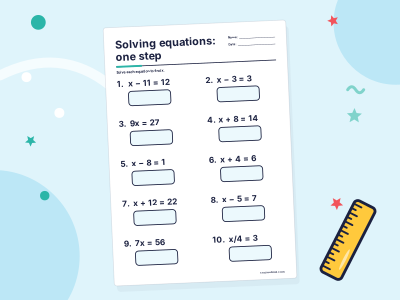
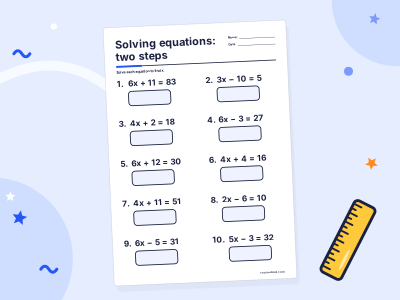
Algebra worksheets
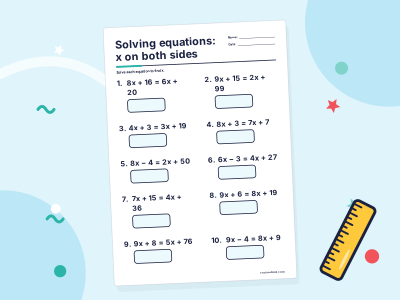

Practise it step by step in a full course: Grade 10 Maths
For grown-ups
Related topics

Equations
An equation says two things are equal, using an = sign, like 2x + 1 = 9. Solving it means finding the value of the letter that makes it true, here x = 4.

Algebra
Algebra is maths that uses letters, like x or n, to stand for numbers we don't know yet or numbers that can change. For example, if n + 3 = 10, then n = 7.

Square roots
The square root of a number is the value that, multiplied by itself, gives that number. The square root of 25 is 5, because 5 × 5 = 25. The sign is √.

Coordinates
Coordinates are a pair of numbers that give an exact position on a grid, like (3, 5). The first number is how far across (x) and the second is how far up (y).

Completing the square
Completing the square rewrites x² + bx + c as (x + b/2)² − (b/2)² + c. It solves quadratics, finds the vertex (turning point) of a parabola and proves the quadratic formula.

The quadratic formula and the discriminant
The quadratic formula x = (−b ± √(b² − 4ac)) / 2a solves any equation ax² + bx + c = 0. The discriminant b² − 4ac tells you whether there are two, one or no real solutions.