Maths
What is the vertex of a parabola, and how do you find it?
Quick answer
The vertex is the turning point of a parabola: its lowest or highest point. For y = ax² + bx + c it is at x = −b/2a; put that x back into the equation to get y.


In one sentence
The vertex of a parabola is its turning point: the lowest point of a ∪-shaped curve, or the highest point of a ∩-shaped one.
Explained
The graph of every quadratic, y = ax² + bx + c, is a parabola: a smooth, symmetrical curve shaped like a U. The vertex is the point where the curve stops going down and starts going up (or the other way round). In the UK it is often called the turning point.
 ball
 bridge
 mountain
Which way the parabola opens depends on the sign of a, the number in front of x²:
- a > 0: the parabola opens upwards (∪) and the vertex is its minimum, the lowest point.
- a < 0: the parabola opens downwards (∩) and the vertex is its maximum, the highest point.
The vertical line through the vertex is the axis of symmetry. Fold the graph along it and the two halves match exactly.
The vertex formula. For y = ax² + bx + c, the vertex is at
x = −b ÷ 2a, and the y-coordinate is what you get when you put that x back into the equation.
Where does −b ÷ 2a come from? Look at the points where y = c. Then ax² + bx = 0, so x(ax + b) = 0, which gives x = 0 or x = −b ÷ a. These two points are at the same height, so by symmetry the vertex sits exactly halfway between them: x = −b ÷ 2a. If you prefer a formula for y too, it is y = c − b² ÷ 4a.
You can find the vertex from any of the three usual forms of a quadratic:
- Standard form y = ax² + bx + c: use x = −b ÷ 2a, then work out y.
- Vertex form y = a(x − h)² + k: the vertex is simply (h, k). Watch the sign: y = (x + 4)² − 7 is y = (x − (−4))² − 7, so the vertex is (−4, −7). You turn standard form into vertex form by completing the square.
- Factored (intercept) form y = a(x − p)(x − q): the parabola crosses the x-axis at p and q, so the vertex is halfway between them, at x = (p + q) ÷ 2.
Why does it matter? Whenever something follows a parabola, the vertex answers "what is the most (or least), and when?" A ball thrown upwards with height h = 20t − 5t² metres reaches its vertex at t = −20 ÷ (2 × −5) = 2 seconds, when h = 40 − 20 = 20 m. So it rises to 20 m after 2 seconds, then falls. The vertex is also the middle of the two solutions of a quadratic equation, which is exactly why the quadratic formula starts with −b ÷ 2a.
Examples
| Equation | Form | Working | Vertex | Max or min |
|---|---|---|---|---|
| y = x² − 6x + 5 | standard | x = 6 ÷ 2 = 3; y = 9 − 18 + 5 = −4 | (3, −4) | minimum |
| y = 2x² + 8x + 3 | standard | x = −8 ÷ 4 = −2; y = 8 − 16 + 3 = −5 | (−2, −5) | minimum |
| y = −x² + 4x + 1 | standard | x = −4 ÷ (−2) = 2; y = −4 + 8 + 1 = 5 | (2, 5) | maximum |
| y = 3(x − 1)² + 4 | vertex | read off h = 1, k = 4 | (1, 4) | minimum |
| y = −(x + 2)² + 6 | vertex | read off h = −2, k = 6 | (−2, 6) | maximum |
| y = (x − 1)(x − 5) | factored | x = (1 + 5) ÷ 2 = 3; y = 2 × (−2) = −4 | (3, −4) | minimum |
The first and last rows are the same parabola: (x − 1)(x − 5) multiplies out to x² − 6x + 5, and both methods give (3, −4).
Worked example: find the vertex of y = 2x² − 4x + 5. Here a = 2 and b = −4, so x = −(−4) ÷ (2 × 2) = 4 ÷ 4 = 1. Then y = 2(1)² − 4(1) + 5 = 2 − 4 + 5 = 3. The vertex is (1, 3), and because a = 2 is positive it is the minimum. Check with the y-formula: 5 − 16 ÷ 8 = 5 − 2 = 3. ✓
Common mistakes
- Dropping the minus sign in −b ÷ 2a. For y = x² + 6x + 1, b = 6, so x = −6 ÷ 2 = −3, not 3.
- Getting the sign in vertex form wrong. y = (x − 2)² + 5 has its vertex at (2, 5); y = (x + 2)² + 5 has it at (−2, 5). Ask: which x makes the bracket zero?
- Dividing by 2 and forgetting the a. −b ÷ 2a means −b ÷ (2 × a). For y = 3x² − 12x, x = 12 ÷ 6 = 2, not 12 ÷ 2 = 6.
- Squaring a negative x wrongly. If x = −2, then x² = 4, so 2x² = 8. Put the value in brackets: 2(−2)².
- Assuming the vertex is always the lowest point. If a is negative, the vertex is the highest point.
Step by step
Step by step
- Read a, b and cWrite the quadratic as y = ax² + bx + c and note the signs.
- Find the x-coordinateWork out x = −b ÷ 2a. (In vertex form, read h off instead; in factored form, take the midpoint of the roots.)
- Find the y-coordinateSubstitute that x into the original equation and calculate y.
- Decide max or minIf a > 0 the vertex is a minimum; if a < 0 it is a maximum.
- Check with symmetryPick two x-values the same distance either side of the vertex. They should give the same y.
The axis of symmetry is then the line x = (your x-coordinate). When you sketch the graph, plot the vertex first and work outwards in both directions.
Practice questions
Find the vertex
Try each one, then check your answer.
- Find the vertex of y = (x − 4)² + 1.
Show answer
(4, 1) - Find the vertex of y = (x + 3)² − 5.
Show answer
The bracket is zero at x = −3: (−3, −5) - Find the vertex of y = −2(x − 1)² + 8. Is it a maximum or a minimum?
Show answer
(1, 8), a maximum (a = −2 is negative) - Find the vertex of y = x² + 4.
Show answer
b = 0, so x = 0 and y = 4: (0, 4) - Find the vertex of y = x² − 4x + 7.
Show answer
x = 4 ÷ 2 = 2; y = 4 − 8 + 7 = 3: (2, 3) - Find the vertex of y = x² + 10x + 21.
Show answer
x = −10 ÷ 2 = −5; y = 25 − 50 + 21 = −4: (−5, −4) - Find the vertex of y = 2x² − 12x + 13.
Show answer
x = 12 ÷ 4 = 3; y = 18 − 36 + 13 = −5: (3, −5) - Find the vertex of y = −x² + 6x − 2.
Show answer
x = −6 ÷ (−2) = 3; y = −9 + 18 − 2 = 7: (3, 7), a maximum - Find the vertex of y = 3x² + 6x + 1.
Show answer
x = −6 ÷ 6 = −1; y = 3 − 6 + 1 = −2: (−1, −2) - Find the vertex of y = x² − 5x + 4.
Show answer
x = 5 ÷ 2 = 2.5; y = 6.25 − 12.5 + 4 = −2.25: (2.5, −2.25) - Find the vertex of y = (x − 2)(x − 8).
Show answer
x = (2 + 8) ÷ 2 = 5; y = 3 × (−3) = −9: (5, −9) - Find the vertex of y = −(x + 1)(x − 5).
Show answer
x = (−1 + 5) ÷ 2 = 2; y = −(3)(−3) = 9: (2, 9), a maximum - Write y = x² + 8x + 10 in vertex form and give the vertex.
Show answer
(x + 4)² − 16 + 10 = (x + 4)² − 6, vertex (−4, −6) - A parabola has its vertex at (2, −3) and passes through (0, 1). Find its equation in vertex form.
Show answer
y = a(x − 2)² − 3; at (0, 1): 1 = 4a − 3, so a = 1: y = (x − 2)² − 3 - What is the greatest value of y = −4x² + 8x + 5?
Show answer
x = −8 ÷ (−8) = 1; y = −4 + 8 + 5 = 9: the maximum is 9, at x = 1
Word problems
The vertex in real life
Try each one, then check your answer.
- A ball's height is h = 20t − 5t² metres after t seconds. How high does it go, and when?
Show answer
t = −20 ÷ (2 × −5) = 2; h = 40 − 20 = 20: 20 m, after 2 seconds - A rectangle is made from 40 m of fencing, so its area is A = x(20 − x) m², where x is the width. What is the largest area?
Show answer
A = −x² + 20x; x = −20 ÷ (−2) = 10; A = 10 × 10: 100 m² (a 10 m by 10 m square) - Water from a fountain follows h = −5t² + 10t + 1 metres. What is its highest point?
Show answer
t = −10 ÷ (−10) = 1; h = −5 + 10 + 1: 6 m, after 1 second - A bridge arch has the shape y = −0.02x² + 2x, in metres, where x is the distance from one foot of the arch. How high is the arch?
Show answer
x = −2 ÷ (−0.04) = 50; y = −0.02 × 2500 + 100 = −50 + 100: 50 m high, 50 m from the foot - Two numbers add up to 14. What is the largest possible product?
Show answer
P = x(14 − x) = −x² + 14x; x = 7: 49 (7 × 7) - A lemonade stand's daily profit is P = −10p² + 60p − 40 dollars, where p is the price of a cup in dollars. Which price gives the most profit?
Show answer
p = −60 ÷ (−20) = 3; P = −90 + 180 − 40 = 50: $3 a cup, for a profit of $50
Questions people ask
What is the vertex formula?
For y = ax² + bx + c, the vertex is at x = −b ÷ 2a. Substitute that into the equation to get y, or use y = c − b² ÷ 4a. The vertex is the point (−b ÷ 2a, c − b² ÷ 4a).
What is vertex form?
Vertex form is y = a(x − h)² + k. The vertex is (h, k), so you can read it straight off. y = 2(x − 3)² + 1 has its vertex at (3, 1).
How do you find the vertex from two x-intercepts?
The vertex is halfway between them. Add the two x-intercepts and divide by 2 to get the x-coordinate, then substitute to find y. This works for factored (intercept) form, y = a(x − p)(x − q).
How do you find the vertex from a graph?
Look for the point where the curve turns. If it is not on a grid line, find two points on the curve at the same height: the vertex is directly halfway between them.
How do you find the vertex by completing the square?
Rewrite y = x² + bx + c as y = (x + b/2)² − (b/2)² + c. For y = x² − 6x + 5 that is (x − 3)² − 4, so the vertex is (3, −4).
What is the focus of a parabola?
The focus is a different point, inside the curve. Every point on a parabola is the same distance from the focus as from a line called the directrix, and the vertex sits exactly halfway between them. For y = ax², the focus is at (0, 1 ÷ 4a).
Can a parabola have more than one vertex?
No. A parabola has exactly one vertex and one axis of symmetry. (Ellipses and hyperbolas have two vertices on their main axis, which is where the plural “vertices” comes from.)
Quick quiz
Vertex of a parabola
Check what you know with 5 quick questions.
Question 1 of 5
What is the vertex of y = (x − 3)² + 2?
Practise it
Try it
Practise quadratic graphs with unlimited questions
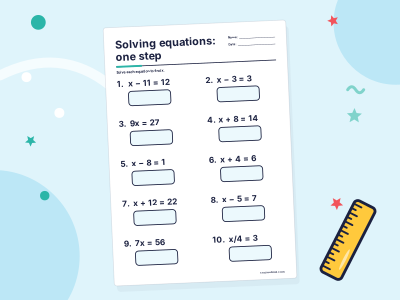
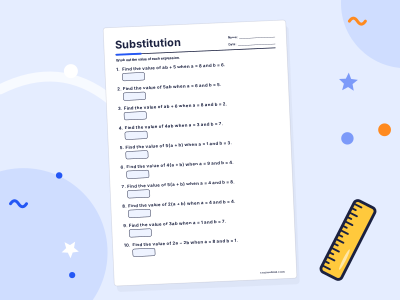
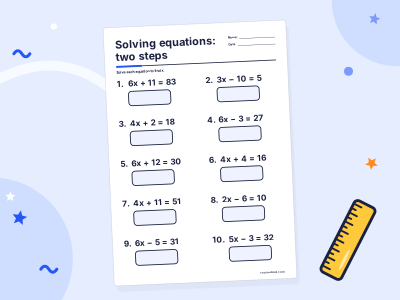
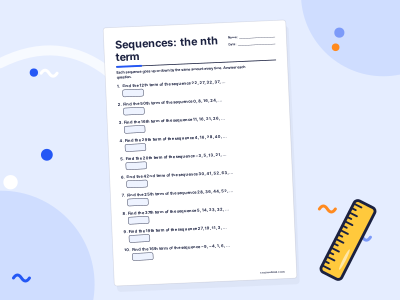
Algebra worksheets

Practise it step by step in a full course: Grade 10 Maths
For grown-ups
Related topics

Completing the square
Completing the square rewrites x² + bx + c as (x + b/2)² − (b/2)² + c. It solves quadratics, finds the vertex (turning point) of a parabola and proves the quadratic formula.
Quadratic equations and the quadratic formula
A quadratic equation looks like ax² + bx + c = 0. The quadratic formula x = (−b ± √(b² − 4ac)) ÷ 2a solves every one, and b² − 4ac tells you how many solutions there are.

The quadratic formula and the discriminant
The quadratic formula x = (−b ± √(b² − 4ac)) / 2a solves any equation ax² + bx + c = 0. The discriminant b² − 4ac tells you whether there are two, one or no real solutions.

Functions (maths)
A function is a rule that gives exactly one output for each input. In f(x) = 2x + 3, the input 4 gives the output 2 × 4 + 3 = 11.
Algebra
Algebra is maths that uses letters, like x or n, to stand for numbers we don't know yet or numbers that can change. For example, if n + 3 = 10, then n = 7.

Composite functions
A composite function applies one function and then another. f(g(x)), also written (f ∘ g)(x) or fg(x), means do g first, then put the answer into f.