Maths
What are the x-intercept and y-intercept, and how do you find them?
Quick answer
The y-intercept is where a graph crosses the y-axis: put x = 0. An x-intercept is where it crosses the x-axis: put y = 0. For y = 2x − 6 they are (0, −6) and (3, 0).



In one sentence
Intercepts are the points where a graph crosses the axes: the y-intercept is where it crosses the y-axis, and an x-intercept is where it crosses the x-axis.
Explained
Picture a graph drawn on coordinate axes. As the line or curve passes through, it usually cuts the two axes. Those crossing points are the intercepts, and they are often the first things you plot when you sketch a graph.
 map
 ruler
 pencil
The whole topic comes down to one fact: every point on the y-axis has x = 0, and every point on the x-axis has y = 0. So:
- To find the y-intercept, put x = 0 and work out y. Write the answer as a point (0, y).
- To find an x-intercept, put y = 0 and solve for x. Write the answer as a point (x, 0).
Straight lines. In slope-intercept form, y = mx + b, the number b is the y-intercept and m is the slope. (In the UK the same equation is written y = mx + c.) Putting y = 0 gives 0 = mx + b, so the x-intercept is x = −b/m. For y = 2x − 6, the y-intercept is (0, −6) and the x-intercept is x = 6/2 = 3, the point (3, 0).
If a line is written as Ax + By = C, cover up one letter at a time. For 2x + 3y = 12: with x = 0, 3y = 12, so (0, 4); with y = 0, 2x = 12, so (6, 0). Two special cases: a horizontal line such as y = 4 never meets the x-axis, and a vertical line such as x = 3 never meets the y-axis.
Parabolas. For y = ax² + bx + c, the y-intercept is always (0, c). The x-intercepts are the solutions of ax² + bx + c = 0, which you find by factorising, by completing the square or with the quadratic formula. A parabola can have two, one or no x-intercepts. In vertex form, y = a(x − h)² + k, set y = 0 and take square roots: for y = (x − 1)² − 9, (x − 1)² = 9, so x − 1 = ±3 and x = 4 or x = −2.
Other functions. The rule never changes. For a fraction like y = (x − 2)/(x + 1), the x-intercept is where the top is zero (x = 2), as long as the bottom is not zero there. A function can have many x-intercepts but at most one y-intercept, because each x gives only one y.
What intercepts mean. In real-life graphs the y-intercept is usually the starting value: a taxi's fixed fee, the money in a savings account at the start, a full battery. The x-intercept is often when something runs out or lands: the moment a tank is empty or a ball hits the ground.
Examples
| Equation | y-intercept (put x = 0) | x-intercept(s) (put y = 0) |
|---|---|---|
| y = 2x − 6 | (0, −6) | 2x = 6: (3, 0) |
| y = −3x + 9 | (0, 9) | 3x = 9: (3, 0) |
| 2x + 5y = 10 | 5y = 10: (0, 2) | 2x = 10: (5, 0) |
| y = 4 | (0, 4) | none (horizontal line) |
| y = x² − x − 6 | (0, −6) | (x − 3)(x + 2) = 0: (3, 0) and (−2, 0) |
| y = (x − 1)² − 9 | 1 − 9 = −8: (0, −8) | x − 1 = ±3: (4, 0) and (−2, 0) |
| y = (x − 2)/(x + 1) | −2/1: (0, −2) | top is zero at x = 2: (2, 0) |
Worked example: a line passes through (1, 5) and (3, 9). Find both intercepts. The slope is (9 − 5)/(3 − 1) = 4/2 = 2, so y = 2x + b. Put in (1, 5): 5 = 2 + b, so b = 3 and the y-intercept is (0, 3). Now put y = 0: 0 = 2x + 3, so x = −1.5 and the x-intercept is (−1.5, 0).
Common mistakes
- Swapping the zero. The x-intercept has y = 0, so it is (3, 0), not (0, 3). Say it: "on the x-axis, y is zero."
- Taking the slope as the intercept. In y = 3x + 5 the y-intercept is 5, not 3.
- Misreading a rearranged equation. In y = 7 − 2x the y-intercept is 7 and the slope is −2. Rewrite it as y = −2x + 7 if that helps.
- Expecting exactly two x-intercepts for every parabola. Check the discriminant b² − 4ac first: it can give two, one or none.
- Using a value that makes the bottom of a fraction zero. For y = (x − 2)/(x + 1), x = −1 is not allowed, so it can never be an intercept.
Step by step
Step by step
- y-intercept: put x = 0Replace every x with 0 and work out y. Write it as (0, y).
- x-intercepts: put y = 0Set the equation equal to zero.
- Solve for xFor a line, rearrange. For a quadratic, factorise, take square roots or use the formula. For a fraction, make the top zero (but not the bottom).
- Write pointsEach x-intercept is a point (x, 0). There may be none, one or several.
- Check with a sketchPlot the intercepts. Do they fit the shape you expect (line, ∪ or ∩)?
Practice questions
Find the intercepts
Try each one, then check your answer.
- Find the y-intercept of y = 4x − 7.
Show answer
(0, −7) - Find the x-intercept of y = 4x − 8.
Show answer
0 = 4x − 8, so x = 2: (2, 0) - Find both intercepts of y = −2x + 6.
Show answer
(0, 6) and, from 2x = 6, (3, 0) - Find both intercepts of y = 5x.
Show answer
Both are (0, 0): the line passes through the origin - Find both intercepts of 3x + 4y = 12.
Show answer
x = 0 gives y = 3: (0, 3); y = 0 gives x = 4: (4, 0) - Find both intercepts of y = ½x + 2.
Show answer
(0, 2); 0 = ½x + 2 gives x = −4: (−4, 0) - Find the intercepts of the line x = −5.
Show answer
x-intercept (−5, 0) and no y-intercept (a vertical line) - A line has slope 3 and passes through (2, 1). Find its y-intercept.
Show answer
1 = 3 × 2 + b, so b = −5: (0, −5) - Find both intercepts of the line through (−1, 4) and (3, −4).
Show answer
Slope = −8/4 = −2; 4 = 2 + b, so b = 2: (0, 2); 0 = −2x + 2: (1, 0) - Find the intercepts of y = x² − 9.
Show answer
(0, −9); x² = 9: (3, 0) and (−3, 0) - Find the intercepts of y = x² + 2x − 8.
Show answer
(0, −8); (x + 4)(x − 2) = 0: (−4, 0) and (2, 0) - Find the intercepts of y = x² − 6x + 9.
Show answer
(0, 9); (x − 3)² = 0: only (3, 0), where the parabola touches the axis - Find the intercepts of y = x² + 2x + 5.
Show answer
(0, 5); b² − 4ac = 4 − 20 = −16 < 0: no x-intercepts - Find the intercepts of y = 2x² − 3x − 2.
Show answer
(0, −2); (2x + 1)(x − 2) = 0: (−½, 0) and (2, 0) - Find the intercepts of y = (x + 1)² − 4.
Show answer
x = 0: 1 − 4 = −3, so (0, −3); x + 1 = ±2: (1, 0) and (−3, 0) - Find the intercepts of y = (x − 3)/(x + 2).
Show answer
x = 0: −3/2, so (0, −3/2); the top is zero at x = 3: (3, 0)
Word problems
Intercepts in real life
Try each one, then check your answer.
- A taxi ride costs C = 2.5d + 4 dollars for d miles. What is the C-intercept, and what does it mean?
Show answer
d = 0 gives C = 4: (0, 4), a $4 fixed fee before you travel at all - A phone battery has B = 100 − 8t percent left after t hours. When is it flat?
Show answer
100 − 8t = 0, so t = 12.5: after 12.5 hours - A tank holds V = 600 − 40t litres after t minutes of draining. Find both intercepts and say what they mean.
Show answer
(0, 600): it starts with 600 litres; 40t = 600 gives (15, 0): it is empty after 15 minutes - A ball's height is h = −5t² + 20t metres after t seconds. Find the t-intercepts.
Show answer
−5t(t − 4) = 0, so t = 0 (thrown) and t = 4 s (lands) - Maya's savings are S = 15w + 30 dollars after w weeks. Find both intercepts. Do they both make sense?
Show answer
(0, 30): she starts with $30. 15w = −30 gives (−2, 0): two weeks before she started, so it does not make sense in this story
Questions people ask
What is the formula for the x-intercept?
There is one rule for every graph: put y = 0 and solve for x. For a straight line y = mx + b, that gives x = −b/m. For a quadratic, it means solving ax² + bx + c = 0.
What is the y-intercept in y = mx + b (or y = mx + c)?
It is b (or c in the UK version): the value of y when x = 0. The line crosses the y-axis at (0, b).
How do you find the y-intercept from two points?
Find the slope m = (y₂ − y₁)/(x₂ − x₁). Put one point into y = mx + b and solve for b. The y-intercept is (0, b).
How do you find the x-intercepts of a parabola?
Set ax² + bx + c = 0 and solve it by factorising, completing the square or the quadratic formula. The solutions are the x-intercepts, also called the roots or zeros of the function.
Can a graph have more than one y-intercept?
A function cannot: each x has only one y, so x = 0 gives one point at most. A circle, which is not a function, can cross the y-axis twice.
What is intercept form?
For a straight line it is x/p + y/q = 1, which crosses the axes at (p, 0) and (0, q). For a parabola, "intercept form" means factored form, y = a(x − p)(x − q), whose x-intercepts are p and q.
Quick quiz
x-intercepts and y-intercepts
Check what you know with 5 quick questions.
Question 1 of 5
What is the y-intercept of y = 3x + 5?
Practise it
Try it
Practise straight-line graphs with unlimited questions
Algebra worksheets
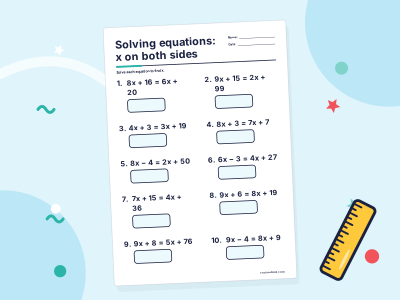

Practise it step by step in a full course: Grade 9 Maths
For grown-ups
Related topics

Slope (gradient)
Slope (called gradient in the UK) measures how steep a line is. It is the rise divided by the run, m = (y₂ − y₁) ÷ (x₂ − x₁), and it can be positive, negative, zero or undefined.
Coordinates
Coordinates are a pair of numbers that give an exact position on a grid, like (3, 5). The first number is how far across (x) and the second is how far up (y).

Line graphs
A line graph shows how something changes over time. Points are plotted on a grid and joined by a line, so you can see rises, falls and patterns at a glance.
The quadratic formula and the discriminant
The quadratic formula x = (−b ± √(b² − 4ac)) / 2a solves any equation ax² + bx + c = 0. The discriminant b² − 4ac tells you whether there are two, one or no real solutions.

Algebra
Algebra is maths that uses letters, like x or n, to stand for numbers we don't know yet or numbers that can change. For example, if n + 3 = 10, then n = 7.

Completing the square
Completing the square rewrites x² + bx + c as (x + b/2)² − (b/2)² + c. It solves quadratics, finds the vertex (turning point) of a parabola and proves the quadratic formula.