Crayonbird
Menu

Science · Ages 5–6 · 45 minutes

Weather and the seasons

Children observe and describe today's weather, name different kinds of weather, and talk about how the weather and day length change across the seasons where they live.

Success criteria

  • I can describe today's weather
  • I can name different kinds of weather
  • I can say how the weather changes in different seasons

Key vocabulary

  • weather
  • sunny
  • rainy
  • cloudy
  • windy
  • snowy
  • season
  • spring
  • summer
  • autumn
  • winter
  • wet season
  • dry season

You will need

  • a large weather chart
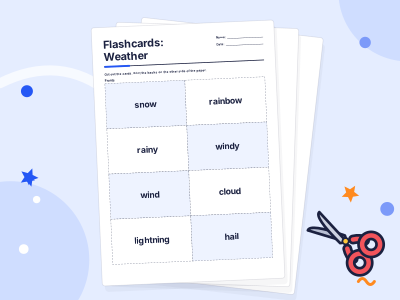
  • weather picture cards
  • a teddy and a box of clothes (sunhat, coat, scarf, wellies)
  • paper streamers on sticks
  • crayons
  • Year 1· England

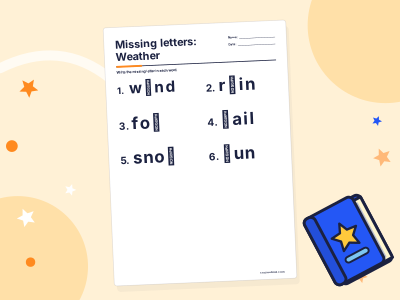
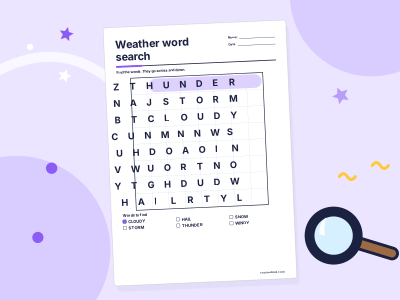
Practice sheets

Generated fresh each time you press a button, and marked instantly on screen.

The lesson at a glance

45 minutes in all. Timings are a guide: follow your class.

  1. Step 1: Starter

    Take the class to the window, or outside if it is dry.
    5–10 min
  2. Step 2: Teach

    Show weather picture cards one at a time and act each one out with the class: sunny (shade your eyes), rainy (wiggle fingers down), windy (sway), cloudy (make a cloud shape), snowy (shiver).
    10–15 min
  3. Step 3: Guided practice

    Play "Dress the Teddy".
    10 minutes
  4. Step 4: Independent practice

    Children draw today's weather and what they are wearing, then use the practice buttons.
  5. Step 5: Plenary

    Play "What should I take?" Say a weather and children mime what they would take: an umbrella, sun cream, a coat, gloves.
  6. Step 6: Assessment for learning

    Can children use at least three weather words correctly?
  7. Step 7: Differentiation

    Support: use picture cards and actions, and accept spoken answers.
  8. Step 8: Common misconceptions

    "It is always cold in winter everywhere." Seasons are different around the world.
  9. Step 9: Home link

    Each morning this week, look out of the window together and choose one word for the weather.

Weather is the one science topic children can check every day just by looking out of the window. This lesson builds a class weather routine, gives children the words to describe what they see, and links the weather to the seasons, which are different in different parts of the world.

1.Starter

5–10 min

Take the class to the window, or outside if it is dry. Ask: "What is the weather like today? What can you see? What can you feel?" Give a minute of quiet looking, then take answers. Hold up a streamer: "Is it windy? How can we tell?" Eight minutes.

2.Teach

10–15 min

Show weather picture cards one at a time and act each one out with the class: sunny (shade your eyes), rainy (wiggle fingers down), windy (sway), cloudy (make a cloud shape), snowy (shiver).

Then explain seasons simply: "A season is a part of the year with its own kind of weather. In many countries there are four seasons: spring, summer, autumn and winter." Show what changes: "In summer the days are long and it is often warm. In winter the days are short and it is colder."

Then add: "In some countries, like Nigeria or India, people talk about a wet season with lots of rain and a dry season with very little. Not everywhere gets snow!" Ask: "What seasons do we have here? What is the weather like in each one?"

  • sun
  • rain
  • cloud
  • wind
  • snow
  • rainbow
Sunny, rainy, cloudy, windy, snowy, and a rainbow when sun and rain meet.

The rest of the plan

Guided and independent practice, the plenary, assessment for learning, differentiation, common misconceptions and the home link are free with a Crayonbird account.

  1. Guided practice10 minutes
  2. Independent practice
  3. Plenary
  4. Assessment for learning
  5. Differentiation
  6. Common misconceptions
  7. Home link

Learning Wiki

Weather

Weather is what the air is like at a particular place and time, such as hot or cold, wet or dry, windy or calm, sunny or cloudy. It changes from day to day.

Evaporation

Evaporation is when a liquid slowly turns into a gas from its surface, like a puddle drying in the sun. It happens faster when it is warm, windy or the liquid is spread out.

The water cycle

The water cycle is the endless movement of water between the land, the sea and the sky. Water evaporates, condenses into clouds, falls as rain or snow and collects in rivers and oceans.

  • Science · Ages 5–7 · 50 min

    Everyday materials and their properties

    Children name everyday materials, describe their properties and test which materials are waterproof to choose the best one for a job.

  • Science · Ages 6–8 · 50 min

    The healthy eating plate

    Children sort foods into the main food groups and explain that a balanced meal includes a variety of foods, with plenty of fruit and vegetables.

  • Science · Ages 7–8 · 50 min

    Magnets: attract, repel and magnetic materials

    Children test which materials are magnetic, discover that magnets attract or repel depending on which poles face each other, and record results in a table.