Crayonbird
Menu

Maths · Ages 7–8 · 50 minutes

Money, coins and giving change

Children add prices and work out change by counting up from the amount spent to the amount paid.

Success criteria

  • I can add two prices
  • I can count up to find change
  • I can check my change by adding

Key vocabulary

  • price
  • cost
  • total
  • change
  • pay
  • coin
  • note
  • count up

You will need

  • real or plastic coins and notes in your local currency
  • price labels
  • a toy-shop table
  • mini whiteboards
  • number lines 0–50
  • Year 3· England
  • Grade 2· United States
  • Primary 3· Nigeria
  • Class 3· India

Practice sheets

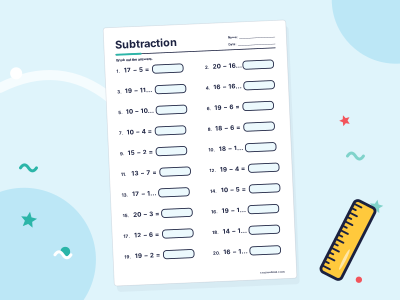
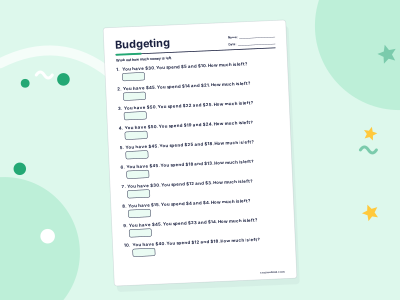
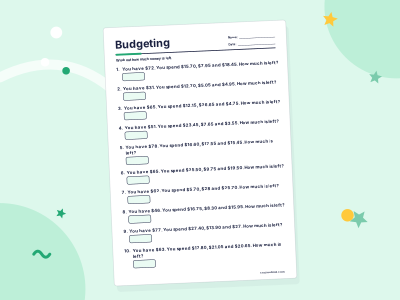
Generated fresh each time you press a button, and marked instantly on screen.

The lesson at a glance

50 minutes in all. Timings are a guide: follow your class.

  1. Step 1: Starter

    Hold up three coins of different values.
    8 minutes
  2. Step 2: Teach

    Set up the toy shop with labels: a pencil 4, a ball 9, a book 13.
    12 minutes
  3. Step 3: Guided practice

    Pairs play shop. One is the shopkeeper, one the customer.
    10 minutes
  4. Step 4: Independent practice

    Use the practice buttons above.
    15 minutes
  5. Step 5: Plenary

    "A shopkeeper says: 'Your total is 16, you paid 20, here's 6 change.' Is that right?" Children explain the mistake and fix it (4).
    5 minutes
  6. Step 6: Assessment for learning

    Look for children who: add two prices correctly before finding change; count up in friendly jumps (to the next 5 or 10); check by adding total and change.
  7. Step 7: Differentiation

    Children who need support should use real coins for every question and keep totals under 20.
  8. Step 8: Common misconceptions

    Thinking bigger coins are always worth more.
  9. Step 9: Home link

    When shopping, let your child work out the total of two items and how much change you should get, then check the receipt together.

1.Starter

8 minutes

Hold up three coins of different values. "Which is worth the most? Is the biggest coin always worth the most?" (In many countries it isn't.) Then make 20 with coins in two different ways and ask children to find a third.

2.Teach

12 minutes

Set up the toy shop with labels: a pencil 4, a ball 9, a book 13. Use your local currency; the method is the same with pounds, dollars, naira, rupees or euros.

"I buy the ball and the pencil. What's the total? 9 + 4 = 13. I pay with a 20 note. How much change?"

"I count up from what I spent to what I paid, like a shopkeeper. Start at 13." Draw jumps on a number line: 13 to 15 (2), 15 to 20 (5). "2 + 5 = 7. My change is 7."

Step by step

  1. Find the totalAdd the prices.
  2. Count up to what you paidJump to the next 5 or 10 first, then to the amount paid.
  3. Add your jumps and checkTotal spent + change should equal what you paid.

Do one more: a book and a ball (13 + 9 = 22), paid with 30. Count up: 22 to 25, then 25 to 30. Change is 8. Check: 22 + 8 = 30.

"Why count up instead of taking away? Because it's how shops really do it, and it's easier to count up in friendly jumps than to take 22 away from 30 in your head."


The rest of the plan

Guided and independent practice, the plenary, assessment for learning, differentiation, common misconceptions and the home link are free with a Crayonbird account.

  1. Guided practice10 minutes
  2. Independent practice15 minutes
  3. Plenary5 minutes
  4. Assessment for learning
  5. Differentiation
  6. Common misconceptions
  7. Home link

Learning Wiki

Money

Money maths means counting coins and notes, adding up prices and working out change. Most currencies split one unit into 100 smaller ones, like 100 pence in a pound.

Pictograms

A pictogram shows data using small pictures or symbols. A key tells you what each picture is worth, such as one apple standing for 2 apples. In the US it is often called a picture graph.

Subtraction

Subtraction is taking one amount away from another, or finding the difference between two numbers. The sign is −, so 9 − 4 = 5.

  • Maths · Ages 7–8 · 55 min

    Tally charts and bar charts

    Children collect data with a tally chart, draw a bar chart from it with a labelled scale, and answer "how many more" questions from the chart.

  • Maths · Ages 7–8 · 50 min

    Column addition with exchanging

    Children add two-digit numbers using the column method, lining up digits by place value and exchanging ten ones for one ten.

  • Maths · Ages 7–8 · 50 min

    Division as sharing and grouping

    Children solve division by sharing into equal groups and by making groups of a given size, and use multiplication facts to find the answer faster.