Fractions
A fraction is part of a whole that has been split into equal parts. In ¾, the bottom number says how many equal parts and the top says how many you have.
Maths · Ages 8–9 · 50 minutes
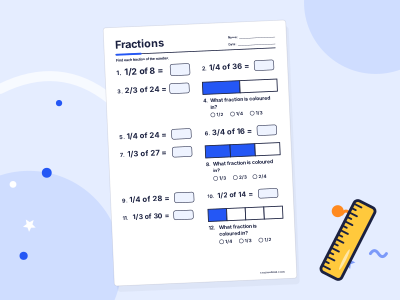
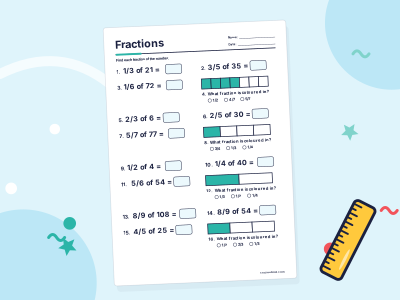
Children find unit and non-unit fractions of amounts by dividing by the denominator and multiplying by the numerator, and explain each step with a bar model.
Generated fresh each time you press a button, and marked instantly on screen.
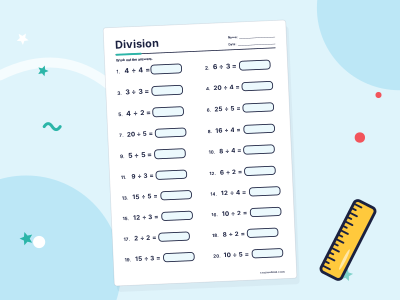
Quick division recall on whiteboards: 20 ÷ 4, 18 ÷ 3, 35 ÷ 5, 24 ÷ 6. Then ask: "What is half of 30? How did you work it out?" Someone will say "divide by 2". Write it up: half of 30 = 30 ÷ 2 = 15. "Today, every fraction will work like that."
Draw a long bar and write 24 above it. "This bar is all 24 sweets. I want to find one third of 24."
Split the bar into 3 equal parts. "The denominator, 3, tells me how many equal parts. 24 ÷ 3 = 8, so each part is 8." Write 8 in each part. "One third of 24 is 8."
"Now two thirds. That's two of those parts." Shade two parts. "8 + 8 = 16, or 2 × 8 = 16. Two thirds of 24 is 16."
Step by step
Try 3/4 of 20 together. Bar in 4 parts; 20 ÷ 4 = 5; three parts is 15. Ask: "What is the other quarter? What do 15 and 5 make?" This shows the parts always rebuild the whole.
"A short way to remember it: divide by the bottom, times by the top."