Crayonbird
Menu

Maths · Ages 8–9 · 50 minutes

Equivalent fractions

Children find equivalent fractions using a fraction wall and explain that multiplying the numerator and denominator by the same number keeps the fraction the same size.

Success criteria

  • I can find equivalent fractions on a fraction wall
  • I can explain why they are the same size
  • I can multiply the top and bottom by the same number

Key vocabulary

  • equivalent
  • numerator
  • denominator
  • fraction wall
  • equal
  • simplify

You will need

  • printed or hand-drawn fraction walls (halves to twelfths)
  • paper strips for folding
  • coloured pencils
  • mini whiteboards
  • Year 4· England
  • Grade 3· United States
  • Primary 4· Nigeria
  • Class 4· India

Practice sheets

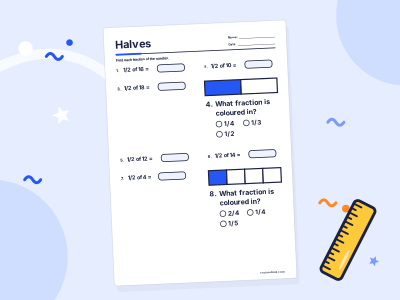
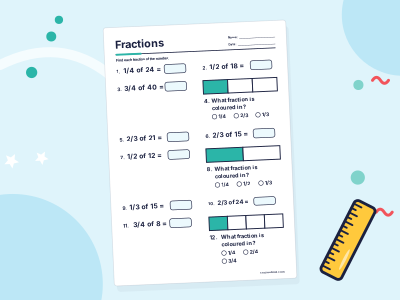
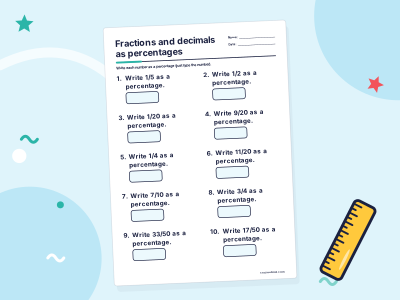
Generated fresh each time you press a button, and marked instantly on screen.

The lesson at a glance

50 minutes in all. Timings are a guide: follow your class.

  1. Step 1: Starter

    Two children each get a paper strip of the same length.
    8 minutes
  2. Step 2: Teach

    Show a fraction wall: one whole at the top, then halves, thirds, quarters, sixths and eighths in rows below.
    12 minutes
  3. Step 3: Guided practice

    Children use the wall and a whiteboard for each: 1/4 = ?/8 2/3 = ?/6 1/2 = ?/10 3/4 = 6/?
    10 minutes
  4. Step 4: Independent practice

    Use the practice buttons above.
    15 minutes
  5. Step 5: Plenary

    "Odd one out": 2/6, 1/3, 3/9, 2/4.
    5 minutes
  6. Step 6: Assessment for learning

    Look for children who: read the wall correctly using a straight edge; multiply numerator and denominator by the same number; can explain in words why equivalent fractions are the same size.
  7. Step 7: Differentiation

    Children who need support should fold paper strips themselves and colour the shaded parts before writing anything.
  8. Step 8: Common misconceptions

    Adding the same number to top and bottom (1/2 = 2/3).
  9. Step 9: Home link

    Cut a pizza or a sandwich into halves, then quarters, and ask "How many quarters are the same as one half?"

1.Starter

8 minutes

Two children each get a paper strip of the same length. One folds it in half; the other folds it into quarters. "Shade one half on your strip. Shade two quarters on yours." Hold them side by side. "What do you notice?" The shaded parts are the same length.

Write 1/2 = 2/4. "Different fractions, same amount. That's what equivalent means."

2.Teach

12 minutes

Show a fraction wall: one whole at the top, then halves, thirds, quarters, sixths and eighths in rows below.

"Put a ruler straight down from the end of 1/2. Which other fractions does it line up with?" Children find 2/4, 3/6, 4/8. "All equivalent to one half."

Write the list in a column:

1/2 = 2/4 = 3/6 = 4/8

"Look at the numbers. 1/2 to 2/4: the numerator doubled and the denominator doubled. 1/2 to 3/6: both times 3. Why does that work? Because I'm cutting each piece into more, smaller pieces, but the shaded amount doesn't change."

Step by step

  1. Line it upUse a ruler on the fraction wall to find fractions that end in the same place.
  2. Spot the multiplierWhat number turned the denominator into the new one?
  3. Do the same to the topMultiply the numerator by that same number.

Try 1/3 → ?/6 and 3/4 → ?/8 together, then check each on the wall.

The rest of the plan

Guided and independent practice, the plenary, assessment for learning, differentiation, common misconceptions and the home link are free with a Crayonbird account.

  1. Guided practice10 minutes
  2. Independent practice15 minutes
  3. Plenary5 minutes
  4. Assessment for learning
  5. Differentiation
  6. Common misconceptions
  7. Home link

Learning Wiki

Fractions

A fraction is part of a whole that has been split into equal parts. In ¾, the bottom number says how many equal parts and the top says how many you have.

Equivalent fractions

Equivalent fractions look different but are the same size, like 1/2, 2/4 and 4/8. You make them by multiplying or dividing the top and bottom by the same number.

Division

Division is sharing into equal groups, or finding how many groups fit. The sign is ÷, so 12 ÷ 3 = 4. The answer is called the quotient.

  • Maths · Ages 8–9 · 50 min

    Finding fractions of amounts

    Children find unit and non-unit fractions of amounts by dividing by the denominator and multiplying by the numerator, and explain each step with a bar model.

  • Maths · Ages 9–10 · 50 min

    Decimals and tenths

    Children read and write tenths as fractions and decimals, place them on a number line and link them to place value and to hundredths.

  • Maths · Ages 6–7 · 45 min

    Halves and quarters

    Children find halves and quarters of shapes and small amounts and explain that the parts must be equal.