Crayonbird
Menu

Study skills · Ages 7–9 · 50 minutes

Algorithms without a computer

Children write a clear, ordered set of instructions (an algorithm) to complete a task, test it, and debug it when it goes wrong.

Success criteria

  • I can explain what an algorithm is
  • I can write precise instructions in the right order
  • I can find and fix a bug in an algorithm

Key vocabulary

  • algorithm
  • instruction
  • sequence
  • precise
  • order
  • bug
  • debug
  • test
  • program
  • robot

You will need

  • a large floor grid (masking tape or a 5×5 chalk grid)
  • arrow cards (forward, turn left, turn right)
  • a soft toy as the "treasure"
  • squared paper
  • pencils

Practice sheets

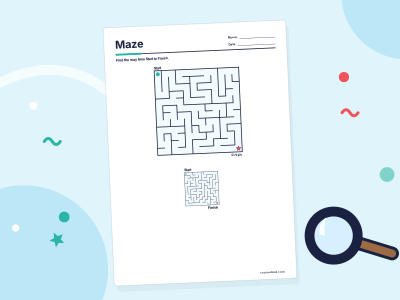
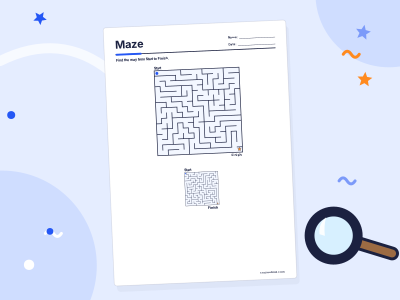
Generated fresh each time you press a button, and marked instantly on screen.

The lesson at a glance

50 minutes in all. Timings are a guide: follow your class.

  1. Step 1: Starter

    Announce: "Today I am a robot.
    5–10 min
  2. Step 2: Teach

    Explain: "An algorithm is a set of step-by-step instructions to do a job.
    10–15 min
  3. Step 3: Guided practice

    Use the floor grid. One child is the robot and stands on the start square facing forward.
    15 minutes
  4. Step 4: Independent practice

    Children write algorithms using arrows (↑ forward, ← turn left, → turn right) or compass words.
  5. Step 5: Plenary

    Show an algorithm on the board with a deliberate bug (the square from the teach section with one step missing).
  6. Step 6: Assessment for learning

    Can children explain what an algorithm is with an example?
  7. Step 7: Differentiation

    Support: use only forward and turn right first, and work in pairs on the floor grid.
  8. Step 8: Common misconceptions

    "An algorithm has to be on a computer." Any set of ordered steps is an algorithm.
  9. Step 9: Home link

    Ask your child to give you step-by-step instructions for making a drink or tidying a toy, and follow them very literally.

Computers do exactly what they are told, which is very different from what we mean. This lesson turns the teacher into a very literal robot, so children discover for themselves why instructions need to be precise and in the right order. No screens are needed.

1.Starter

5–10 min

Announce: "Today I am a robot. I can only do exactly what you tell me." Ask the class to instruct you to sit down on a chair. When someone says "Sit down", sit on the floor next to the chair. When they say "Walk to the chair", walk straight into it gently and stop. Let the laughter happen, then ask: "Why did that go wrong?" Seven minutes.

2.Teach

10–15 min

Explain: "An algorithm is a set of step-by-step instructions to do a job. Recipes, the steps for brushing your teeth and the directions to school are all algorithms. Computers follow algorithms called programs."

Model writing a good algorithm on the board for something simple, like drawing a square on squared paper:

  1. Put your pencil on a dot.
  2. Draw a line 3 squares to the right.
  3. Draw a line 3 squares down.
  4. Draw a line 3 squares to the left.
  5. Draw a line 3 squares up.

Script: "Every step is clear, and the order matters. What would happen if I swapped steps 2 and 4?" Then introduce bugs: "When an algorithm has a mistake, we call it a bug. Finding and fixing it is called debugging. Every programmer debugs, all the time."

  • robot
  • computer
  • blocks
  • puzzle
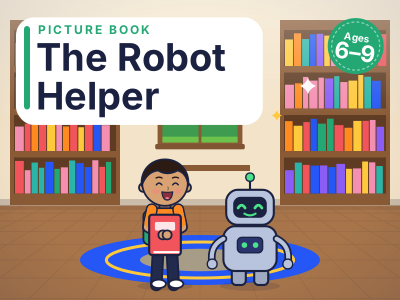
Robots, computers and blocks: algorithms are everywhere.

The rest of the plan

Guided and independent practice, the plenary, assessment for learning, differentiation, common misconceptions and the home link are free with a Crayonbird account.

  1. Guided practice15 minutes
  2. Independent practice
  3. Plenary
  4. Assessment for learning
  5. Differentiation
  6. Common misconceptions
  7. Home link

Learning Wiki

Flashcards

Flashcards are small cards with a question on one side and the answer on the other. They work best when you answer from memory before you flip.

Growth mindset

A growth mindset is the belief that abilities can improve with practice, good strategies and help. A fixed mindset is the belief that you either have a talent or you don't.

Mind maps

A mind map is a diagram with one main idea in the centre and branches spreading out to related ideas. It helps you organise a topic and see the connections.

  • Study skills · Ages 7–10 · 50 min

    Staying safe online

    Children know which information should stay private online, know that they should stop and tell a trusted adult whenever something online worries them, and practise what to say.

  • Geography · Ages 7–9 · 55 min

    Map skills and compass directions

    Children use the four compass points to give and follow directions on a grid map, and read simple map symbols with a key.

  • Science · Ages 7–9 · 55 min

    Animal life cycles

    Children sequence the life cycles of a butterfly, a frog and a bird, and explain how a young animal changes as it grows into an adult.