Study skills
How do you use flashcards to learn?
Quick answer
Flashcards are small cards with a question on one side and the answer on the other. They work best when you answer from memory before you flip.
In one sentence
Flashcards are cards with a question on the front and the answer on the back, used to test yourself.
Explained
A flashcard is a tiny quiz. You read the question, try to remember the answer, then flip to check. That moment of trying is what makes them powerful: it is active recall, and it trains your memory much better than reading a list.
Flashcards suit facts that have a clear answer: vocabulary in another language, times tables, capital cities, key dates, science words and their meanings, spellings and formulas. They are less good for big "explain why" ideas, which need longer answers. For those, write a question on the card ("Explain three causes of earthquakes") and answer it on paper.
The best flashcard habits are simple:
- Make your own. Writing the cards is already part of learning.
- One idea per card. Short questions, short answers.
- Answer first, then flip. Say it out loud or write it down. No peeking.
- Shuffle. Do not always study them in the same order, or you will learn the order instead of the answers.
- Sort as you go. Right answers go in one pile, wrong ones in another. Repeat the wrong pile.
Come back to the cards over several days and weeks; see spaced repetition, including the Leitner box system.
 apple
apple cat
cat sun
sun house
house
Examples
| Front | Back |
|---|---|
| 7 × 8 | 56 |
| What is the capital of Kenya? | Nairobi |
| Spanish: "the dog" | el perro |
| What does a herbivore eat? | only plants |
| Formula for the area of a rectangle | length × width |
Two-way cards: for vocabulary, test both directions, English to Spanish and Spanish to English.
Common mistakes
- Flipping straight away. If you don't try to remember first, you are only reading.
- Cards with paragraphs. Too much text makes it hard to know if you were right.
- Dropping cards once right. Get it right on another day too before retiring it.
- Always the same order. Shuffle every time.
Quick quiz
Flashcards
Check what you know with 4 quick questions.
Question 1 of 4
What should be on the front of a flashcard?
Practise it
Try it
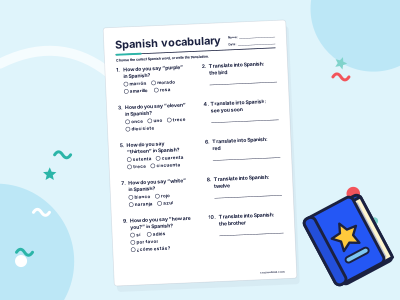
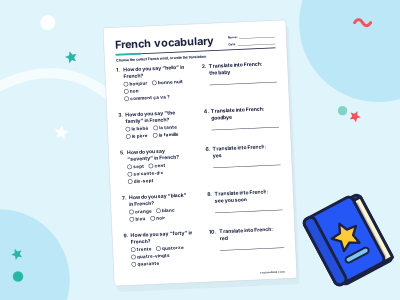
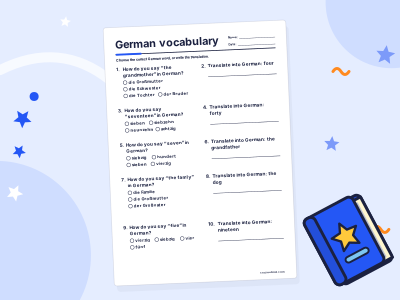
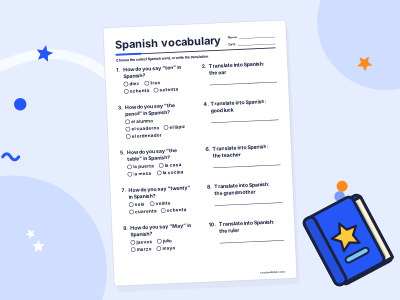
Printable flashcards
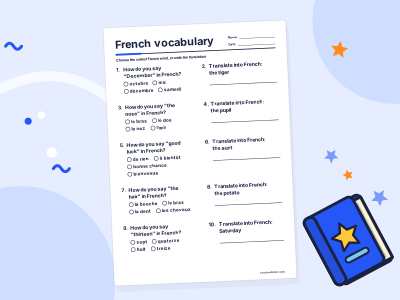
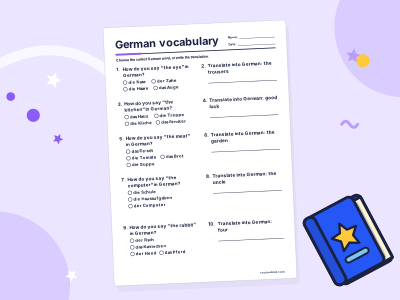
For grown-ups
Related topics
Active recall
Active recall means testing yourself by pulling information out of your memory, instead of rereading it. It is one of the best-supported ways to revise.
Spaced repetition
Spaced repetition means reviewing what you have learned several times with gaps in between, instead of cramming it all at once. The gaps help memories last longer.
Times tables
Times tables are lists of the multiplication facts for a number, such as 3 × 1 = 3 up to 3 × 12 = 36. Knowing them by heart speeds up almost all later maths.
Growth mindset
A growth mindset is the belief that abilities can improve with practice, good strategies and help. A fixed mindset is the belief that you either have a talent or you don't.
Mind maps
A mind map is a diagram with one main idea in the centre and branches spreading out to related ideas. It helps you organise a topic and see the connections.
Exam technique
Exam technique is the set of skills for answering the paper well on the day, such as reading questions carefully, using marks to plan time and checking your work.