Study skills
What is a growth mindset?
Quick answer
A growth mindset is the belief that abilities can improve with practice, good strategies and help. A fixed mindset is the belief that you either have a talent or you don't.
In one sentence
A growth mindset is believing that you can get better at things through practice, smart strategies and help from others.
Explained
The idea comes from research by the psychologist Carol Dweck at Stanford University. She described two ways people think about ability. With a fixed mindset, you see ability as something you are born with: "I'm not a maths person." With a growth mindset, you see ability as something that can develop: "I'm not good at fractions yet."
Why does it matter? If you believe ability is fixed, mistakes feel like proof that you are not good enough, so you may avoid hard work. If you believe you can grow, mistakes become information about what to try next. Programmers think like this all the time: an error is just a bug to find; see debugging.
It is worth being honest about what the research shows. Large studies have found that short growth-mindset lessons on their own make only a small difference to grades on average, with larger effects for some students who were struggling. Believing you can improve is a good start, but it does not replace actually learning. What helps is combining that belief with effective strategies, like testing yourself, and asking for help when stuck.
A growth mindset is also not about pretending everyone can be the best at everything, or praising effort when nothing is working. "Try harder" with the same broken method is not growth; "try a different way" is.
 mountain
 star
star puzzle
 blocks
Examples
| Fixed-mindset thought | Growth-mindset version |
|---|---|
| I'm bad at spelling. | I'm learning these spellings; I'll test myself again tomorrow. |
| This is too hard. | This is hard. Which part can I do first? |
| I made a mistake, I'm useless. | What does this mistake tell me? |
| She's just naturally good. | She's practised a lot. What does she do that I could try? |
| I give up. | I'll try another strategy or ask for help. |
Common mistakes
- Thinking growth mindset means effort only. Strategy and help matter just as much.
- Thinking you either have it or you don't. Everyone has fixed-mindset moments; noticing them is the skill.
- Ignoring real difficulties. Some children need extra support, and asking for it is a growth move.
Quick quiz
Growth mindset
Check what you know with 3 quick questions.
Question 1 of 3
Which sentence shows a growth mindset?
Practise it
Try it
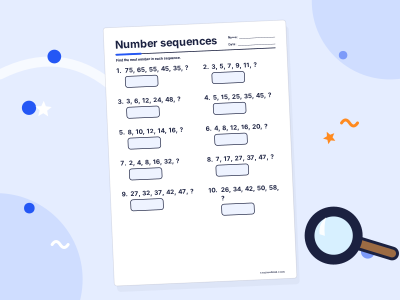
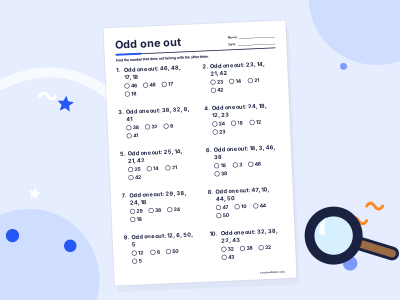
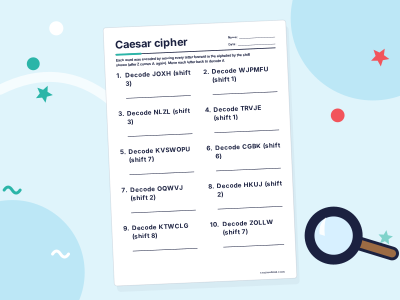
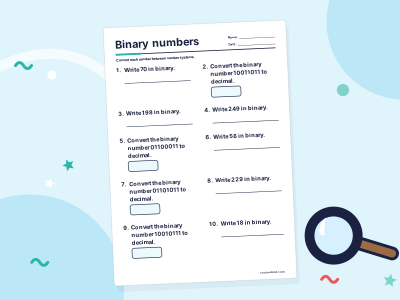
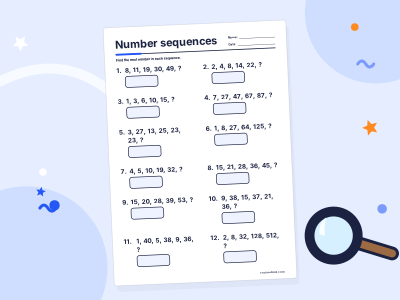
Puzzles to practise not-yet thinking
For grown-ups
Related topics
Active recall
Active recall means testing yourself by pulling information out of your memory, instead of rereading it. It is one of the best-supported ways to revise.
Exam technique
Exam technique is the set of skills for answering the paper well on the day, such as reading questions carefully, using marks to plan time and checking your work.
Debugging
Debugging means finding and fixing mistakes, called bugs, in an algorithm or a computer program. It is a normal part of coding for everyone.
Algorithm
An algorithm is a precise, step-by-step set of instructions for solving a problem or doing a task. Computers follow algorithms written as code.
Coding
Coding, or programming, means writing instructions in a language a computer understands so it can do a job, like run a game, an app or a website.
Flashcards
Flashcards are small cards with a question on one side and the answer on the other. They work best when you answer from memory before you flip.